


Healthcare revenue cycle management: Process, challenges, and best practices
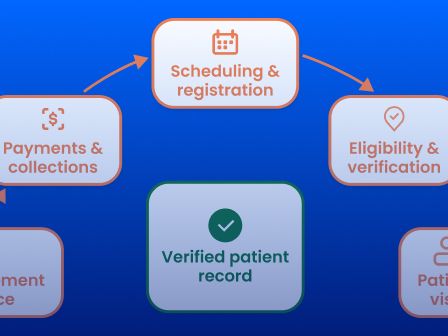
Healthcare revenue cycle management involves tracking patient revenue from patient scheduling to payment collection. Effective healthcare revenue management early in the cycle helps providers prevent delayed payments, revenue leakage, and returned patient communications downstream.
Healthcare revenue cycle management typically involves these stages:
- Patient scheduling and registration
- Insurance benefit and eligibility verification
- Patient visit
- Medical coding, billing, and compliance
- Healthcare claims processing
- Remittance tracking and denial management
- Patient payments and collections
Patient data impacts every stage of the healthcare revenue cycle. While collecting accurate patient demographics, insurance information, and address data during patient scheduling and registration can help healthcare providers create a strong foundation for optimized healthcare revenue cycle management, collecting inaccurate data can lead to issues later in the cycle, including claims processing, billing, and data exchange.
Patient addresses are a key aspect of patient data. Accurate address data helps healthcare providers identify and remove duplicate patient records and send patient communications to the right address. That streamlines healthcare claims processing, billing, and interoperability, while avoiding HIPAA violations.
With address autocomplete and address verification for healthcare providers, you can improve your address data management. Try these tools now, or keep reading for a full breakdown of best practices for revenue cycle optimization.
In this article, we’ll cover:
What is healthcare revenue cycle management?
The healthcare revenue cycle process
Front-end vs. back-end revenue cycle management
Why healthcare revenue cycle management matters
How patient data quality affects every stage of the revenue cycle
Revenue cycle optimization best practices
Healthcare revenue cycle metrics to monitor
Conclusion
FAQ
What is healthcare revenue cycle management?
By relying on revenue cycle management, healthcare providers can monitor revenue from the moment a patient enters the healthcare system until the provider receives payment from a patient or a payer.
The healthcare revenue cycle process
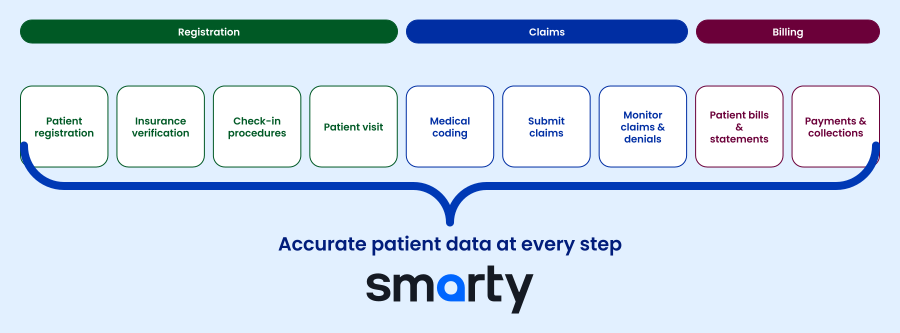
The American Medical Association breaks the healthcare revenue cycle into nine key stages:
- Patient registration: The provider collects a patient’s contact, demographic, insurance, and medical information, whether in person, online, or over the phone. Maintaining patient registration accuracy and strong healthcare data quality at this stage improves financial outcomes downstream.
- Insurance verification: Using patient data, the provider confirms the patient’s insurance eligibility and benefits, then estimates copays.
- Check-in procedures: The patient completes any remaining paperwork to provide additional patient data, then pays any copay or outstanding balance.
- Patient visit: The patient receives care.
- Medical coding: The provider uses a completed electronic health record (EHR) to convert the provided medical services into billing codes.
- Preparing and submitting claims: With medical codes and patient data, the provider creates and submits a claim to a payer, making this stage essential to effective healthcare claims management.
- Monitoring claims, payer remittances, and denials management: The provider monitors claim status and receives payer remittances for clean claims. Otherwise, denied claims are resolved.
- Preparing patient bills and statements: If an outstanding balance remains, the provider sends a bill to the patient, often by delivering a statement to the patient’s address. If the patient overpaid, a refund check is sent instead.
- Managing patient payments and collections: The provider collects the remaining balance in person, online, or by phone. Unpaid accounts may be sent to collections.
Front-end vs. back-end revenue cycle management
Healthcare revenue cycle management can be split into two phases: front-end and back-end. While each phase serves a different purpose, both depend on accurate patient data.
| Front-end revenue cycle management | Back-end revenue cycle management |
|---|---|
| Covers revenue cycle stages that occur before and during patient care | Covers revenue cycle stages that occur after a patient receives care |
| Includes patient registration, insurance checks, check-in procedures, and the patient visit | Includes medical coding, healthcare claims management, billing, and payment processing |
| Focuses on collecting and verifying the patient data needed for clean claims | Focuses on processing claims and collecting payments |
| Provides downstream revenue cycle stages with accurate patient demographic, insurance, and contact data | Uses accurate patient demographic, insurance, and contact data to submit claims, communicate with patients, and resolve outstanding balances |
Why healthcare revenue cycle management matters
Providers lose revenue when front-end revenue cycle management fails to maintain accurate patient data. Those early errors lead to issues throughout the rest of the cycle, including:
- Duplicate patient records that separate patient demographic, insurance, and contact data across multiple systems
- Inaccurate addresses that cause statements, payment reminders, collection notices, refund checks, and other patient communications to be returned as undeliverable or get mailed to the wrong location
- Manual rework, including calling patients, re-verifying eligibility, merging duplicate records, and remailing documents
That’s why healthcare revenue cycle optimization matters. Back-end revenue cycle management relies on front-end data.
When providers collect accurate patient data from the start, the entire revenue cycle runs smoothly. Healthcare providers submit more clean claims, collect payment sooner, improve reimbursement rates, and give patients clearer information about their coverage and financial responsibility.
Address verification is an important front-end quality control measure. It helps providers keep patient addresses verified and standardized throughout the revenue cycle and identify duplicate patient records before they cause downstream issues.
New to address verification? No worries. Address verification, also called address cleansing, is the process of checking an address against an authoritative database to determine whether it’s real and correctly formatted.
To learn more about address verification, check out our comprehensive guide to healthcare address verification solutions, or keep reading for a breakdown of how better address data governance can impact revenue cycle management, healthcare best practices, and ROI.
How patient data quality affects every stage of the revenue cycle
Clean patient data supports every stage of the revenue cycle. With cleaner patient data, providers can streamline scheduling and registration, insurance eligibility checks, check-in procedures, patient visits, medical coding, claims submission, and billing.
Along with accurate demographic, health, and insurance information, accurate patient addresses help providers identify patients, match patient records, submit clean claims, and deliver patient communications.
Patient scheduling and registration
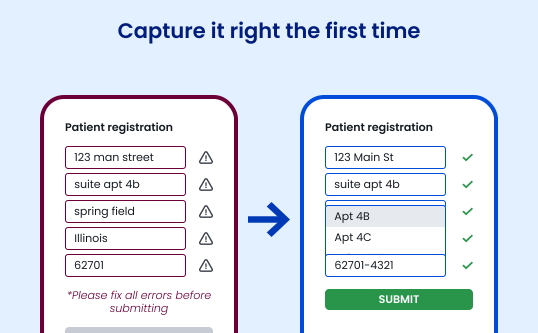
Errors in a patient’s name, date of birth, phone number, address, subscriber name, member ID, or other pieces of personally identifiable information (PII) can create duplicate patient records, eligibility mismatches, and billing delays. You can verify these key fields during scheduling and registration to help patient records stay reliable from the start.
A patient’s address is one of the first pieces of PII collected during scheduling and registration. When patients or providers manually enter those addresses into a practice management system (PMS), misspellings, missing secondaries, incorrect ZIP Codes, and other seemingly small errors can fall through the cracks and create havoc.
Address autocomplete reduces those errors at the point of entry. As a patient or provider types, autocomplete suggests a dropdown of real, valid addresses, including secondaries like apartment or suite number. That way, users can select the correct address, rather than manually enter individual address components, which are prone to errors such as misspellings, especially on mobile devices.
By reducing the number of keystrokes it takes to enter an address, address autocomplete also helps eliminate form fatigue. More often than not, healthcare forms are lengthy and frustrating, so any reduction in the time it takes to complete them improves patient satisfaction.
Address autocomplete is one revenue cycle automation tool providers can use to prevent address errors from entering healthcare revenue cycle management systems during registration. However, since users can ignore or edit suggested addresses, it shouldn’t be your only safeguard.
After entering a patient’s address, address verification checks it against an authoritative database, corrects any remaining errors, and standardizes address formatting, to help healthcare providers improve patient registration accuracy from the beginning of the revenue cycle.
Address verification that standardizes addresses also ensures that patient addresses are consistent across systems, supporting healthcare revenue cycle management by helping providers better match patient records across electronic health records (EHRs) and their enterprise master patient index (EMPI) or master patient index (MPI).
Smarty’s address verification for healthcare providers also assigns a SmartyKey®, a persistent, unique identifier (PUID) that maps to a single delivery point and remains constant even if address components change down the line.
With SmartyKey, alongside key patient demographics such as name and date of birth, providers can easily identify, review, and merge duplicate records before they lead to fragmented patient records and histories that create roadblocks later in the revenue cycle.
Insurance eligibility and benefits verification
Those duplicate records often occur when a patient of record is mistakenly entered as a new patient. When that happens, providers may repeat insurance eligibility and benefits verification, creating unnecessary work and slowing the revenue cycle.
In revenue cycle management, healthcare technologies like address autocomplete, verification, and SmartyKey help providers identify and merge duplicate patient records at registration, leading to smooth insurance eligibility and benefits verification in the front end of the revenue cycle, and clean patient data for back-end processes.
But even after duplicate patient records are merged, incorrect member IDs, payer names, coverage dates, or other insurance data points can still cause failed eligibility checks, incorrect estimates, and denied claims. It’s equally important to verify insurance data during registration as it is to verify addresses.
Check-in procedures
To shorten patient check-in procedures, healthcare providers often allow patients to provide or update their name, contact information, insurance coverage, and other demographic details through a patient portal. That way, a PMS or an EHR can hold up-to-date patient data before a patient visits, reducing errors that could impact eligibility, claims, billing, or patient communications.
When patient portals are equipped with address verification and autocomplete, these features help prevent typos, formatting errors, and invalid addresses from entering healthcare systems.
Addresses can also change when streets are renamed to honor a figure or organization, building numbers are adjusted to accommodate new construction, and ZIP Codes are added or altered to improve routing efficiency. When revenue cycle management healthcare teams regularly verify patient addresses in a PMS, EMPI, or MPI, providers can catch outdated addresses before they lead to inaccurate claims, returned patient communications, or billing errors.
Patient visit
During a patient’s visit, recording complete and accurate health data is critical for diagnoses, procedures, and prescribing medications. Correct health data also informs medical coding, which gives providers the information needed to submit clean claims.
As a patient receives care, their health and demographic data may also be exchanged between pharmacies, labs, imaging systems, claims platforms, and other healthcare revenue cycle management systems.
When a patient or provider adds or updates a name, phone number, address, or other patient identifier in one of those systems, that change needs to carry across all systems. Using address standardization and address validation to verify patient addresses before or after they’re exchanged helps every healthcare system receive clean, consistent data or keep good data from being overwritten.
Address verification services also allow healthcare providers to participate in a qualified health information network (QHIN), a secure digital space for sharing patient data between healthcare providers, pharmacies, and other health entities.
Participating in a QHIN can help healthcare providers:
- Give patients access to their own healthcare data from providers across the country
- Seamlessly share a patient's full health history with other providers working with the same patient
- Support public health reporting during pandemics or outbreaks
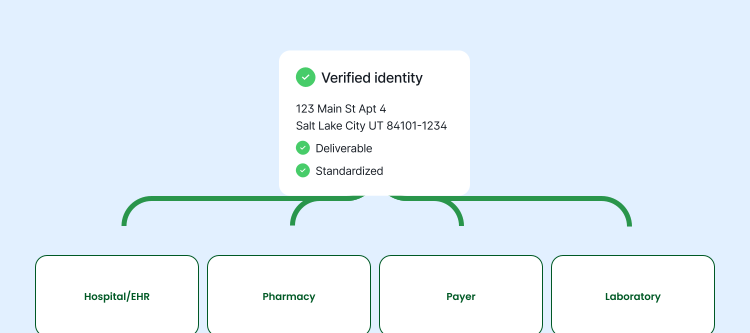
To participate in a QHIN, providers need to format patient addresses to meet Project US@ standards, which include capitalizing all letters in an address and writing out abbreviations. By standardizing addresses to meet these requirements with address verification, providers can join a QHIN and exchange data across systems without the administrative burden.
Medical coding
Accurate medical coding relies on accurate health data. Without information about a patient’s diagnosis, procedures, or provider, providers may miss codes or add incorrect codes, leading to misinformed claims and denials.
Claims, payer remittances, and denials management
With accurate patient demographic, insurance, and health data, payers can better match the patient and provider reported on a claim with an eligible patient and provider in the payer’s records, improving overall healthcare claims management and claims processing efficiency.
Provider data accuracy depends on addresses. When provider addresses are verified, standardized, and up to date, claims move from submission to payment with fewer delays. Inaccurate or non-standardized address data, on the other hand, causes duplicate records, delays, denials, and rework.
Maven One Health, a provider data management firm offering tech-enabled services to payers, uses address verification to confirm provider addresses and eliminate duplicate addresses from their database. Using that clean provider data, Maven One Health’s customers can reduce undeliverable claims and automate healthcare claims processing.
That combination of complete, valid, and accurate data is tremendously important. It always has been.

Billing, payment, and collections
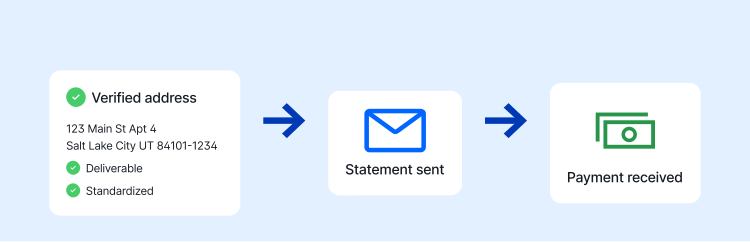
After a claim is processed, healthcare providers can determine whether a patient has an outstanding balance or needs to be reimbursed. Either way, the provider will send a communication to the patient, whether that’s a statement or a refund check.
When those communications are mailed to patients, accurate patient addresses are essential. If a provider collected an incorrect or outdated address during patient registration, it could cause communications to be returned as undeliverable.
Returned mail creates rework throughout the medical billing workflow. Billing departments have to contact patients to update their phone numbers, addresses, or other contact information, then use that information to redeliver communications. Improving healthcare mailing accuracy reduces avoidable printing, postage, and handling costs.
Address verification and autocomplete at patient registration support patient contact data management by ensuring billing platforms direct patient financial communications to deliverable addresses. That reduces delivery and compliance failures and delays in the healthcare revenue cycle.
Revenue cycle optimization best practices
Revenue cycle optimization starts with better patient data, because when patient demographic, insurance, and health data are accurate from the start, revenue cycle management healthcare processes run smoothly.
Using these revenue cycle management healthcare best practices, you can stop patient data errors early:
- Automate data capture: Reduce manual data entry by adding tools like address autocomplete to your registration system or PMS, which reduces the number of keystrokes needed to enter addresses, thereby reducing patient form fatigue.
- Validate patient demographics and insurance coverage at intake: Improve data quality at the point of entry by confirming patient name, address, DOB, insurance provider, subscriber name, and member ID when patients schedule appointments.
- Strengthen interoperability: Standardize patient demographic, insurance, and health data to meet authoritative standards, including using address verification for healthcare providers to comply with the Project US@ standards.
- Improve data governance: Find and eliminate duplicate patient records using identifiers like name, date of birth, and address to reduce fragmented patient records and histories across your systems.
- Monitor denial trends: Identify the root causes of denied claims and use denial analytics to strengthen claims denial prevention by correcting recurring issues, such as inaccurate patient demographics, coverage errors, missing health records, or incorrect medical coding.
- Measure registration accuracy: Track demographic corrections, failed eligibility checks, how often billing communications are returned as undeliverable, and how much time you spend correcting patient addresses.
- Track operational KPIs: Measure key performance indicators, from clean claim rate to net collection rate, so you can see how revenue cycle management healthcare programs improve reimbursement rates.
Healthcare revenue cycle metrics to monitor
Better patient demographic, insurance, health, and address data quality can improve your overall revenue cycle optimization. To highlight the ROI of accurate address data and revenue cycle management, healthcare providers can check these metrics.
| Metric | Before revenue cycle optimization | After revenue cycle optimization |
|---|---|---|
| Clean claim rate | 85%–90% | 95%–98% |
| First-pass claim acceptance rate | 88%–92% | 95%–98% |
| Denial rate | 8%–12% | <5% |
| A/R days | 45–55 days | 30–40 days |
| Net collection rate | 90%–94% | 95%–97% |
| Cost to collect | $4–$6 for every $100 collected | $3 or less for every $100 collected |
| Registration accuracy | 90%–95% | 98%–99% |
| Claims accuracy | 90%–95% | 97%–99% |
| Returned mail rate | 10% | 3%–5% |
| Duplicate patient record rate | 5%–10% | <1%–2% |
After you’ve implemented Smarty address data or other solutions and measured the results, contact us! We’ll write up your story and add it to a collection of customer stories to share with the greater healthcare community.
Conclusion
Successful healthcare revenue cycle management starts with accurate patient data. Collecting clean demographic, insurance, and health data at registration helps providers identify patients, verify insurance eligibility and benefits, match and exchange patient records across healthcare systems, submit clean claims, and deliver statements and reimbursements to patients on time.
To keep patient addresses accurate and up to date, providers can use address verification and autocomplete to validate and standardize patient addresses at registration. To start optimizing your revenue cycle management healthcare operations, start a 42-day free trial of Smarty’s US Address Verification API and US Address Autocomplete API.
FAQ
What is a clean claim?
A clean claim accurately documents:
- The service rendered
- The patient who received it
- The healthcare professional who provided it
- The date and location of the service
- That the patient is eligible for coverage
- That the service was medically necessary
Can inaccurate patient addresses cause claim denials?
Yes. Incomplete patient data, such as an inaccurate patient address, can lead payers to fail to match a patient listed on a claim with an eligible patient in their records, resulting in a denied claim.
What is first-pass claim acceptance?
First-pass claim acceptance is the percentage of claims accepted and reimbursed on the first submission to a payer.
How does address verification improve healthcare billing accuracy?
Address verification ensures that patient billing documents, including statements, payment reminders, collection notices, and refund checks, are sent to the real, deliverable addresses, preventing returned mail and delayed payments.
How does duplicate patient data affect revenue cycle management?
Duplicate patient data creates fragmented patient records and histories across healthcare systems. If providers submit duplicate claims for these accounts, they’ll end up with returned claims, delayed reimbursements, and time-consuming rework.
With address verification and persistent, unique identifiers, providers can identify and eliminate duplicate patient records before claims submission.
How does patient address verification improve interoperability?
When address verification validates and standardizes an address in one system, it ensures that other systems receive clean, consistent data during data exchanges. It makes matching patient records more accurate across disparate systems.
What KPIs should healthcare organizations track to measure revenue cycle performance?
To measure revenue cycle performance, healthcare organizations can track:
- Clean claim rate
- First-pass claim acceptance rate
- Denied claim rate
- Accounts receivable days
- Net collection rate
- Cost to collect
- Registration accuracy
- Claims accuracy
- Returned mail rate
- Duplicate patient record rate
Was this helpful?