
Business intelligence for reinsurance: Data integrity foundations


Business intelligence for reinsurance: Data integrity foundations

Business intelligence for reinsurance uses connected data, analytics, and reporting systems to improve underwriting, claims, exposure management, and portfolio strategy. While bad addresses have historically been allowed to slide into reinsurance portfolios, it doesn’t have to be this way. As reinsurers move beyond fragmented spreadsheets and retrospective reporting, APIs, cloud platforms, automated workflows, and real-time analytics can help teams identify risk and act sooner.
But more sophisticated technology doesn’t automatically produce better intelligence. When those systems receive incomplete, duplicated, or imprecisely located records, they can automate uncertainty rather than reduce it.
Business intelligence (BI) is only as reliable as the data flowing through it. When exposure records are incomplete, locations are inconsistent, or the same entity appears differently across systems, teams spend more time reconciling information and less time acting on it.
The result is weaker exposure analysis, slower decision-making, and less confidence in the portfolio view that guides pricing, capital, and growth.
For insurance companies, better business intelligence begins with six foundational steps:
- Establish an authoritative address intelligence layer.
- Ensure the policies you reinsure bring in clean, standardized, and model-ready data.
- Build the business case around risk, accuracy, and clarity of exposure.
- Implement a data governance framework for location data.
- Continuously enrich and monitor location-based risk information.
- Power reinsurance BI with accurate and enriched data.
Address intelligence supports a strong data foundation by strengthening one of the most important inputs to risk management and analysis: the location associated with each exposure.
Smarty can serve as the authoritative address intelligence layer at the top of the data cascade. By validating, standardizing, geocoding, identifying, and enriching location records before they reach downstream systems, Smarty automates reconciliation and provides reinsurance business intelligence with a more dependable foundation.
Better business intelligence for reinsurance is just around the corner with topics like:
- Business intelligence for reinsurance: Data integrity foundations
- Why data integrity is the foundation of business intelligence for reinsurance
- How reinsurance data analytics turns better data into better decisions
- Common barriers limiting business intelligence and reinsurance data analytics
- How to build a reinsurance data management strategy that scales
- How business intelligence improves performance across the reinsurance lifecycle
- Conclusion
- Business intelligence for reinsurance FAQ
Why data integrity is the foundation of business intelligence for reinsurance
Dependable business intelligence for reinsurance requires data that is accurate, complete, consistent, and usable.
Maintaining that standard is difficult because insurance data is constantly moving. It passes among cedents, brokers, underwriting systems, catastrophe models, claims platforms, actuarial tools, finance teams, and reporting environments. Every handoff creates another opportunity for records to be reformatted, duplicated, truncated, or disconnected.
Even a well-standardized database can become unreliable over time. Addresses change, postal boundaries shift, businesses move, properties are redeveloped, and disasters can alter whether a location still represents a usable or insurable exposure. At the reinsurance scale, those changes compound quickly.
The same insured location may therefore appear differently across systems. One platform may store a complete address, another an abbreviated version, and a third only a ZIP Code centroid. Without standardization, downstream systems may treat those records as separate exposures or connect them to different hazards.
This reflects three related data challenges:
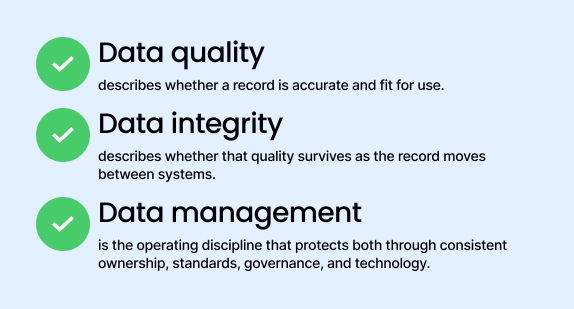
Without all three, sophisticated models can produce precise-looking answers from unreliable inputs that are, generally speaking, flat-out wrong.
Poor data affects risk and casualty portfolios differently, but the business consequence is the same: less confidence in the decisions built on the data.
For risks within your portfolios, location precision influences hazard assignment, accumulation analysis, and catastrophe modeling. Two properties within the same ZIP Code may face very different conditions, so broad coordinates can mask meaningful differences in exposure. Validated addresses and rooftop-level geocodes give reinsurers a clearer view of where risk sits. The address should still be verified before it’s geocoded—a precise coordinate attached to the wrong location is still wrong.
For casualty portfolios, consistent address information helps connect policies and claims to the correct insured properties, business premises, incident locations, and related organizations. It can also improve matching across policyholders, claimants, providers, employers, and vendors. Address standardization isn’t a complete entity-resolution or property-resolution strategy, but it strengthens a key field used to connect records across systems.
At the enterprise level, the immediate cost of poor data appears in repeated cleanup, model reruns, and slower analysis. The greater risk is making pricing, capital, claims, or portfolio decisions from understated concentrations, distorted loss estimates, and reporting that can’t be confidently traced or defended.
How reinsurance data analytics turns better data into better decisions
Reinsurance data analytics uses statistical methods, business rules, predictive models, and visualization tools to support faster, more confident insurance decisions. Business intelligence for reinsurance has the ability to deliver ROI, depending on whether the underlying records accurately represent exposures, claims, entities, and locations.
Standardized address and entity data give actuarial, underwriting, claims, and analytics teams a shared foundation. It helps them connect properties to the correct hazards, consolidate duplicate exposures, identify geographic concentrations, match related claims and parties, improve reserving inputs, and uncover patterns that inconsistent formatting might otherwise hide.
That consistency also strengthens portfolio analysis. Leaders can compare portfolio performance with greater confidence that the differences they see are real—not artifacts of inconsistent source data.
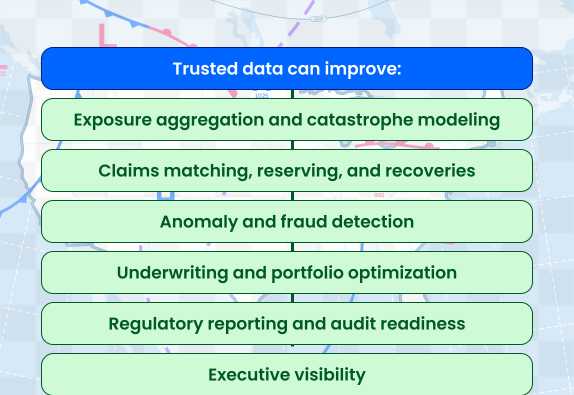
The same foundation makes it easier to connect external property, hazard, climate, and geospatial data to the correct exposure. In many cases, the address serves as the common link between those sources.
Carpe demonstrates how that foundation can work in practice.
The insurtech company uses Smarty’s US Address Verification to normalize and validate addresses before matching data across millions of online sources. That gives underwriting and claims workflows more consistent, reliable records for downstream decision-making. As Carpe’s Ashley Fong explained, “Smarty is reliable. When we validate our addresses, we know we’re going to get reliable results that we can always depend on downstream.”
Common barriers limiting business intelligence and reinsurance data analytics
Business intelligence can underperform even when reinsurers have access to advanced insurtech tools and large datasets. The most common barriers usually fall into three categories: unreliable data, poorly matched technology, and weak adoption.
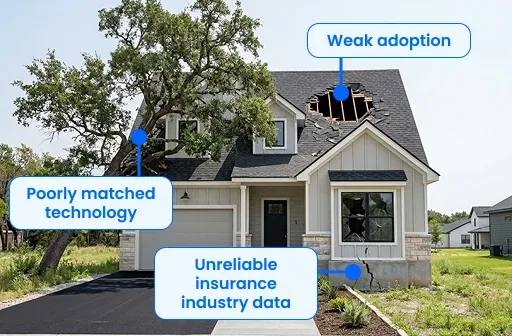
| Category | Barrier | How it limits business intelligence | What reinsurance and insurance companies should look for in a provider |
| Unreliable insurance industry data | Incomplete or inconsistent data | Incomplete submissions, duplicate exposures, mismatched entities, and inconsistent addresses weaken analytics before a model begins processing the information. | Broad address coverage, precision data, transparent match results, and consistent standardization |
| Poorly matched technology | High costs and unclear ROI | Licensing, integration, storage, training, engineering, and maintenance costs can make investments difficult to justify without measurable business outcomes. | Predictable pricing and a measurable pilot tied to operational outcomes |
| Overly complex tools | Products that require specialized expertise, heavy customization, or ongoing engineering support can be difficult to maintain and scale. | Straightforward APIs, batch processing, documentation, and low maintenance requirements | |
| Poor workflow fit | Separate portals, repeated uploads, and complicated outputs add friction and can push teams back toward spreadsheets and manual workarounds. | Integration with existing systems rather than a separate manual process | |
| The wrong level of capability | Overly advanced platforms increase cost and maintenance, while limited tools may lack the precision, scalability, or transparency needed for high-stakes decisions. | Enough precision and metadata for the use case without unnecessary complexity | |
| Weak scalability or vendor support | Tools may perform well during a pilot but struggle as data volumes, users, markets, and use cases expand. | Proven throughput, dependable infrastructure, and responsive technical support | |
| Weak adoption | Limited training and expertise | Teams may underuse features, misinterpret outputs, or apply the product inconsistently when training and internal ownership are weak. | Clear implementation guidance, professional services, and understandable outputs |
| Low trust in automated results | Underwriters, actuaries, and claims professionals may resist tools that do not clearly explain match quality, confidence, exceptions, or limitations. | Match metadata, confidence indicators, and transparent exception handling | |
| Inconsistent adoption across teams | Mixed processes create conflicting records, duplicate work, and inconsistent reporting across underwriting, claims, finance, actuarial, and analytics. | A shared upstream service that applies the same rules across teams | |
| Unclear ownership and governance | Without defined data integrity owners, standards, sources of truth, and exception processes, even a strong platform can become another disconnected system. | Clear separation between provider responsibilities and internal business rules |
These concerns are valid. Reinsurers should expect a provider to justify its cost, integrate cleanly, scale with data volume, and remain manageable after implementation.
The right address intelligence provider absorbs much of that complexity. Validation, standardization, geocoding, and enrichment can run within existing workflows while internal specialists remain focused on risk, portfolio performance, and business decisions.
Choosing the provider is only the first step. Reinsurers also need a scalable operating model that defines how trusted location data enters the organization, how exceptions are handled, and how results are measured.
How to build a reinsurance data management strategy that scales
A scalable strategy should improve information before it reaches critical systems, preserve that quality throughout the data lifecycle, and make trusted records available across insurance operations, claims handling, actuarial, finance, underwriting, and analytics.
You shouldn’t have to ask every internal team to maintain address data independently. Instead, you can rely on an authoritative address data provider at the top of the cascade, then apply your own business rules, reviews, and downstream verification as needed.
Step 1: Establish an authoritative address intelligence layer
Select a provider that can validate, standardize, geocode, and enrich location records before they reach downstream systems.
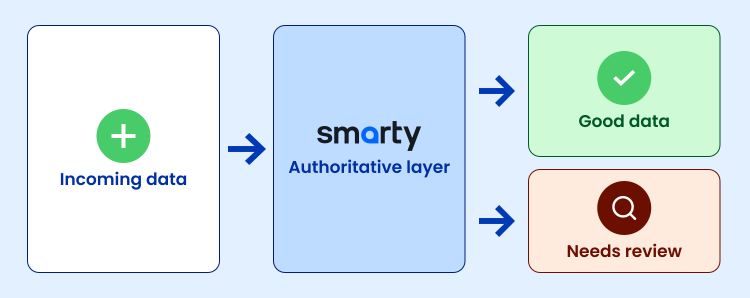
Smarty can serve as the authoritative layer at the top of the data cascade, providing models and business teams with a consistent location foundation. Insurance industry teams retain control over business rules, match thresholds, exception policies, reporting requirements, and final decisions. Records that require additional investigation can still be routed to internal or third-party reviewers.
This separation allows Smarty to manage address-data complexity while the reinsurer (that’s you) governs how the results are applied.
Step 2: Ensure incoming data is clean, standardized, and model-ready
The best time to correct data is before it reaches downstream systems.
Addresses should be validated and standardized as they enter submission portals, underwriting platforms, claims systems, and data warehouses. Legacy databases and third-party files should pass through the same process so that historical and incoming records follow consistent standards.
Smarty supports this workflow through:
- US Address Autocomplete for cleaner address entry. Only validated and standardized addresses are suggested to the user for selection.
- US Address Verification for validation and standardization of existing datasets or data that is being aggregated from outside sources.
- US Rooftop Geocoding for precise coordinates. This adds location context like elevation, distance to coast, and where exactly on a parcel is the structure that’s being insured.
- US Property Data for property-level enrichment to learn details about roof type, number of garages, ownership details, and more.
Standardizing location data early gives catastrophe models, claims systems, analytics tools, and reporting platforms more consistent inputs for you to make sounder business decisions on. It also reduces the need for each downstream team to clean the same records independently.
Step 3: Build the business case around risk, accuracy, and exposure clarity
The business case should connect address intelligence to outcomes that matter beyond the data team.
Measure operational efficiency through cleanup time, manual-review volume, exception handling, and repeated model runs. Measure risk clarity through match quality, duplicate-exposure reduction, rooftop-level coverage, and successful linkage to hazard data. Measure decision performance through faster submission review, fewer claims delays, shorter reporting cycles, and broader use of the same trusted location record.
Benchmark those measures before implementation, then run a representative portfolio or location file through Smarty. Comparing the same records under both workflows will provide a more credible estimate of potential ROI than evaluating data quality in isolation.
Step 4: Implement a data governance framework for location data
Once Smarty provides the authoritative address foundation, reinsurers need clear rules for how that data should be used.
A data governance model should define how location records are accepted, reviewed, corrected, and used. That includes setting clear thresholds for match confidence and geocode precision, along with a consistent process for exceptions. When those rules are embedded across the organization, downstream teams work from the same standards and maintain a clearer audit trail.
Data governance should be built into systems and workflows rather than only written in policy documents.
Step 5: Continuously enrich and monitor location-based risk data
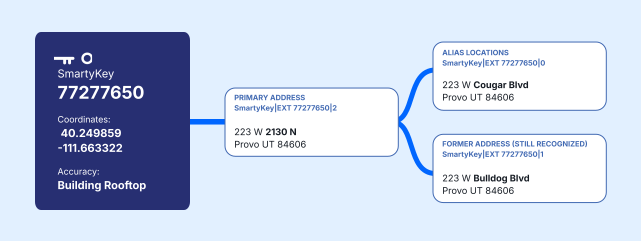
Address data and the properties connected to it change over time. Businesses move, new structures are built, streets are renamed, portfolios expand, and new third-party datasets enter the workflow.
A good address data provider can continue supplying validated, standardized, and enriched location data as those changes occur.
You can then track whether the data foundation is improving by measuring match quality, precision, exception volume, and the amount of manual intervention still required.
Once an address is validated and geocoded, reinsurers can use it to match the correct property with relevant internal or third-party datasets they may add later, such as property characteristics, hazard zones, climate models, and geographic boundaries.
Step 6: Power reinsurance BI with accurate, location-aware data
With Smarty positioned at the top of the cascade, a scalable workflow can:
- Collect an address from a submission, claim, database, or third-party file.
- Send it to Smarty for validation and standardization (this can be an automated process).
- Assign a persistent, unique identifier (PUID) when available.
- Geocode it at the appropriate level of precision.
- Enrich it with relevant property or risk information.
- Route uncertain or business-critical records for additional review.
- Deliver model-ready data to downstream systems.
This approach allows address intelligence to operate quietly in the background while underwriting, claims, catastrophe, and analytics teams focus on evaluating risk and making decisions.
APIs can support the workflow in real time, while batch services can standardize legacy databases and large third-party files. Reinsurers retain control over how the data is governed and applied, while Smarty handles the complexity required to keep the address foundation accurate and usable.
Explore more about property and casualty insurance, location intelligence for insurance, and verification and rooftop geocoding for risk analysis.
How business intelligence improves performance across the reinsurance lifecycle
Insurance business intelligence creates the most value when it connects information across the full reinsurance lifecycle rather than improving one report or department in isolation.
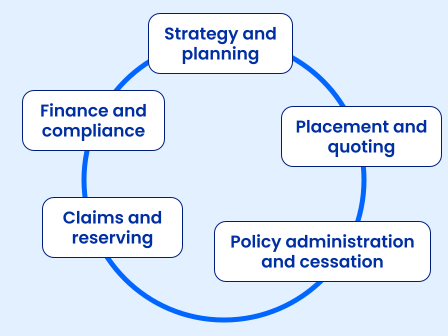
During strategy and portfolio planning, trusted data helps leaders evaluate concentration, profitability, capacity, and growth opportunities.
During placement and quoting, clean data helps underwriters review submissions faster, compare new risks with existing exposure, and produce more consistent pricing inputs.
During policy administration and cession, standardized records reduce duplicate exposures, mismatches, reconciliation work, and reporting inconsistencies.
During claims and reserving, consistent address and entity data improve matching, event aggregation, loss histories, reserving analysis, and recovery workflows.
Finance, regulatory compliance, and executive teams benefit from more consistent calculations, clearer lineage, faster reconciliation, and more reliable dashboards.
As you adopt predictive models and real-time monitoring in the insurance industry, source data quality becomes even more important.
Automating an inaccurate process only produces unreliable results faster.
Validated and enriched location data strengthens loss modeling, catastrophe monitoring, fraud detection, scenario planning, and third-party data integration.
Conclusion
The business case for better data boils down to improving the quality, speed, and defensibility of the decisions that clean records support.
When location data is incomplete, inconsistent, or imprecise, the effects spread across your company. Teams spend more time reconciling records and less time refining models. That weakens both the analysis itself and the executive decisions built on it.
A scalable strategy addresses that problem at the top of the data cascade.
Smarty absorbs the technical complexity of maintaining an accurate address foundation at the very start of the address data journey, while your organization retains control over governance, review thresholds, business rules, and final decisions.
Your specialists should spend their time refining risk management, testing assumptions, and acting on results—not correcting the location data beneath them.
Better address data reduces operational drag and provides a more reliable foundation for every downstream analytics investment.
Placing Smarty at the top of the cascade helps address those problems before they spread and minimizes the level to which you depend on other providers further down in the cascade.
The result is stronger business intelligence for reinsurance, less operational drag, clearer exposure, and a more reliable foundation for future analytics investments.
Start with a representative portfolio, submission file, or legacy dataset. Compare match quality, geocode precision, exception volume, manual review requirements, and claims processing time against your current workflow. Start a free trial or speak with a Smarty account executive to design a test around your systems and business priorities.
Business intelligence for reinsurance FAQ
What is insurance business intelligence?
Insurance business intelligence uses integrated data, analytics, reporting, and visualization to support underwriting, pricing, claims, exposure management, finance, and portfolio strategy.
What is reinsurance data analytics?
Reinsurance data analytics applies statistical analysis, predictive models, and business rules to identify patterns in exposure, claims, pricing, catastrophe risk management, and portfolio performance.
What is reinsurance data management?
Reinsurance data management includes the processes, technologies, standards, and ownership used to collect, maintain, integrate, and use reinsurance information.
Why are model outputs inconsistent across datasets?
Outputs often differ because source records were incomplete, duplicated, imprecise, or formatted inconsistently before entering each model.
How does poor address data affect catastrophe modeling?
Poor address data can place exposures in the wrong locations, link properties to incorrect hazards, obscure concentrations, and distort modeled losses.
Why should addresses be validated before geocoding?
Validation confirms and standardizes the address before coordinates are assigned, reducing the risk of attaching a precise geocode to the wrong location.
What should a data governance model for reinsurance include?
It should define ownership, validation standards, source systems, duplicate treatment, match thresholds, geocode precision, exception handling, lineage, and quality metrics.
How does Smarty support business intelligence for reinsurance?
Smarty helps reinsurers validate and standardize addresses, generate rooftop-level coordinates, and enrich locations with property information for underwriting, catastrophe modeling, claims, analytics, and reporting.
Was this helpful?