


Healthcare provider compliance & data accuracy explained
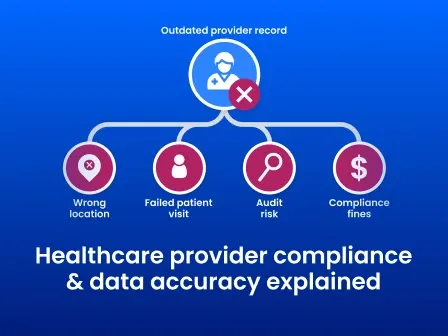
Healthcare provider data accuracy is crucial to healthcare provider compliance because accurate data helps providers meet regulations, reduce risk, and improve patient access to care.
Think of it this way.
Ideally, providers and payers use provider data to help patients find in-network care nearby and confidently choose the right provider. In reality, that only works when healthcare provider data accuracy stays high.
Often, it doesn’t.
Provider data can include addresses that refer to outdated practice locations, CMRAs, PO Boxes, or that just don’t exist. Or they might list a nearly correct address but miss a suite number, an up-to-date ZIP Code, or a more current street name.
On top of that, provider data changes constantly, meaning records that looked clean at the beginning of the year may be 50–70% inaccurate by the end of it.
That’s why provider data management matters.
Strong provider data governance and NPI data validation help payers and providers maintain healthcare data integrity, all while reducing compliance risk. Without healthcare provider data accuracy, patients struggle to find care and lose trust in payers and providers, while payers and providers face compliance fines, patient access issues, and reputational damage.
The good news? Strong provider data governance, supported by tools like address validation, puts healthcare provider compliance within reach. Read on to learn how, or put Smarty’s US Address Verification to the test now.
Think of this article as your guide to all things healthcare data compliance. We’ll cover:
What is healthcare provider compliance?
Key regulations impacting provider data compliance
What is healthcare provider data accuracy?
Provider data accuracy beyond addresses
Why data accuracy is critical for healthcare provider compliance
Common challenges in provider data accuracy
Benefits of improving healthcare provider data accuracy
How to ensure healthcare provider compliance through better data
What is healthcare provider compliance?
Healthcare provider compliance is the process of ensuring that healthcare providers and payers adhere to the laws, standards, and policies that regulate the healthcare industry.
In the US, healthcare provider compliance includes requirements set by the Centers for Medicare & Medicaid Services (CMS). These CMS compliance requirements include the use of National Provider Identifiers (NPIs).
An NPI is a unique number used to identify healthcare providers in the US throughout billing, claims, and prescription processes.
That makes NPI data validation a key part of healthcare provider compliance. When NPI data is valid, patients can reliably find credentialed providers, all while claims are accurately routed.
Healthcare provider compliance is often evaluated through audits that look for noncompliance indicators like billing errors, fraud, inaccurate provider data, gaps in reimbursement documentation, and other issues affecting healthcare data integrity.
Key regulations impacting provider data compliance
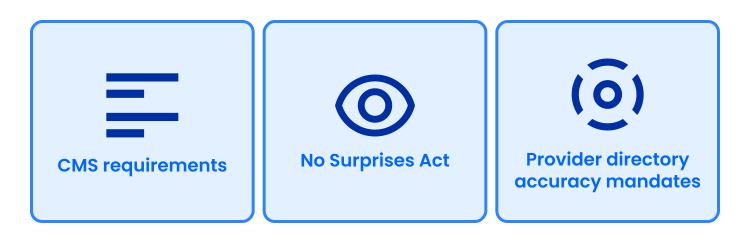
Now that we’ve covered what healthcare provider compliance means, let’s get you up to speed on key provider data regulations.
To be listed as a CMS provider and receive payment for covered services, healthcare providers participating in Medicare and Medicaid need to follow CMS requirements, including maintaining provider data with frequent validation and updates. Staying compliant means knowing when provider data was last verified, what changes were made, and how quickly inaccuracies were corrected.
CMS requirements work hand in hand with the No Surprises Act to keep provider data up to date and accurate. Outdated data can delay care, make it hard to find the right provider, and lead to miscompliance.
The No Surprises Act requires providers and payers to “take steps to update and verify the accuracy of their provider directory information at least once every 90 days.”
That protects patients from being misled by incorrect provider data and unintentionally receiving care from an out-of-network provider, making their medical bills substantially higher than the estimate they received from their provider.
Healthcare provider data accuracy mandates require providers and payers to regularly verify their provider directory data, utilize NPI data validation, and clearly indicate out-of-network providers. In some states, these mandates also require directories to reach a minimum accuracy threshold.
What is healthcare provider data accuracy?
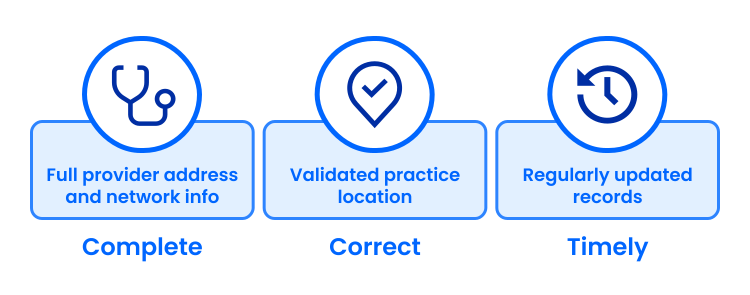
Healthcare provider data accuracy means your provider records are complete, correct, and timely.
Complete
Complete provider data improves overall healthcare data quality by giving patients, payers, and providers the information they need to identify providers in the right locations and networks.
Incomplete healthcare provider data creates ambiguity. That ambiguity leads to duplicate provider records, misdirected patients, billing errors, and sensitive documents sent to the wrong place.
Provider addresses are just one spot for trouble. Without validation, provider addresses may omit ZIP Codes, secondary information, or other necessary address components.
Complete provider data includes complete provider addresses. That way, payers can accurately map providers, so patients can find the care they need.
Correctness
Provider data also has to be accurate. A record can be complete and still include the wrong information.
For example, a provider’s address may be valid but actually refer to a PO Box, residential address, or Commercial Mailing Receiving Agency (CMRA) rather than a practice location.
That’s where address metadata helps. Validated addresses return alongside metadata points that can flag addresses as PO Boxes, residential, or CMRA. For provider data, that extra context means provider addresses can be labeled correctly or reviewed before causing patient confusion.
Timeliness
Provider data isn’t stagnant. Providers move offices, change networks, retire, and update contact information. Even if a provider hasn’t moved offices, their address may have changed because streets can be renamed and postal codes reassigned.
That means that accurate data from six months ago may be wrong today. Keeping a high level of healthcare provider data accuracy requires ongoing validation.
Provider data accuracy beyond addresses
Up-to-date provider addresses help improve provider data accuracy, but they’re only one piece of the puzzle. Provider data also includes licensing, credentialing, network participation, and specialty information. When those details are inaccurate, risk follows.
Common non-address provider data risks include:
- Licensing status: Provider licenses can expire or become restricted while still appearing active. That creates compliance risk, as providers can appear eligible to deliver services they’re no longer approved to provide.
- Credentialing updates: Providers are recredentialed periodically. If directories, claims systems, or scheduling tools don’t reflect those updates, providers may be listed as available before they’re revalidated or hidden from patients because of an incorrect credentialing status.
- Network participation: Provider data should accurately indicate which plans and products a provider participates in. Inaccurate network data can lead patients to choose a provider they believe is in-network, only to run into delays and unexpected out-of-network costs.
- Specialty accuracy: Specialty and subspecialty data help patients, payers, and providers find the right provider. Incorrect data can misroute referrals, distort network adequacy analysis, and make directories less useful for patients searching for specific care.
Why data accuracy is critical for healthcare provider compliance

When provider data becomes incomplete, outdated, or inaccurate, payers and healthcare providers face three big risks:
- Patient access issues
- Fines
- Reputational damage
Regulatory risks of inaccurate provider data
Regulatory risk often starts with patient access.
Poor provider data management can mislead patients in several ways.
After reviewing Medicare Advantage provider directories online, CMS found that 45.1% of provider directory locations reviewed were inaccurate.
Incorrect addresses can send a patient to a PO Box rather than a practice, or even to the practice of a retired provider. And location data isn’t the only culprit.
Inaccurate provider data can also refer patients to phone numbers that are no longer in service. In fact, one academic study found that 21.4% of reviewed providers couldn’t be contacted using publicly available provider data.
Patients are sometimes misled even before they contact a provider’s office.
Many patients choose coverage plans based on whether specific providers are listed in provider directories as in-network, only to discover that the directory is out of date and the care they were looking for is either out-of-network or farther away than expected.
That’s when audits are triggered.
CMS program audits review provider directory accuracy to determine whether listed providers are actually accessible to patients. On-site verification audits may even be used to verify that a provider actually operates at a listed address. That doesn’t bode well for a surgeon who lists one of his offices at the local grocery store pharmacy. (Yes, that’s a real example.)
When those audits uncover serious inaccuracies, fines can follow.
For example, the State of California Department of Justice announced a $40 million settlement with Health Net after the San Diego City Attorney’s Office filed a lawsuit over the payer’s inaccurate provider directories that caused delays in patient care and even led patients to be unable to find care.
And that’s not even mentioning the legal costs of court representation, which can cost companies thousands of dollars in addition to settlement costs.
Impact on patient access and trust
After access issues and legal action, patients start to lose trust in provider directories, and, beyond that, trust in the payer or provider who gave them the directories in the first place—all because of seemingly minor provider data inaccuracies.
Common challenges in provider data accuracy
So, what makes provider data governance challenging to begin with?
Provider data gets messy when it lives in too many places.
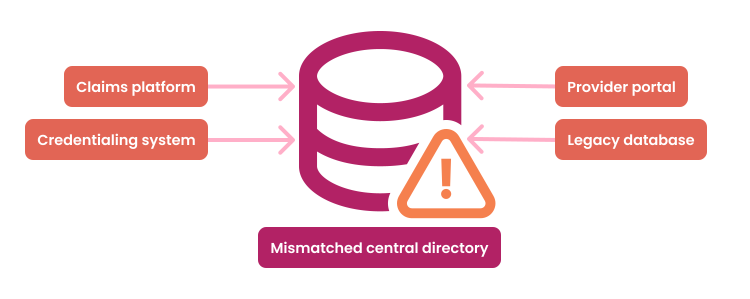
Providers and payers often store provider data across multiple databases, making it easy for provider records to start to conflict. One database may show previous practice locations, while another may still have a retired provider listed as active and in-network. That creates inconsistency and poor provider data accuracy.
Inconsistent formatting can also create challenges with provider data.
When healthcare providers send provider data to payers or other healthcare organizations, each could use their own formatting standards. Plus, when provider information is manually entered, it leaves room for typing and spelling errors. This leads to:
- Missing, mispelled, or incomplete fields
- Duplicate provider records
- Inconsistent naming conventions
While these may seem like small mistakes, they can create problems downstream for healthcare data compliance.
To make things even more difficult, provider data changes frequently. Even perfectly entered provider data may become outdated, and require updates to:
- Practice location
- Network participation
- “Accepting new patients” status
- Credentialing status
- Specialization
- Phone number
- Office hours
To meet healthcare data compliance requirements, providers and payers have to make ongoing validation a part of their processes.
Benefits of improving healthcare provider data accuracy
It can be tricky to keep provider data accurate, but the payoff of strong provider data governance and consistent provider data management is worth it. Here’s what to expect:
- Reduced compliance risk: Fines, audits, and non-compliance penalties don’t come from accurate provider data. They come from preventable errors like outdated practice locations, incorrect network participation, and inaccurate credentialing statuses. Clean, validated records support healthcare data compliance standards and CMS compliance requirements.
- Better scalability: As they scale, payers add new providers to their networks. Accurate payer provider data makes that growth easier to manage. Existing provider data is kept clean, and new data is validated before entering the system to prevent duplicate, conflicting, or incomplete records.
- Improved patient experience: Patients choose providers based on coverage and convenience. When an accurate provider directory helps patients find an in-network provider at the location they expected, they don’t experience the delays, surprise costs, and frustration of bad provider data.
How to ensure healthcare provider compliance through better data
Healthcare provider data accuracy starts with data governance. With a comprehensive data governance process, providers and payers can keep provider licensing status, credentialing updates, network participation, specialty, phone number, office hours, and accepting-new-patients status up to date.
A simple healthcare provider data governance process could look like:
- Data entry: Provider data is collected throughout credentialing, contracting, the claims process, or even manual updates.
- Standardization: Key data points (name, NPI, address, phone number, etc.) are normalized to fit a consistent format.
- Validation: Key data points are checked against authoritative sources.
- Deduplication: Provider records are matched across databases to prevent duplicate or conflicting records.
- Review: When data conflicts across sources, provider records are reviewed and corrected.
- Approval: Approved provider records are added to provider directories, claims systems, referral lists, scheduling platforms, and reporting tools.
- Ongoing monitoring: Records are revalidated every 90 days or as provider data changes.
- Audit trail: Each change is documented to ensure compliance.
Throughout this process, provider addresses are used for directories, claims, referrals, deduplication, and network analysis.
So, if you want better provider data management, start by regularly validating each provider address as it enters your database.
Implement real-time data validation
Real-time address validation prevents bad provider data from becoming a healthcare data compliance issue in the first place. How? With address autocomplete.
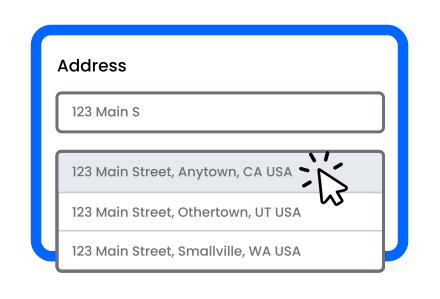
Address autocomplete suggests addresses the moment a user—whether that’s a patient or a healthcare professional—begins typing.
Smarty’s address autocomplete API only suggests valid, standardized addresses, so the user can click on the right address after just a few keystrokes.
The result? Providers and payers avoid typos and manual entry, and their provider data is cleaner from the start. Plus, typing 4–5 keystrokes rather than the typical 40–50 it takes to type a full address requires less effort from the user, increasing form completion rates.
Maintain ongoing data hygiene processes
Provider addresses change. Address components change, too.
When a ZIP Code changes or a street is renamed, your provider data can become outdated. That’s why healthcare providers and payers need ongoing address validation.
Address validation healthcare solutions can be configured to automatically and regularly standardize, normalize, and verify provider addresses.
In addition to keeping provider addresses as up-to-date as possible, this makes provider address data consolidation easier.
Blending data using addresses that follow a consistent format improves healthcare address match rates across systems, so fewer duplicate provider records trip up patients.
Project US@ address standardization, an initiative to improve the accuracy of addresses used by the healthcare industry, can also help maintain data hygiene by encouraging a consistent address format across healthcare providers, payers, and provider directories.
Conclusion
Healthcare provider compliance depends on healthcare provider data accuracy. When provider addresses, network participation, specializations, and contact information are accurate and up to date, healthcare providers and payers can reduce risk, improve efficiency, and help patients quickly find the care they need.
With address autocomplete and validation, healthcare providers and payers can keep provider addresses cleaner from the start, standardize addresses across databases, improve record matching, and send patients to the correct locations with confidence.
Smarty’s address data solutions are built to do just that.
Ready to clean up your provider data? Start a 42-day free trial to put Smarty’s address verification and autocomplete to the test! Have enterprise-level needs? Contact us to talk with an address expert.
FAQ
Why is healthcare provider data accuracy important?
Complete, correct, and timely healthcare provider data dispels ambiguity, helping patients find the care they need without delay, all while payers and providers stay compliant and better maintain provider data across platforms.
What regulations affect provider data accuracy?
In the US, Centers for Medicare & Medicaid Services (CMS) requirements, the No Surprises Act, and provider directory accuracy mandates encourage providers and payers to keep their provider data accurate.
How can healthcare organizations improve provider data accuracy?
Through ongoing validation. In addition to provider addresses, NPIs, licensing status, credentialing status, network participation, specialty, phone number, and accepting-new-patients status should be reviewed regularly.
What are the risks of inaccurate provider data?
Inaccurate, incomplete, and out-of-date provider data can lead to fines, audits, and noncompliance penalties. Plus, when patients are misled by bad provider data, they lose trust in payers and healthcare providers.
How does address validation support provider data accuracy?
Address validation:
- Confirms a provider’s address is real
- Identifies when a residential address, PO Box, or CMRA is incorrectly listed as a provider’s address
- Normalizes and standardizes addresses for provider data blending
- Improves healthcare data quality ROI
Can provider data accuracy improve patient experience?
Yes! Patients often choose providers based on payer provider data. When that data is accurate, patients can reach their desired provider without delay or surprise out-of-network costs.
Was this helpful?