
Monthly vs. annual plans: How to choose what’s right for you
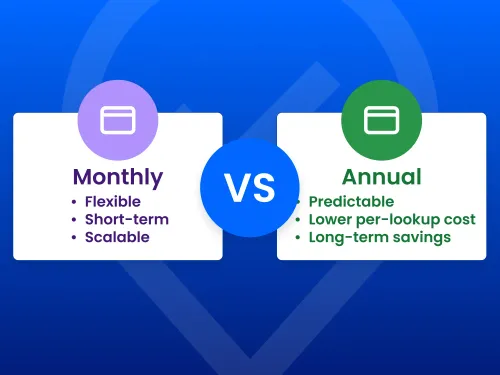



If you’ve ever found yourself stuck while deciding between a monthly plan and an annual plan, you’re not alone. This is one of the most common questions we hear—and honestly, it’s a good problem to have. It means you’re thinking carefully about usage, cost, and flexibility.
This guide is designed to help you make the right call for your use case. Feel free to read the whole thing, or jump to the section that you’re most interested in:
- The main difference
- When a monthly plan makes the most sense
- When an annual plan makes the most sense
- Real cost scenarios (monthly vs. annual)
- What happens if you go over your limit?
- How to decide (without overthinking it)
- Pick the plan that matches how you actually use address data
The main difference
What it really boils down to is this: monthly plans bring flexibility, while annual plans provide cost efficiency and additional features and functionality.
Monthly plans give you the freedom to scale up, scale down, or walk away if need be. Annual plans reward you for committing to a predictable volume with lower per-lookup pricing and added features.
So which should YOU pick?
When a monthly plan makes the most sense
Monthly plans are typically the better fit when your usage is uncertain or temporary.
For example, common scenarios we’ve seen for monthly users of our address validation products are:
- Initial batch validation: Maybe you’re performing a first-time clean-up for your list, merging two or more different datasets into one location, participating in an audit-forced remediation, analyzing a portfolio prior to acquisition, or maybe it’s something else that you’ll only need to do 1-2 times per year.
- Early-stage testing or proof of concept: Maybe you aren’t totally sold on Smarty yet. That’s ok! Send us your hardest addresses in this flexible monthly subscription and see how Smarty handles them.
- Unknown volume: Maybe you’re a startup unfamiliar with your true business workload. Monthly plans might make the most sense to start with. You can always ramp up to an annual plan once predictable volume and lookup patterns are established.
- Short-term projects: Sometimes, organizations need address data tools for a CRM cleanup sprint, system migration prep, direct mail campaigns, customer reactivation campaigns, territory realignment, fraud/risk review, or compliance remediation.
- Lookup volume closely or exactly matches a monthly option: Typically, if the number of 1-time lookups you need to verify closely matches a monthly plan, it might make sense to pay for one month to cover the volume you need to get the job done.
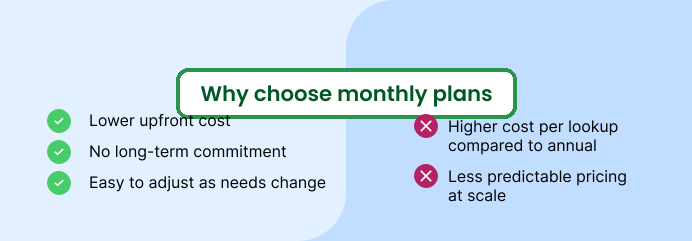
Think of monthly plans like renting: great for flexibility but not optimized for long-term savings or adding features.
When an annual plan makes the most sense
Annual plans shine when usage is consistent, growing, or high volume. Some of the common scenarios for customers on annual address verification plans are when they have:
- Ongoing API usage in production: Think ecommerce checkout, insurance quoting, patient intake, loan applications, account creation, delivery scheduling, customer onboarding, etc. If accurate address data is part of the customer experience or your operational workflow, predictable annual access can make sense.
- High-volume batch processing: Useful for teams who routinely and regularly clean, enrich, or migrate/aggregate large address lists. These can be healthcare systems updating patient records, insurers reviewing policyholder data, retailers cleaning customer databases, telecom providers validating serviceable areas, logistics teams prepping delivery zones, or financial institutions standardizing customer records for compliance/reporting. Ongoing data hygiene on a monthly or quarterly basis (best practice) typically makes more sense under an annual plan structure, given how often address data changes.
- Embedded address validation in apps or workflows: Consider things like software companies, SaaS platforms, CRMs, ERPs, ecommerce platforms, healthcare portals, insurance systems, and fintech apps that need address data built directly into the user experience (internal or customer-facing). When address data is part of the product or workflow itself, annual plans support long-term reliability and easier planning.
- Teams that know they’ll need address verification all year: If addresses affect billing, routing, compliance, communication, risk, or service delivery throughout the year, an annual plan helps keep that data layer consistently available.
- When you need additional features and functionality: If SSO, API key management features like limit-by-key or usage-by-key reports, or component analysis are critical to your workflows, annual plans are the way to go. These advanced features are available in select annual plans. Consult sales for details.
- Inconsistent monthly volume: Perhaps your busiest times are in December and February, or maybe promotions and coupons cause business to fluctuate inconsistently. An annual plan would make sense in this case because an abundant lookup consumption one month may even out in the months that follow with little to no volume, while still cutting overall costs.
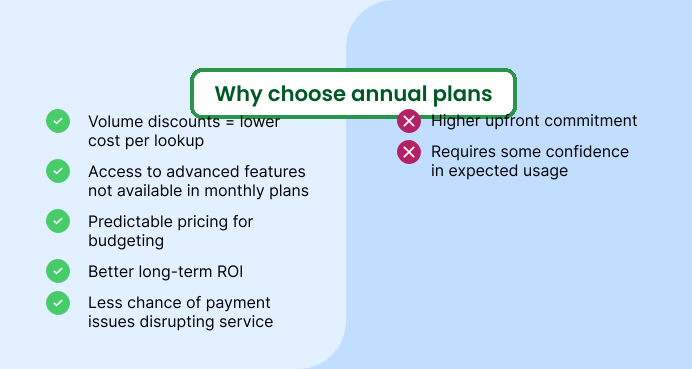
If monthly plans are akin to renting, then annual plans are akin to home ownership. You pay more upfront, but your cost per unit drops significantly, and you can “decorate” your plan how you’d like with additional à la carte advanced features.
Real cost scenarios (monthly vs. annual)
Let’s make this concrete with Smarty’s published pricing models for address verification.
US Address Verification
Smarty’s US Address Verification starts with a 42-day free trial that includes 1,000 lookups.
Paid professional plans change based on usage per month and per year:
| Monthly lookups | Monthly price | Monthly cost per 1,000 lookups | Annual lookups | Annual price | Annual price monthly cost equivalent | Annual cost per 1,000 lookups |
| 1K | $17/month | $17.00 | 12K | $195 | $16.25/month | $16.25 |
| 5K | $50/month | $10.00 | 60K | $552 | $46.00/month | $9.20 |
| 10K | $88/month | $8.80 | 120K | $1,020 | $85.00/month | $8.50 |
| 25K | $173/month | $6.92 | 300K | $2,040 | $170.00/month | $6.80 |
| 50K | $258/month | $5.16 | 600K | $3,060 | $255.00/month | $5.10 |
| 85K | $380/month | $4.47 | 1M | $3,720 | $310.00/month | $3.72 |
| 170K | $485/month | $2.85 | 2M | $4,980 | $415.00/month | $2.49 |
**Note: Smarty also offers plans for companies that need greater lookup volumes than those shown above, custom legal work, enterprise speed guarantees, global coverage, and/or enhanced data privacy.
The pattern is clear: as usage increases, the cost per lookup drops quickly. That’s why the right plan depends less on whether a team “needs address verification” and more on how often they need it. Depending on volume, teams can save nearly 17% by choosing an annual plan.
Scenario 1: light, one-time use

A team needs 50,000 lookups for a one-time cleanup, such as cleaning a customer database, standardizing addresses before a migration, or validating a mailing list.
For this scenario, the monthly plan is the better fit. The 50K monthly plan costs $258/month, so the team can complete the project for $258.
The comparable annual plan includes 60K lookups for $552/year, or about $46/month. That’s a lower monthly equivalent if broken down, but it only makes sense if the team needs 50K lookups every month and paying an up-front cost of $552 is doable for that organization.
For a one-time 50K project, the annual plan would cost $294 more than the monthly plan and would include several hundred thousand lookups that the team may never use.
Scenario 1’s best fit: Monthly plan
Why: There’s a monthly plan that exactly fits their usage, and the usage is required all at once.
Scenario 2: moderate ongoing usage
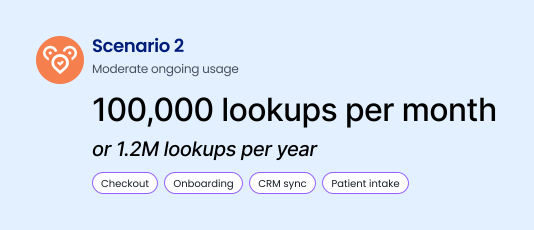
A company needs about 100,000 lookups per month, or 1.2M lookups per year, for ongoing workflows like ecommerce checkout, patient intake, insurance quoting, CRM updates, customer onboarding, or account creation.
For a monthly approach, this team would need the 170K monthly plan, which costs $485/month. Over 12 months, that comes to $5,820/year.
However, on an annual plan, 1.2M lookups per year falls above the 1M tier, so the closest annual tier is 2M lookups for $4,980/year.
That saves about $840/year compared to paying monthly.
The annual plan also lowers the approximate cost per 1,000 lookups from $2.85 on the monthly 170K plan to $2.49.
Scenario 2’s best fit: Annual plan
Why: Usage is steady year-round. Even though the annual tier includes more lookups than the team’s projected 1.2M, it still costs less than paying monthly for the required monthly volume, and the extra lookups can serve as a safety buffer should usage unexpectedly scale due to other data acquisition or projects that arise throughout the year.
Scenario 3: high-volume production use
A company needs 1M+ lookups per month for a production workflow, such as a high-traffic checkout experience, a logistics platform, a telecom serviceability check, an insurance platform, a healthcare system, a fintech onboarding flow, or a SaaS product.
At this volume, the need is beyond Smarty’s published self-serve monthly and annual tiers. The highest published monthly tier is 170K lookups/month, and the highest published annual tier is 2M lookups/year.
A company doing 1M lookups per month would need 12M+ lookups per year. This is a great chance to reach out to an Account Executive to explore options. Smarty is built to scale with you and your organization at whatever speed and volume you may require, and even though there are no published plans available, Smarty serves Fortune 500, Fortune 100, and even Fortune 10 enterprise customers by creating custom annual plans that meet their high-volume requirements.
Scenario 3’s best fit: Custom annual plan
Why: Monthly plans offer flexibility, but they’re not designed for this level of production usage. A custom annual plan built by your Account Executive provides high-volume teams with appropriate lookup volume, cost per lookup, speed guarantees, legal work, privacy needs, and predictable annual spend.
**Note: If you want us to model up pricing scenarios for products outside of address verification, we’re happy to do so! Simply reach out to an Account Executive, give us your use case, and we’ll help you find the plan that makes the most sense for your business.
What happens if you go over your limit?
Smarty doesn’t handle depleted plans with traditional overage fees like most data providers.
Instead, paid subscriptions are valid for a set period of time or a set number of lookups, whichever comes first.
If auto-renewal is turned on, your subscription renews when your billing period ends or when you use all of your included lookups.

If auto-renewal is turned on, Smarty will charge your credit card for a new block of address lookups and renew your subscription starting on the current date. This helps keep your service available, rather than interrupting API access when usage is higher than expected.
For example, say you started a monthly subscription for 50,000 lookups on December 1.
Normally, if auto-renew is turned on, that subscription would renew at the end of the month.
But if a holiday sales rush caused you to use all 50,000 lookups by December 10, your subscription would automatically renew at the same level on December 10.
Your new subscription period would then start from that renewal date.
Essentially, if auto-renewal isn’t enabled and your paid subscription runs out of lookups before the expiration date, API requests may return a 402 “payment required” error. That can affect downstream systems that depend on an active subscription, so production workflows should be configured with the correct plan size and renewal settings. If you’re concerned about exceeding your subscription limit, we recommend enabling auto-renew to ensure your service continues as expected.
If you’re still not quite sure which subscription will fit the bill, please reach out to an Account Executive who will listen to your specific use case and volume needs and strategize with you to determine the best fit.
Notifications
Smarty’s Account Dashboard allows you to set up usage notifications when you’ve reached 25%, 50%, and/or 70%. We will also ALWAYS send an email when you have only 10% of your lookups remaining, so you have time to review usage and determine whether the plan you’re on is a good fit or if an upgrade might be in order. (We’ll also send notifications to notify you of when lookups are exhausted or expired.)
One important note: if a subscription is depleted more than three times within 24 hours, further auto-renewals may be disabled to help protect you against unintended runaway usage. Annual plans can help you manage lookups and usage, providing you with more control and visibility into your lookup spend.
How renewals work
There are two ways to renew a paid Smarty subscription: 1) auto-renewal or 2) invoicing.
Auto-renewal helps prevent service interruptions by renewing your subscription when your lookups are depleted or when your subscription period ends.
Invoicing is available for annual plans over $500. If your account is set up for invoicing, Smarty can invoice you for renewal instead of charging a card. However, this may disrupt service during usage spikes.
You can also change your subscription at any time from your account. Changes take effect when the current billing cycle ends or when the lookups you already purchased are depleted.
How to decide (without overthinking it)
If you’re unsure, use this quick gut check:
Go monthly if:
- You’re testing, experimenting, or unsure about volume
- Your usage is temporary or very low
- You value flexibility over cost savings
Go annual if:
- You have consistent usage
- You want to reduce the cost per lookup
- You prefer predictable budgeting
- You need SSO or key management capabilities
- You want access to advanced features like component analysis (tell you what changed about the entered address (if anything) to obtain a match, and why). Advanced features are available in select annual plans. Connect with sales for details.
Additionally, if you need more, contact an Account Executive to access:
- Address verification volume that runs at production scale
- Usage exceeding the published self-serve tiers
- Additional speed guarantees, privacy requirements, compliance needs, and more predictable spend
And if you’re right in the middle? Start monthly. You can always move to annual once your usage patterns are clearer.
Pick the plan that matches how you actually use address data
In any direction you go, if you’re feeling overwhelmed or hesitant about choosing a monthly or annual plan, please reach out to an Account Executive. Smarty is here to help you choose the plan that fits how address data supports your business today and gives you room to grow when your usage becomes more predictable.
Remember:
Monthly plans are great when flexibility matters most.
Annual plans make more sense when your usage is steady enough that you can plan around it.
Need more? Your Account Executive can help.
Clean, accurate address data helps reduce failed deliveries, prevent bad customer records, improve workflows, and avoid downstream cleanup. Choosing a plan that matches your current usage ensures your critical address verification is integrated into your workflow and keeps business operational as usual.
If you want help modeling lookup volume or comparing monthly to annual plans, your Account Executive can help you find the best fit.
Was this helpful?