
What is a Residential Delivery Indicator (RDI), and where to find it



RDI stands for "residential delivery indicator." This data point is provided by the United States Postal Service (USPS) and indicates whether a mailing address in the US is residential or business.
The USPS tracks addresses registered specifically for commercial use and has configured its database so that businesses with authorized programs and CASS-certified address software can access that data.
If you ship packages to customers, this is good to know! Private shippers often charge more to deliver to residential addresses; some even charge a fee if you enter the address incorrectly. For example, if you mistakenly label a residential address as a business, they may charge you to fix it.
Smarty® has address verification tools that provide RDI status as metadata for your analysis. Whether you need to check one address or a list of addresses to see the USPS RDI indication, we’ve got your back. Feel free to try out some of our tools below. We return the RDI status of every address as part of the included metadata set.
Now we can get started on learning more about the RDI. In this article, we'll discuss the following topics:
- Residential vs. commercial address
- Residential delivery indicator (RDI)
- Private carrier "residential" vs. USPS "residential"
- How to use the USPS RDI
- Conclusion
- RDI FAQ
Residential address vs. commercial address
Why does the type of address even matter? Shipping can be a funny business sometimes. Mail carriers, be they private or otherwise, sometimes make decisions or take actions that seem… strange to the rest of us. The residential address vs. commercial address issue is one such topic.
Most private mail carriers charge one rate for shipping to a commercial or business address and another for shipping to residential addresses. The address type matters to your business because types of addresses differ in price for the other guys—residential rates are typically higher.
Unfortunately, there’s no way to intuitively determine if an address is a home or an office. Shipping something to 221B Baker Street, expecting it to be a business address, might land you in unexpected fee territory if it’s actually a residential address.
The reason is this: private mail carriers primarily service business locations. The vast majority of their work takes them to commercial and industrial districts. While they do deliver to residential areas, it's often outside of their normal routes. If they're going to drive over the river and through the woods just to bring you cookies from your grandma's house, they're more likely to ask for a little something extra on your shipping rates to compensate for it.
So, how do you determine, before the additional shipping charges, if an address is a commercial building or a residential address?
That's where RDI comes in.
Residential delivery indicator (RDI) meaning in business
Since the USPS maintains the authoritative address database for the US, they already know whether an address is residential or business. And they share that data through the residential delivery indicator, or RDI.
For businesses, the residential delivery indicator indicates whether the delivery address is residential. Pretty simple, right? So why would the USPS share this data with you? They have an ulterior motive.
Unlike private carriers, the USPS doesn't charge different rates for residential address delivery.

So, if you know that UPS and FedEx will charge you extra to ship something to an address just because of the type of address, you might prefer to go through USPS instead. It's not a bad option, especially if your primary issue is the additional cost non-USPS couriers would charge you.
The bottom line is that understanding the meaning of RDI in business allows you to reduce your shipping expenses. Want more? See how A3 Freight saves 6% on freight audits and 18% on spend analytics by using the RDI flag and address standardization included in Smarty's US Address Validation service.
Private carrier "residential" vs. USPS "residential"
The USPS isn't the only delivery service that can determine whether an address is residential or commercial real estate. Private carriers also classify addresses as residential or commercial.
However, private carriers may classify an address as 'residential,' whereas the USPS classifies it as 'commercial.' Why?
When private carriers like UPS and FedEx classify locations as "commercial" or "residential," the classification largely depends on the location, not the property's actual use.
Cities divide themselves into different "zones," like residential, industrial, or commercial. These zones often restrict what can be built where and, overall, lead to development within their respective zones. Residential structures are typically built in residential zones, and commercial structures are built in commercial zones.
In other words, for private carriers, an address in a residential zone is a residential address, regardless of the structure's actual use. All other addresses are considered "commercial" and pay the lower rates.
That means that, according to the likes of UPS or FedEx, if your neighbor Greg chases his dream and builds a poodle salon in his home garage, that business is still classified by the zone it's in (residential). So, sending anything to him will require you to pay a higher rate when shipping via private carriers, even if you're mailing to his business rather than his personal residence.
By contrast, the USPS RDI tells you how a location is used rather than which zone it's in.
So, if Greg's poodle salon is a commercial use, even though it's located in a residential zone, the USPS will tell you that your parcel will be going to a business location, even if the city has zoned the property as "residential."
How to check if an address is residential or commercial using USPS RDI and Smarty
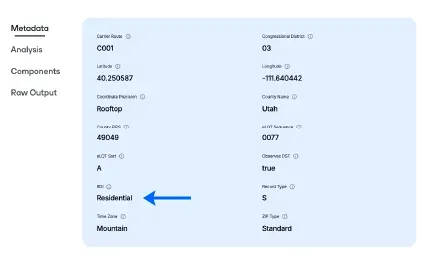
So, how do you use the USPS RDI? The simplest way is to check an address using a residential or commercial address checker, such as the one built into Smarty's US address validation service. Our residential or commercial address checker
gives you access to the RDI as part of the metadata returned on every address. It also standardizes, validates, and parses the address.
If you want to know where to find this information, here's what our output looks like in our single-address validation tool.
Conclusion
The USPS Residential Delivery Indicator (RDI) can indicate whether an address is residential or commercial.
Need more clarification? Feel free to get in touch with us. We can find the right services and tools to support your needs and show you where to find RDI in our output, or even debate whether RDI is actually telling you what you want to know. We're happy to answer any questions you have or help you determine which term applies to your address: "residential" or "commercial."
RDI FAQ
Is RDI the same as residential address verification?
No. RDI is a data point that indicates whether USPS classifies a delivery address as residential or commercial. Residential address verification typically involves a broader process of validating that the address exists, correcting or standardizing its components, and potentially returning additional address metadata. RDI can be included in that verification process, as we do here at Smarty, but other providers may not combine RDI in their address verification metadata.
How accurate is USPS RDI data?
USPS RDI data is based on how an address is classified within USPS address data. However, an RDI result shouldn't necessarily be treated as a description of a property's zoning, building type, or current occupant. A residential-looking property may be classified as commercial, particularly when a business operates from that address.
Does RDI identify apartments as residential addresses?
Generally, an apartment or other residential unit can receive a residential RDI classification, but the result depends on the USPS classification associated with the deliverable address. Checking the complete address, including a valid apartment or secondary unit number when applicable, helps ensure you're evaluating the correct location or delivery point.
Can a home-based business have a commercial RDI classification?
Yes. Because USPS RDI reflects address classification rather than simply a property's appearance or zoning, a business operating from a home may have a commercial classification in some circumstances. That's one reason you shouldn't determine residential or commercial status based solely on whether an address looks like a house.
Can RDI help prevent residential delivery surcharges?
RDI can help businesses identify addresses USPS classifies as residential before shipping, providing another data point for carrier selection and shipping cost analysis. However, private carriers maintain their own rules and classifications for residential delivery fees, so a USPS RDI result doesn't guarantee how another carrier will assess a surcharge.
Why would UPS or FedEx classify an address differently from USPS RDI?
USPS and private carriers don't necessarily use the same criteria to classify delivery locations. USPS RDI reflects USPS address data, while private carriers may apply their own residential delivery definitions and pricing rules. As a result, the same address can potentially receive different residential or commercial classifications depending on the carrier.
Does an RDI result tell me whether an address is deliverable?
Not by itself. RDI describes the residential or commercial classification associated with an address; it isn't a substitute for USPS address validation. To determine whether an address is recognized and deliverable, use an address verification service that validates the address and returns RDI alongside other relevant USPS address metadata.
Was this helpful?