

ZIP+4 Code lookup | Get the last 4 digits of 9-digit ZIP codes
ZIP+4 lookup tool
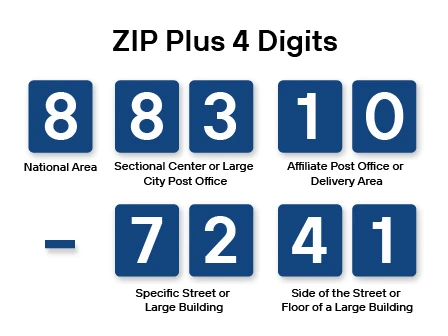
A ZIP+4 Code is a 4-digit code appended to a standard 5-digit ZIP that helps the USPS sort, route, and deliver mail more efficiently. The last 4 digits of these 9-digit ZIP Codes usually represent 6-20 delivery points on a USPS carrier route.
ZIP Code information can be incredibly dry, but knowing its inner workings will help to clarify what ZIP+4 Codes can bring to the address table.
Stick with us to learn how ZIP Plus 4 Codes help to prevent misdelivered, lost, delayed, and returned mail. Including the last 4 digits of the ZIP Code can reduce delivery time by up to 2 days, improving operations across your organization.
Full 9-digit ZIP Code lookup
Also called plus-four codes, 9-digit ZIP Codes, and full ZIP Codes, USPS ZIP+4 Codes can be looked up using various tools.
Smarty provides easy-to-use options for single ZIP+4 Code lookups by address, ZIP+4 Codes in bulk (up to millions at a time), and ZIP plus 4 lookups via API. Try them out here or read on to learn more about ZIP+4 Codes.
Bonus: We'll also validate, standardize, and correct your addresses with each ZIP plus 4 code lookup, too.
In this article, we'll cover the following:
- Find my ZIP+4 Code or any ZIP+4 Code (video)
- What is a ZIP Code?
- How ZIP Codes became 9-digit ZIP Codes
- What are ZIP+4 Codes?
- Benefits of full 9-digit ZIP Code lookups (ZIP+4 lookups)
- ZIP+4 Code database
- What is my full ZIP Code with the extra 4 digits?
- ZIP+4 FAQ
Video: Find my ZIP+4 Code or any ZIP+4
Quickly find the last 4 digits of ZIP Code numbers for almost any address in the United States by watching this video.
Fully understanding the last four digits of ZIP Codes requires knowing about 5-digit ZIP Codes, too.
What is a ZIP Code?
A ZIP Code is a number assigned by the postal service to a specific land area and route. Contrary to popular belief, they’re not boundaries but rather a string of numbers attached to delivery routes to ease the lives of package and mail service carriers.
We’re gonna say it again, because if you don’t get this, you won’t understand the bigger picture of full ZIP Code lookups later. It's essential to note that ZIP Codes aren't "boundaries." They're a collection of delivery routes. They don't follow geographic or administrative boundary lines; they can cross city, county, and state lines. They follow where the delivery trucks go and color all over those boundary lines.
To help you grasp this, consider the following example: If you're mailing a letter from Boston to Seattle, the mail carrier in Massachusetts doesn't care what the destination's street address is. It's what you might call "outside his jurisdiction." He just needs to know which mail carrier to send it to so the appropriate mail carrier can do their job and get it to the correct address.
A postal worker can only cover so much ground on a given day. Since the USPS has a standard for delivering in rain, sleet, or snow, it rules out the possibility of delivering in stages (some today, some tomorrow). That means any post office only serves what it can reach in a day. ZIP Codes reflect that.
Let’s reference the basic structure of the original 5-digit postal code in the image below.
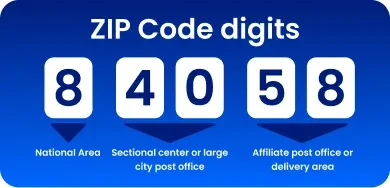
Typically, a ZIP Code is tied to a post office; by that, we mean that each additional digit contains part of the previous one. It’s starting at the national area (in our image, reference the first number 8), then zooming in to the sectional center or large city post office (in our image, see the 83), and finally zooming in further to the associate post office or delivery area (in this case, 10).
You might think of ZIP Codes as mailing addresses for particular post offices. Some handle more than one ZIP Code, but a one-on-one game plan is standard.
Some ZIP Codes are a bit different in function. Among them are "military" ZIP Codes, which include everything from military bases (domestic or otherwise) to battleships at sea. Then there are "unique" ZIP Codes. Businesses and organizations sometimes get a dedicated ZIP Code that they don't have to share with anyone due to the volume of mail they send and receive.
These frequently benefit from bulk mailing discounts since the organization usually has a mail department that (1) presorts mail before giving it to the USPS and (2) distributes mail internally, so the USPS doesn't have to. Like standard ZIP Codes, "military" and "unique" ZIP Codes circumscribe their delivery area. For a more in-depth guide, visit our ZIP Codes page.
How ZIP Codes became 9-digit ZIP Codes
Going back to the origins of ZIP Codes, the Zone Improvement Plan (ZIP) was a USPS initiative to make it easier to ship letters and packages across the country. ZIP helps divide the country into different "zones" according to the distribution of mail (opens in new tab), which accelerates sorting and delivery. See our image above for a refresher.
On July 1, 1963, the Post Office Department launched the Zone Improvement Plan. At the same time, they introduced the world to Mr. ZIP or "Zippy." Zippy is the official ZIP Code mascot pictured on our ZIP Codes 101 page. They also released the ZIP Code jingle:
As the US population has grown and spread out since 1963, it's been necessary to expand the system to make room for everybody and their dog. That's where the "plus 4" part comes in.
What are ZIP+4 Codes?
ZIP+4 Codes are a step up in understanding address data.
ZIP+4 Codes are 4-digit codes appended to the original 5-digit USPS ZIP Codes. Using the full ZIP Code with the extra 4 digits when mailing via the USPS ensures the fastest, most accurate mailing possible.
In case you’re wondering, “How can something be more accurate? Isn’t information only accurate or inaccurate?” Well, when we refer to ourselves as being the most accurate, we’re talking about precision. I could say that I live in the United States of America. That’s technically accurate. But, giving you my exact address with its complete ZIP+4 Code will be an even more accurate representation of my location.
Our new infographic, “The 411 on ZIP+4,” explains tons about ZIP Codes and ZIP+4 Codes. You’ll learn how they work, why they’re useful, and other interesting facts. Click the image or this link to read it now (opens in new tab), since it’s the only way to find out how many LEGO Harry Potter Hogwarts Castles you could build if each US address were a LEGO brick.
Magical ZIP plus 4 lookup tools don't just do a full ZIP Code lookup. Before you get the +4 Code, your address goes through the full address standardization and validation process to confirm it is mailable. (How else will you order all those LEGOs?)
These codes indicate a specific delivery route, meaning the path the mail truck would take for a single drop-off. Usually, this comprises 5 to 20 homes or locations. The USPS also assigns ZIP+4 Codes to PO Boxes. Typically, each PO Box gets its own +4 Code, which often matches the box number.
The extra 4 digits on ZIP Codes identify segments of fluid postal delivery routes. They're not permanent lines, so a 9-digit ZIP Code can change regularly. Five-digit ZIP Codes also change, but they do so infrequently; it's less likely that you will live in a ZIP Code when a 5+4 Code changes. Not so for the last 4 digits of ZIP Code numbers, as they can change monthly if necessary.
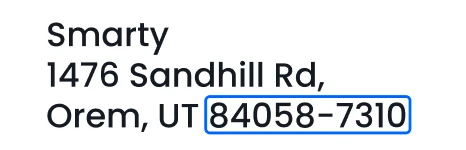
The +4 on a ZIP Code can change as frequently as every 30 days. In fact, 5% of all addresses get their ZIP+4 Code changed each month. The number of postal employees, new construction, remapping delivery areas, etc., are just a few factors that cause ZIP+4 Code changes.
These are the most up-to-date stats for USPS ZIP+4 Codes, 5-digit ZIP Codes, and USPS delivery points as of 2023.
- 44,255,314 - Total USPS ZIP+4 Codes in the US
- 7,282,402 - Total USPS ZIP+4 Codes dedicated to PO Boxes (one ZIP+4 Code per PO Box)
- 36,972,918 - Total USPS ZIP+4 Codes excluding PO Boxes (conventional ZIP+4 Codes)
- 39,969 - Total USPS 5-Digit ZIP Codes
- 925 - Average number of USPS ZIP+4 Codes per 5-digit ZIP Code
- 181,086,464 - Total USPS delivery points in the US
- 4.1 - Average delivery points per ZIP+4 Code (excluding PO Boxes)
Benefits of full 9-digit ZIP Code lookups (ZIP+4 lookup)
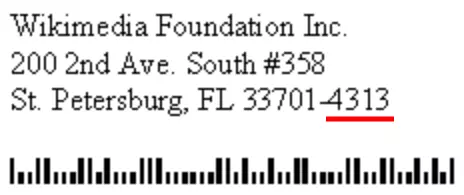
Here are a few benefits of looking up ZIP+4 Codes or 9-digit ZIP Codes as part of your address data management or shipping processes.
- Faster shipping - Each ZIP+4 Code represents delivery route segments that are usually within a single block of the desired delivery point. That simple 9-digit number makes routing more efficient since the USPS knows which mailperson will put the letter in the mailbox. Completing ZIP+4s on your mail can speed up processing and delivery, sometimes by as many as two days.
- Reduced lost mail & misdeliveries - More efficient routing also means fewer opportunities for mistakes along the way.
- Less "returned-to-sender" mail - Obtaining ZIP+4 Codes requires validation, which means the address is a valid delivery point and is standardized to the USPS address format. Mail delivery is more reliable with a valid, standardized address with a ZIP4 Code since the address data is clearly understood.
- More money with bulk mailings - If you send at least 50 packages or more than 200-500 pieces of mail, you may qualify for commercial mailing discounts. By adding ZIP+4 Codes and delivery point barcodes and by sorting/bundling your mail, you can get discounts from 5% to nearly 60% off the prices you'd pay at the post office.
- Cleaner address data - Addresses must be validated, standardized, and corrected before you get the ZIP+4 Code. So, you get much more than a pretty 9-digit ZIP Code; you get a clean, standard address. Clean, standard addresses are easy to sort and compare. Comparing a table of standardized, verified addresses allows you to easily identify duplicates, delete redundancies, or merge records.
- Enriched address data - When you give Smarty an address and ask for the ZIP+4 Code, we give you the ZIP+4 Code along with the validated, standardized address. We also provide up to 55 data points about the address, including county information, lat/long coordinates, time zone, whether the address is residential or commercial, and more, all of which can be used for business intelligence and to better understand your mail recipients.
That's right. Your mail can arrive faster, more cheaply, and more reliably if you label it with a full ZIP+4 Code. Plus, you get fewer returned mail items. Bet you're ready to do your first full ZIP Code lookup now.
Those benefits are just the beginning. If you're getting the ZIP+4 Code, you're already validating and standardizing the address, and address validation improves business results across all types of organizations.
ZIP+4 Code database
For many users, the best way to access the USPS ZIP+4 database is through a CASS Certified USPS address validation vendor, like Smarty. Since the last four digits of ZIP Codes update frequently, even month-old data isn't reliable. Checking addresses regularly against the database will ensure your data remains clean.
The ZIP+4 Code database can be accessed for free directly through the USPS site or the USPS address validation API. In our USPS APIs article, you will find a comprehensive list of uses and limitations of the USPS web-based tool and API. If you need a ZIP+4 Code Database, address validation might scratch your itch better than anything provided by the USPS. You can check out our ebook. It shows how to improve business results in your organization using address validation. Read it here:
 (opens in new tab)
What is my full ZIP Code with the extra 4 digits?
If you need an answer to, "What is my ZIP Code with the extra 4 digits?" Just use the demo at the top of the page, enter your address, and get your +4 Code instantly. Just remember, it's called a ZIP+4 Code, or simply a ZIP+4.
Now that you know everything there is to know about ZIP +4 Codes, there will be a pop quiz next week.
The quiz will include three things:
- ZIP+4 Codes indicate delivery routes.
- Using ZIP+4 Codes gets your mail there faster and more accurately.
- We at Smarty can get you those codes.
If you want to try it on a single address, you can now use our Single Address Verification Tool. Smarty’s US Address Verification API provides the appropriate ZIP+4 Code for every address we process.
Or you could call us instead if you'd prefer to talk to a real person. Smarty is staffed with real people and engineers who can (and are excited to) answer your questions.
ZIP+4 FAQ
Is a ZIP+4 Code required?
No. The USPS doesn’t require a ZIP+4 Code for the delivery of individual mail pieces. However, including the extra four digits can reduce manual mail handling and improve delivery speed and accuracy.
What do the last 4 digits of a ZIP Code mean?
The last four digits identify a more specific segment of a USPS delivery route. A ZIP+4 Code can represent a small group of addresses, such as several homes on the same street, a group of apartments, a city block, or sometimes a single high-volume address.
How do I find the last 4 digits of my ZIP Code?
Use a ZIP+4 lookup tool and enter your full street address. Smarty’s Single Address Verification Tool can validate the address and return its complete 9-digit ZIP Code, including the ZIP+4. Smarty also offers bulk lookup and API options for larger numbers of addresses.
Can two addresses have the same ZIP+4 Code?
Yes. A ZIP+4 Code doesn’t always identify a single address. It usually represents a small delivery segment and can cover roughly 5–20 homes or locations along the same USPS delivery route.
Does every address have a ZIP+4 Code?
No. Not every USPS-deliverable address has an extra four digits assigned. This can happen with certain addresses that aren’t represented in the USPS ZIP+4 data, including some newer or unusual delivery points.
Can I look up a ZIP+4 Code using only a ZIP Code?
Not usually. A 5-digit ZIP Code covers a much larger delivery area and can contain many different ZIP+4 Codes, so the ZIP Code alone generally isn’t enough to determine the correct plus 4 code.
To find a specific ZIP+4, you’ll typically need the street address and any applicable apartment, suite, or unit information. Smarty uses address validation against USPS address data to determine the appropriate ZIP+4.
Was this helpful?