
Healthcare data quality: The foundation of interoperability in healthcare


Healthcare interoperability depends on healthcare data quality. Before organizations can reliably exchange patient information across electronic health records (EHRs), health information exchanges (HIEs), payer systems, portals, and care networks, the data itself needs to be accurate, complete, consistent, current, and sufficiently standardized to be trusted.
Healthcare organizations are investing heavily in interoperability—implementing FHIR APIs, participating in TEFCA, modernizing EHR integrations, expanding patient engagement platforms, and building enterprise analytics programs. Yet many of these initiatives fail to deliver their full value for one surprisingly simple reason: foundational data quality.
Healthcare data includes far more than patient addresses. Modern healthcare organizations manage thousands of interconnected data elements spanning clinical care, operations, billing, research, and public health.
Examples include:
- Clinical data, such as diagnoses, medications, allergies, laboratory results, imaging studies, immunizations, referrals, and physician notes
- Patient demographic data, including names, addresses, phone numbers, dates of birth, race, ethnicity, language preference, and emergency contacts
- Administrative and financial data, such as insurance coverage, claims, billing information, authorizations, and encounter history
- Provider and organizational data, including provider directories, specialties, facility locations, licensing information, and network participation
- Operational data, including scheduling, resource utilization, staffing, and quality reporting
Every one of these data types must be accurate, complete, consistent, timely, and standardized if healthcare organizations want to deliver safe care and exchange information successfully.
Healthcare platforms can exchange information seamlessly, but they can’t fix inconsistent, incomplete, or inaccurate demographic data without additional APIs. When patient and provider records don't align across systems, interoperability becomes operationally unreliable.
Smarty provides data quality tools to help you ensure your address quality is top-notch, so your interoperability and ROI aren’t hemorrhaging, and so your teams can better comply with healthcare initiatives like HL7, TEFCA, USCDI, and HIPAA. Standardized address data supports patient matching, care coordination, and business analytics, and you can test out our tools completely free. Either sign up for a 42-day free trial (no credit card required), or you can try them live on our site.
Here’s what you can expect to learn about healthcare data quality.
Table of contents
- What is healthcare data quality?
- Common types of healthcare data
- What is interoperability in healthcare?
- Why healthcare data quality is essential for interoperability (and why interoperability investments underperform)
- Best practices for improving healthcare data quality
- How address and supplemental demographic data improve interoperability
- Future trends shaping healthcare interoperability
- Conclusion: Building a stronger healthcare data strategy
- Healthcare data quality FAQ
- What is healthcare data quality?
- Why is healthcare data quality important?
- What is interoperability in healthcare?
- How does poor data quality affect interoperability?
- What are the dimensions of healthcare data quality?
- How can healthcare organizations improve healthcare data quality?
- How does address validation support healthcare interoperability?
What is healthcare data quality?
Healthcare data quality is the degree to which healthcare data is accurate, complete, consistent, current, usable, and trusted enough to support patient safety, regulatory compliance, analytics, communication, and decision-making.
High-quality address data is one of the foundational pieces to healthcare operations because many downstream processes rely on, are influenced by, and even tied to patient and provider addresses.
This isn’t just an operational preference. ONC’s Project US@ was created to standardize patient address information, with the goal of improving patient matching across clinical data and administrative healthcare processes through better address quality.
For example, accurate address data helps healthcare organizations with:
- Patient identity and matching: Cleaner addresses help reduce duplicate records and support more reliable patient matching across EHR systems, portals, billing systems, and payer platforms.
- Communication and compliance: Validated addresses help mailed communications, billing statements, care instructions, and other sensitive materials reach the right person at the right location.
- Care access and coordination: Accurate address and location data help teams understand where patients live, route home-based care, identify transportation barriers, and plan outreach.
- Analytics and planning: Data standardization strengthens population health analysis, health equity initiatives, provider network planning, and service-area decisions.
What are the dimensions of healthcare data quality?
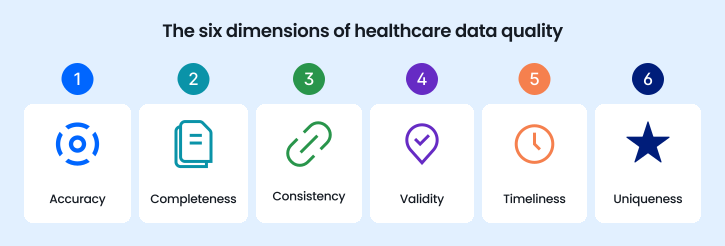
The six primary dimensions of healthcare data quality are: 1) accuracy, 2) completeness, 3) consistency, 4) validity, 5) timeliness, and 6) uniqueness. Maintaining high marks in each category benefits every part of a healthcare organization, including patient care, patient safety, operational efficiency, regulatory compliance, analytics, and decision-making.
Patient care
High-quality clinical, demographic, provider, and administrative data allow clinicians and operational teams to make better decisions with fewer gaps, contradictions, or assumptions. Accurate diagnoses, medications, allergies, laboratory results, demographic information, provider information, and location data all contribute to safer care and more reliable operations.
High-quality location data also supports more equitable access to care.
When organizations understand where patients live in relation to clinics, hospitals, pharmacies, labs, and other care access points, they can better identify transportation barriers, provider shortages, service gaps, and underserved communities.
Patients are also more likely to trust an organization that sends information to the right place, remembers their current details, and does not repeatedly ask them to fix the same information across disconnected systems.
Operational efficiency
Operational efficiency depends on scheduling data, provider directories, billing information, patient demographics, claims data, and contact information remaining synchronized across systems to keep workflows running smoothly. Consistent, valid, and unique data reduces the everyday friction that slows healthcare teams down. A few pieces of that unique data are the patient's address and location data.
When patient addresses are standardized and reliable, front desk teams spend less time re-entering information, call centers spend less time tracking down updated contact details, billing teams spend less time resolving undeliverable statements, patients get better care access through clean provider directories, and care coordinators spend less time confirming where follow-up instructions, test kits, prescriptions, or home care services should go.
Clean address data also improves interoperability by enabling more accurate patient matching, helping information move more smoothly across electronic health records, QHINs, billing platforms, patient portals, payer systems, outreach tools, and reporting workflows. For home health, hospice, mobile clinics, lab services, and community outreach, accurate location data, such as address coordinates, can improve routing and dispatch, making teams more likely to arrive at the right location the first time.
Regulatory compliance
Healthcare compliance relies on trustworthy information across every major data category. Clinical documentation, medication records, provider credentials, provider directories, patient demographics, billing information, and consent records must be accurate and complete to support regulatory reporting, privacy requirements, and patient safety. Accurate, complete, and consistent data support safer documentation and communication workflows.
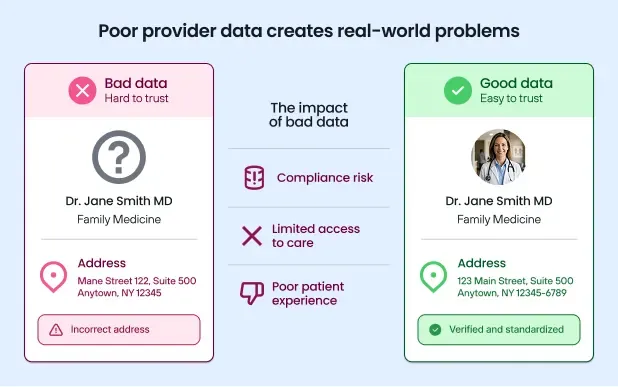
Small data errors can create bigger risks when sensitive information is involved. An outdated mailing address, a duplicate patient record, an incorrect provider location, or an incomplete contact field can lead to misdirected communications, inconsistent documentation, or extra work when teams need to verify what happened.
For healthcare organizations managing provider, state, federal, or sanctioned datasets, address quality can also support compliance workflows. Curatus integrated Smarty’s validation and rooftop geocoding tools to clean and verify large healthcare datasets, reporting that Smarty’s returns were about 15% more accurate than its former provider.
Accurate patient and address information can help reduce the risk of sending protected health information to the wrong person or location, including mailed billing statements, Explanation of Benefits documents, lab notices, care instructions, appointment communications, and other patient-facing materials.
Complete and standardized records also make audits, reporting requirements, privacy reviews, and internal governance easier to support. When data is consistent across EHRs, QHINs, billing platforms, payer systems, patient portals, and outreach tools, teams can more easily verify records, trace communications, resolve discrepancies, and show that policies were followed.
Analytics and decision-making
Analytics are only as trustworthy as the data behind them.
When healthcare data is accurate, complete, timely, and unique, leaders can better understand patient populations, measure outcomes, identify care gaps, forecast demand, allocate resources, and plan new services.
High-quality address data strengthens location-based analysis by showing where patients live, how far they are from care, which communities are underserved, where provider shortages may exist, and where outreach, mobile care, transportation support, or new service locations could have the greatest impact.
Clean address data also improves population health and health equity analysis by making it easier to identify geographic patterns in missed appointments, delayed follow-up care, pharmacy access, lab access, readmissions, chronic condition management, and preventive care gaps.
Without reliable location data, those patterns can be hidden, distorted, or wrongly attributed.
While healthcare data quality spans clinical, operational, financial, and demographic information, demographic data often serves as the bridge that allows those datasets to connect across systems. That's one reason standardized address data has become an increasingly important part of interoperability initiatives.
Common types of healthcare data
Healthcare organizations rely on many categories of information, each supporting different parts of patient care and business operations.
- Clinical data: Diagnoses, medications, allergies, physician notes, laboratory results, imaging reports, referrals, procedures, immunizations, and care plans
- Patient demographic data: Name, date of birth, address, phone number, email, emergency contacts, preferred language, race, ethnicity, and insurance information
- Administrative data: Appointments, admissions, discharges, transfers, authorizations, claims, billing, coding, and payment records
- Provider and organizational data: Provider directories, specialties, credentials, facility information, practice locations, and network affiliations
- Population health and public health data: Disease surveillance, vaccination records, community health indicators, quality measures, and reporting datasets
Although every category requires strong governance, demographic data often serves as the connective tissue among systems.
If patient identity information—including addresses—is inconsistent, even perfectly documented clinical information can become difficult to exchange and associate with the correct patient.
What is interoperability in healthcare?
Interoperability in healthcare is the ability of different healthcare systems to share information and actually use what they receive. It's what allows a hospital’s electronic health record to send a discharge summary to a primary care provider, or an HIE to make patient information available when someone receives care outside their usual network.
There are a few levels of interoperability.
Foundational interoperability means one system can send data to another.
Structural interoperability means the data arrives in an expected format.
Semantic interoperability means both systems understand the data in the same way.
Organizational interoperability is the people-and-policy side of the work, including privacy rules, permissions, governance, and shared processes.
Notice that every level of healthcare data interoperability assumes the underlying information is trustworthy.
FHIR can standardize how data is exchanged. TEFCA can expand who exchanges it. APIs can move it almost instantly.
None of these technologies improves the quality of the data being exchanged.
Garbage still moves at API speed.
Before you modernize anything else, fix the underlying data that everything relies on.
Why healthcare data quality is essential for interoperability (and why interoperability investments underperform)
The impact of cleaner address data is especially clear in public health workflows. For example, the New Mexico Department of Health used Smarty to improve medical data quality, reduce undeliverable mail, and strengthen vaccine outreach. As Katie Cruz, NMSIIS Manager at NMDOH, explained, “We trust the data and don’t have to add time, labor, or stress to use the tools. And implementation was seamless.”
Because healthcare data often moves amongst providers, payers, labs, pharmacies, and patient portals, healthcare data quality matters. If those systems can’t exchange and understand the same information, teams may be left working less efficiently, and all of the money poured into fancier operating and data management systems doesn’t matter. Garbage in? Garbage out.
Common healthcare data quality challenges
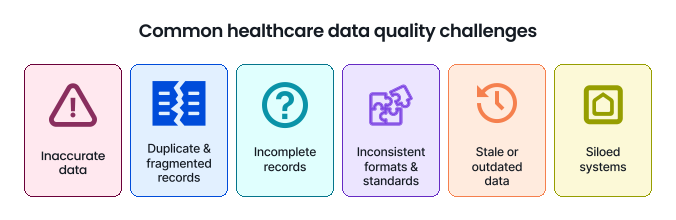
When foundational data quality breaks down, interoperability problems begin to surface in predictable ways:
- Duplicate patient records
- Failed patient matching
- Communication issues
- Claims processing
- Care coordination issues and delays
- Bad or insufficient analytics
- Data silos
- Outdated patient information
- Declining population health, and more.
The enemy of healthcare data quality is chaotic data and data sources, and no one knows that better than AIRA.
Their immunization programs showed how quickly address quality was becoming an interoperability issue. AIRA member organizations integrated Smarty’s address validation into IIS processes to standardize, validate, and geocode addresses for immunization coverage and outreach. In one pilot, Smarty-supported standardization and validation improved deliverability by 23.94%!
Additionally, a member of AIRA's immunization org recently said that part of the problem has been that different parties in the healthcare system send different, outdated, or incorrect addresses to their system, which has sometimes overwritten accurate address data. That's one reason it's a best practice to verify your addresses on an ongoing basis.
Fortunately, these issues are preventable. Most organizations don't need to replace their interoperability strategy—they need to strengthen the data entering it.
Best practices for improving healthcare data quality
Improving healthcare data quality requires organizations to think beyond any single field. Successful data quality programs typically focus on several foundational practices:
- Strong data governance
- Standardized terminology and coding
- Data validation at intake
- Duplicate record management
- Routine auditing and monitoring
- Staff education
- Automation where appropriate
Improving healthcare data quality is possible, and it doesn’t require as much operational overhaul as many organizations expect.
One of the highest-impact opportunities within those practices is improving demographic data quality, particularly patient addresses.
Here are some of the simplest and most cost-effective ways to improve healthcare data quality and strengthen interoperability.
Invest in a proper data intake solution: The best way to improve healthcare data quality is to prevent bad data from entering your systems in the first place. A proper data intake solution, preferably an address autocomplete solution with built-in validation, can help minimize the number of inaccurate, incomplete, or improperly formatted addresses that make it into your database.
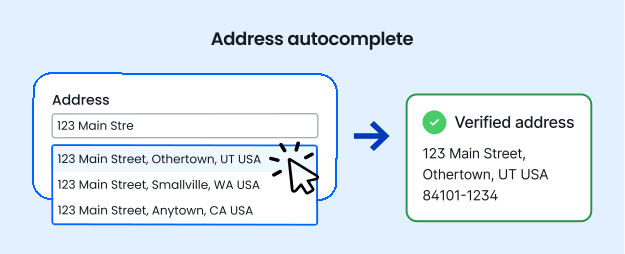
Many address autocomplete tools and APIs can be used externally by patients, members, or providers during form completion, but they should also be readily available to internal teams. Customer success, technical support, billing, enrollment, and provider relations teams all touch data that can affect downstream systems. Giving those teams access to validation at the point of entry helps improve healthcare data quality from the beginning.- Standardize and validate existing foundational demographic data: Healthcare data interoperability often depends on data that already exists across multiple systems. If that data is inconsistent, outdated, duplicated, or invalid, even the best-connected systems will struggle to communicate accurately.
Running an existing address database through a one-time batch cleanse can help standardize records, identify invalid addresses, and reduce duplicates. For example, “St,” “Street,” and “ST.” should all resolve to the same standardized address format. A strong address verification tool can standardize your address records and mark each one as valid or invalid.
That validation flag can become a useful operational signal. It can help teams spot potential fraud, prompt patients or members to update their information, reduce returned mail, improve provider directory accuracy, and recalibrate analytics that may have been built on incomplete or inaccurate data. - Create a sustainable data quality process: Once bad data has been cleaned, and better intake practices are in place, healthcare data quality depends on whether organizations can keep that data accurate over time. Patients move, providers change locations, facilities open and close, organizations merge, and records become outdated. Without a long-term process, the same problems will keep recurring.
Start with data governance. Teams need clear standards for how data is collected, validated, updated, stored, and shared across systems. Governance defines which systems serve as the source of truth, who owns different types of data, and how errors should be corrected. It also gives teams a shared framework for monitoring data quality before issues surface downstream.
From there, organizations can use monitoring and automation together to maintain quality at scale. Tracking indicators like invalid addresses, duplicate records, returned mail, failed communications, and other signs of declining data quality helps teams catch problems before they affect claims, billing, analytics, member communication, or care coordination. Automated validation, standardization, deduplication, and monitoring reduce manual effort while helping teams identify issues earlier and more consistently.
Staff training helps make those standards and tools part of everyday operations. Teams that enter, update, or rely on healthcare data need to understand why accuracy matters, which processes to follow, and how small errors can create larger downstream problems.
Together, an autocomplete solution, regular data validation, and upgraded address data governance practices can address most avoidable issues arising from poor address data management.
Address data doesn’t solve patient identity or fully improve healthcare interoperability on its own, but standardized foundational demographic data, including patient addresses, gives matching systems a cleaner, more consistent demographic field to compare against name, date of birth, phone number, insurance information, and other identifiers.
How address and supplemental demographic data improve interoperability
In healthcare, usable shared data is difficult to obtain because patient information moves within EHRs, HIEs, payer systems, labs, pharmacies, portals, billing platforms, and care management tools, not to mention different people entering that data.
Each system or person likely collects, stores, or formats address data differently, creating confusion when teams try to match records, coordinate care, send communications, or analyze patient populations.
Organizations often try to solve interoperability challenges by investing in additional integration layers. In many cases, improving foundational data quality produces faster returns because every downstream system benefits simultaneously.
Smarty cleans, standardizes, enriches, and validates your foundational data to improve your healthcare data quality across systems:
- US Address Verification validates, standardizes, and corrects addresses so that healthcare systems have cleaner fields to exchange, compare, and use. Addresses are only one part of patient matching, alongside fields like name, date of birth, phone number, and insurance information, but when address data is incorrect or inconsistent, matching becomes even harder. Cleaner address data helps teams connect patients to the right records, avoid duplicate profiles, and coordinate care with more confidence.
- US Address Autocomplete improves address quality at intake by helping patients or staff select a valid address to autofill as they type. Cleaner data from the start means fewer corrections, fewer duplicate records, and less confusion when that information moves among systems. It also helps appointment reminders, care instructions, test kits, prescriptions, and follow-up communications reach the right place sooner.
- US Rooftop Geocoding turns a validated address into precise location data. That location can support home health routing, mobile care planning, provider network analysis, public health outreach, health equity initiatives, and population health analytics.
- US Census Block and Tract Data enriches validated addresses with geographic and demographic context, helping healthcare organizations better understand the communities they serve. Teams can use this data to analyze social determinants of health, identify gaps in access, plan outreach, evaluate service areas, and support population health and health equity initiatives. Because the information is tied to a standardized address, it can also be shared and analyzed more consistently across EHRs, analytics platforms, care management tools, and other healthcare systems.
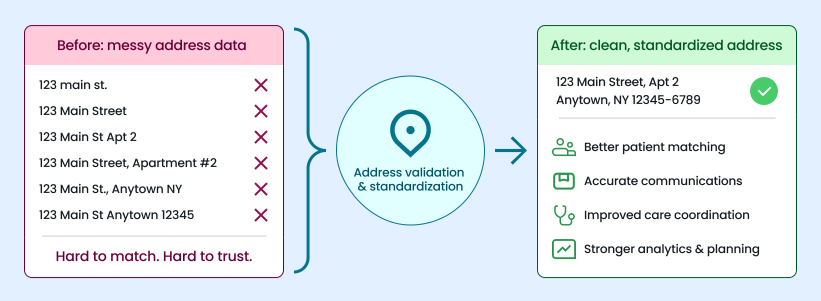
Additionally, SmartyKey® can help healthcare organizations connect address-related data more consistently over time. SmartyKey is a persistent, unique identifier (PUID) for an address, allowing teams to recognize the same standardized address across different systems, workflows, or datasets, even when the address is entered slightly differently.
The best part is that SmartyKey is built into these products, so it’s absolutely free for you to use to improve how your healthcare organization connects and analyzes address data. It tracks and connects disparate data to a single, valid, real location.
For example, one system may store a patient’s address as “168 Sullivan Street, New York, NY,” while another stores it as “168 Sullivan st new york new york,” or even its alias location, “168 Fantasticks Ln, New York, NY.” After validation and standardization, SmartyKey can help tie all of these address inputs back to the same underlying geocoded location.
That can support cleaner patient matching, reduce duplicate records, connect rooftop geocodes or property attributes to the right address, and help analytics teams compare records across EHR, billing, outreach, and care management systems with more confidence.
Together, these tools help healthcare organizations move closer to one accurate, trusted, golden patient record. In one Smarty healthcare customer story, a healthcare company achieved “nearly 100% match rates” with Smarty’s address data quality and planned to expand the integration into member applications serving more than 5 million members.
Address data intelligence obviously doesn’t replace identity management, governance, or interoperability standards–nor is it intended to–but these tools strengthen one of the core data points those efforts depend on.
Future trends shaping healthcare interoperability
The future of healthcare interoperability is being shaped by smarter technology, stronger standards, and broader expectations for secure data exchange.
AI and predictive analytics are enabling the identification of care gaps, forecasting demand, personalizing outreach, and supporting faster decision-making. But these tools are only as reliable as the data behind them. If patient records are incomplete, duplicate, outdated, or inconsistent, even the most advanced model can point teams in the wrong direction.
Standards and frameworks such as HL7 FHIR, USCDI, and TEFCA are driving healthcare data toward a more common language. HL7 FHIR provides healthcare systems with a standard way to exchange electronic health information; USCDI defines a core set of data classes and elements for nationwide exchange; and TEFCA establishes common expectations for secure information sharing across networks.
As more organizations connect through EHRs, HIEs, QHINs, payer systems, and patient-facing platforms, the need for trusted, standardized data becomes even more important.
There’s a common thread: every interoperability initiative depends on maintaining high healthcare data quality.
AI, FHIR, TEFCA, USCDI, and predictive analytics can all help healthcare organizations use information more effectively, but only if the data is accurate, complete, consistent, valid, timely, and sufficiently unique to trust.
Conclusion: Building a stronger healthcare data strategy
Healthcare organizations don't need fewer interoperability investments—they need those investments to perform better.
Before adding another integration, another API, another analytics platform, or another patient engagement tool, organizations should evaluate whether the demographic data flowing through those systems is sufficiently accurate to support them.
Interoperability succeeds when trustworthy data meets modern standards. Without that foundation, even the best technology delivers less than it should.
Improving foundational healthcare data quality—including patient demographics, provider information, and especially standardized address data—is one of the highest-leverage investments healthcare organizations can make because every downstream workflow benefits from it.
By improving foundational data quality first, healthcare organizations can strengthen patient matching, reduce duplicate records, improve communications, support care coordination, and make better decisions with greater confidence.
Smarty’s US Address Verification, US Address Autocomplete, and US Rooftop Geocoding–all backed by SmartyKey–can support a stronger healthcare data quality strategy by helping organizations validate, standardize, locate, and connect address data across workflows. Explore Smarty’s address intelligence tools or start a free trial to see how cleaner address data can support interoperability from the ground up.
Healthcare data quality FAQ
What is healthcare data quality?
Healthcare data quality is the degree to which healthcare data is accurate, complete, consistent, current, usable, and trusted enough to support care, compliance, analytics, communication, and decision-making.
Why is healthcare data quality important?
High-quality healthcare data helps teams match patients to the right records, coordinate care, communicate clearly, reduce administrative errors, support compliance, and make better decisions.
What is interoperability in healthcare?
Interoperability in healthcare is the ability of different healthcare systems to securely share information and actually use what they receive.
How does poor data quality affect interoperability?
Poor data quality makes shared information harder to trust. Incomplete, outdated, duplicate, or inconsistent data can lead to failed patient matching, miscommunication, rework, and unreliable analytics.
What are the dimensions of healthcare data quality?
The six primary dimensions are accuracy, completeness, consistency, validity, timeliness, and uniqueness.
How can healthcare organizations improve healthcare data quality?
They can improve data quality by validating information at intake, standardizing existing records, removing duplicates, monitoring errors, automating cleanup, and creating clear data governance practices.
How does address validation support healthcare interoperability?
Address validation standardizes and corrects address data so systems have a cleaner field to exchange, compare, and use. This supports better patient matching, fewer duplicate records, more reliable communications, and stronger analytics.
Was this helpful?