
HIPAA data governance: Best practices for protecting healthcare data


HIPAA data governance is the framework healthcare organizations use to establish responsibility, policies, controls, and processes for managing protected health information (PHI) and other healthcare data throughout their lifecycles. HIPAA, or the Health Insurance Portability and Accountability Act of 1996, establishes requirements for protecting the privacy and security of certain health information.
Although HIPAA doesn’t prescribe a specific data governance framework, strong governance helps organizations implement those requirements while improving the accuracy, consistency, accessibility, security, and appropriate use of healthcare information.
In this article, we’ll break down what HIPAA data governance is, why it matters, the core components of an effective governance program, common challenges, and practical best practices that healthcare organizations can use to strengthen their approach.
We’ll also look at healthcare data quality as one part of that broader strategy. Smarty specializes in address data, so we’ll show where accurate, validated patient addresses can support governance goals such as cleaner records, better patient identity workflows, more reliable communications, and reduced privacy risk.
Healthcare organizations evaluating Smarty for those workflows can also review Smarty's HIPAA documentation.
Try Smarty free for 42 days, or use the outline below to jump to the HIPAA data governance topic most relevant to you.
To assist healthcare organizations like yours in the search for improved healthcare data integrity, we’ve compiled a list of useful topics on the matter.
Table of contents
- What is HIPAA data governance?
- Why HIPAA data governance matters
- Core components of HIPAA data governance
- Why healthcare data quality is part of HIPAA governance
- How address verification supports HIPAA compliance
- HIPAA data governance best practices
- Common HIPAA data governance challenges
- Conclusion: Build HIPAA data governance on better data
- HIPAA data governance FAQ
What is HIPAA data governance?
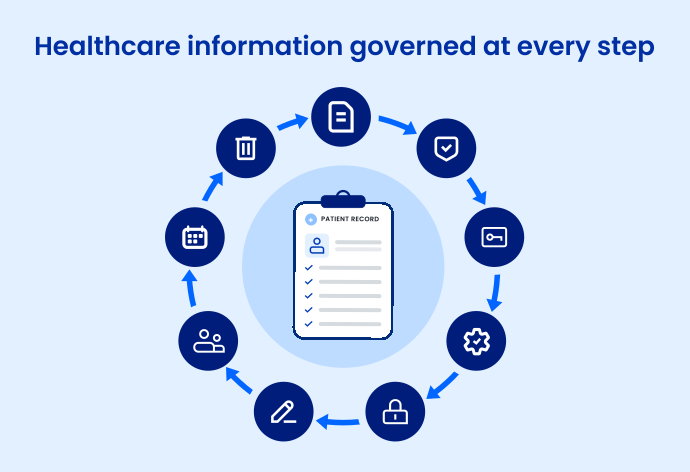
HIPAA data governance is an organizational framework for determining how healthcare information is collected, classified, accessed, maintained, protected, corrected, shared, retained, and disposed of in ways that support HIPAA requirements and organizational policies.
It establishes answers to questions such as:
- Who is responsible for particular healthcare data?
- Who should be allowed to access it?
- How should sensitive information be classified?
- How should data quality problems be identified and corrected?
- How are changes and access activity tracked?
- How long should information be retained?
- What happens when information moves between applications or outside organizations?
- Which vendors are permitted to handle PHI, and under what conditions?
HIPAA itself establishes requirements governing the privacy and security of protected health information. The HIPAA Security Rule, for example, requires regulated entities to use appropriate administrative, physical, and technical safeguards to protect the confidentiality, integrity, and availability of electronic protected health information (ePHI).
Healthcare data governance provides organizations with a business architecture that consistently applies those responsibilities across people, processes, systems, and data.
However, it’s important to note that governance, compliance, and data management are closely related but aren't interchangeable:
| Primary purpose | Example | |
|---|---|---|
| HIPAA compliance | Satisfy applicable HIPAA Privacy, Security, Breach Notification, and other regulatory requirements | Restricting ePHI access to authorized users and maintaining required safeguards |
| Data governance | Establish organizational accountability, policies, standards, ownership, and decision-making for data | Defining who owns patient demographic data and how quality issues are resolved |
| Data management | Carry out the operational and technical work required to store, maintain, integrate, and use data | Standardizing patient records or syncing information between healthcare systems |
Data governance provides the policies, ownership, and standards that guide both HIPAA compliance efforts and day-to-day data management. Policies establish expectations, while healthcare data management processes and technology help teams put those expectations into practice.
Strong governance also complements broader healthcare data security programs. Security asks whether information is adequately protected. Governance expands the discussion to include responsibility, appropriate access and use, quality, lifecycle management, consistency, and accountability.
For organizations evaluating their own obligations, Smarty also maintains HIPAA compliance documentation describing considerations for using our services in healthcare environments, along with articles on healthcare data governance best practices, enterprise healthcare data management, healthcare data security, and personally identifiable information (PII).
Why HIPAA data governance matters
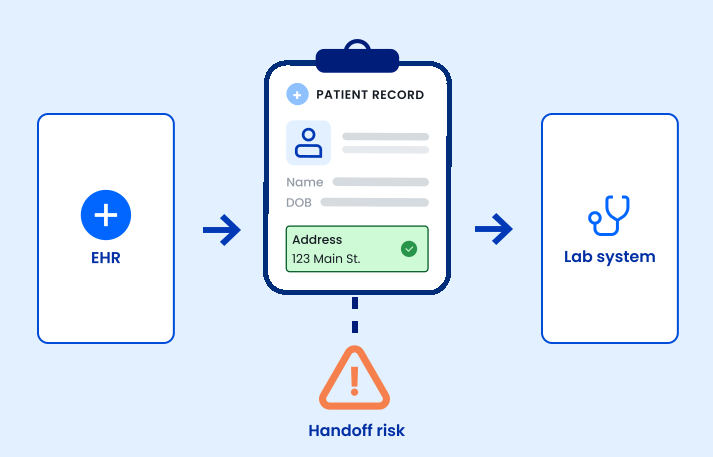
Healthcare information moves between EHRs, billing systems, laboratories, pharmacies, payers, patient portals, analytics platforms, and third-party vendors. Every handoff creates another opportunity for information to become inconsistent, outdated, improperly accessed, or difficult to use.
HIPAA data governance gives organizations consistent rules for managing those risks across systems and teams.
Strong governance can help organizations:
- Protect PHI: Establish appropriate access, use, sharing, and security controls.
- Support HIPAA compliance: Assign responsibility for privacy, security, documentation, monitoring, and risk management.
- Reduce operational risk: Identify inconsistent, unnecessary, outdated, or poorly controlled data before it creates larger problems.
- Improve healthcare data accuracy: Set standards for correcting incomplete, duplicate, or inaccurate information.
- Support interoperability: Make information easier to exchange and interpret consistently across systems and Qualified Health Information Networks (QHINs).
- Strengthen patient trust: Help ensure sensitive information is both protected and reliable.
Poor data quality can undermine many of these goals. For example, a patient record may be securely stored and appropriately accessed, but an incorrect address can still result in returned mail, mismatched and duplicate medical records, billing friction, or failed outreach.
That’s why healthcare provider data compliance, security, and healthcare data quality should be treated as connected parts of a broader governance strategy.
Core components of HIPAA data governance
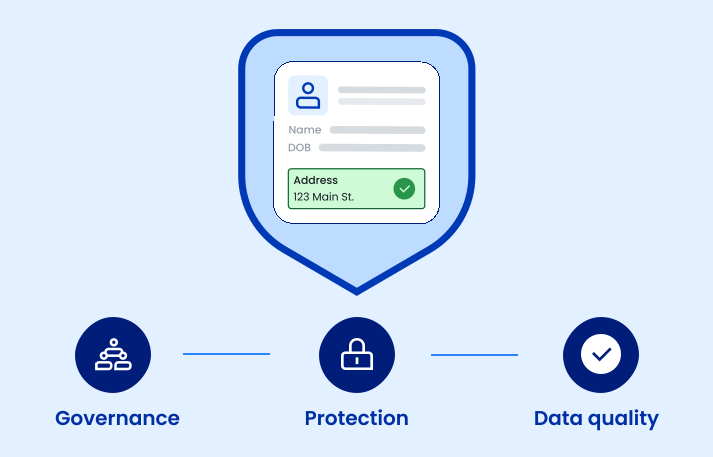
HIPAA data governance brings privacy, security, quality, lifecycle management, and accountability together under one umbrella.
| Component | What it governs |
|---|---|
| Data classification | Identifies PHI and other sensitive information so appropriate controls can be applied. |
| Access controls | Defines who can access ePHI and what authorized users can do with it. |
| Audit trails and controls | Tracks and reviews activity involving systems that contain or use ePHI. |
| Data lifecycle management | Governs information from collection and use through retention and disposal. |
| Data quality management | Establishes standards for accurate, complete, consistent, and usable data. |
| Vendor governance | Defines how third parties may access, use, protect, retain, and dispose of healthcare information. |
These components aren't isolated controls. Data classification helps determine which access and security requirements apply; access and audit controls govern how sensitive information is used; lifecycle policies establish how long information remains available; and data quality standards help maintain HIPAA data integrity as information moves between systems. Vendor governance extends those expectations to outside organizations that may create, receive, maintain, or transmit PHI.
Together, these governance components help you apply HIPAA’s administrative, physical, and technical safeguards consistently across people, systems, and workflows.
Data governance defines the responsibilities and standards, while those safeguards help protect ePHI from unauthorized access, improper disclosure, alteration, loss, and other risks throughout the data lifecycle. Data quality standards also help organizations maintain HIPAA data integrity throughout the creation, updating, exchange, and use of information.
Why healthcare data quality is part of HIPAA governance
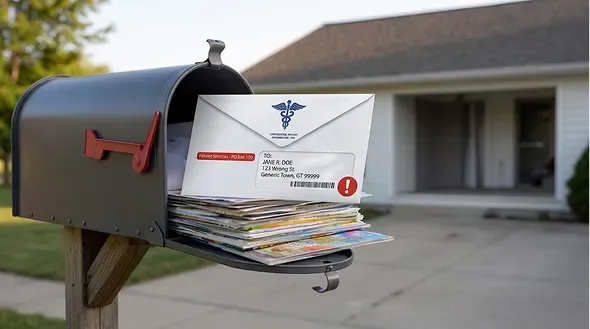
Data can be secure and still be wrong.
An incorrect patient address, an outdated provider location, a duplicate record, or an inconsistent demographic field can lead to misdirected PHI, failed outreach, billing errors, identity-matching issues, inaccurate directories, and unreliable reporting—even when access to that information is otherwise properly controlled.
Data quality issues also compound one another. Inconsistent patient demographics can make patient identity resolution more difficult, while duplicate records can leave different versions of the same address, contact information, or other attributes scattered across systems.
Provider data creates similar challenges when locations, affiliations, or directory information change. Data standardization gives organizations consistent formats for comparing and exchanging that information, while validation helps determine whether individual values are accurate and usable.
Governance standards can apply across demographic, administrative, provider, and clinical information, although the controls used to maintain clinical data quality may differ from those used for patient contact information.
The consequences can become more serious when inaccurate data causes PHI to reach the wrong person. An impermissible disclosure of unsecured PHI may trigger investigation and breach-notification obligations under HIPAA, including notification to affected individuals, Health and Human Services (HHS), and, in some cases, the media. Depending on the circumstances, HIPAA violations can also result in corrective-action requirements, settlements, or civil monetary penalties.
That gives healthcare organizations another reason to treat healthcare data quality as part of governance: protecting information means both controlling who can access a system and maintaining accurate data so sensitive information is less likely to be sent or associated with the wrong person.
The operational value of cleaner data is also reflected in this customer story on improving healthcare data quality, which shows how better address information, with Smarty-supported healthcare workflows for AIRA, improves.
How address verification supports HIPAA compliance
Address verification alone doesn’t make an organization HIPAA compliant. It's one practical data quality control that can support broader HIPAA data governance policies.
Here are some of the places it can help most:
| Use case | Potential benefit |
|---|---|
| Patient registration | Helps reduce incorrect or inconsistently formatted addresses before they are entered into an EHR. |
| Patient identity workflows | Provides standardized address information that can support record matching alongside other identifiers. |
| Mail containing PHI | Helps reduce mail sent to incorrect or undeliverable addresses. |
| EHR maintenance | Helps identify and standardize inaccurate or incomplete address records. |
| Provider directories | Supports more accurate provider and facility location information. |
| Billing and reimbursement | Reduces avoidable address-related corrections, returned statements, and correspondence problems. |
Patient address verification is especially effective when it occurs at the point of entry.
A simple registration workflow might look like this:
Patient begins entering an address
↓
US Address Autocomplete suggests possible verified, standardized addresses
↓
The patient selects the intended address
↓
Cleaner address data enters the EHR and downstream systems
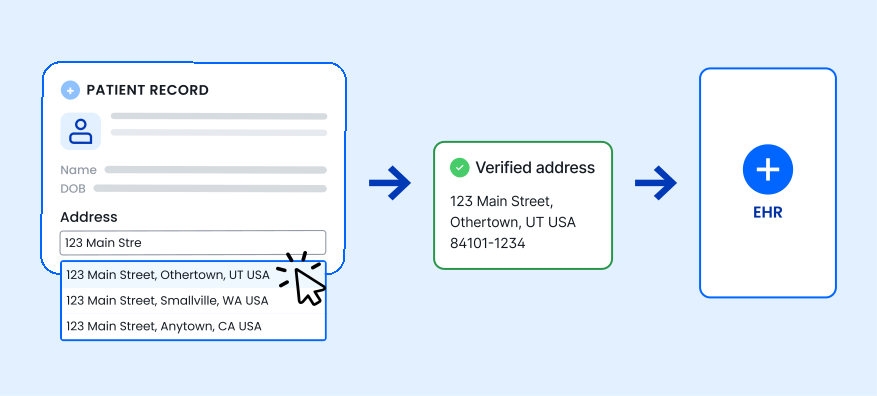
This approach helps organizations prevent common errors instead of relying entirely on cleanup later.
For existing databases, healthcare address validation and address cleansing can help clean up and standardize legacy information, and where it can’t, it can help identify patient records that require review.
These improvements can also support specific healthcare workflows, including patient registration, HIPAA-conscious mailing practices, and efforts to reduce medical billing address fraud.
HIPAA data governance best practices
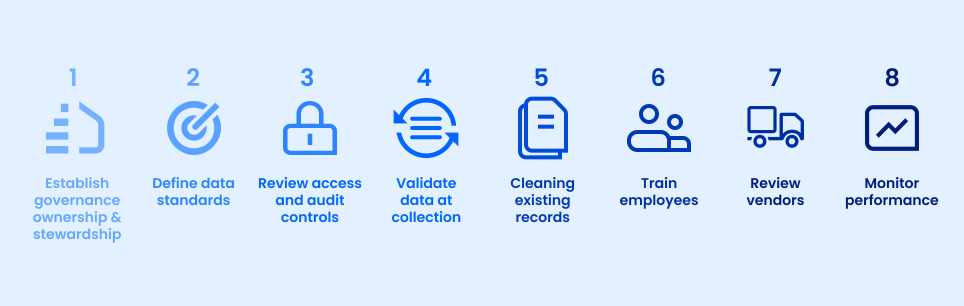
An effective HIPAA data governance program turns privacy, security, and data quality requirements into clear, repeatable, and measurable practices.
1. Establish governance ownership and data stewardship
Establish a governance committee or other accountable leadership structure to set priorities, resolve cross-functional data issues, and approve organization-wide standards. Assign data stewards to major data domains so that responsibility for healthcare data quality, access, definitions, and remediation is clear.
Data stewards can also define patient data quality standards and establish thresholds for when inaccurate or incomplete records require review.
2. Define data standards
Document how important information should be collected, classified, formatted, validated, stored, shared, retained, and corrected.
3. Review access and audit controls regularly
Ensure employees, applications, and vendors only have access appropriate to their roles and responsibilities. Regularly review permissions, remove unnecessary access based on role and business need, automate access changes or removal when an employee changes roles or leaves the organization, where appropriate, and use audit records to identify unusual or inappropriate activity involving ePHI.
4. Validate important data at collection
Preventing errors is generally easier than cleaning them up later. Use validation and structured data-entry controls where they can reduce avoidable mistakes.
For addresses, autocomplete and verification can improve data quality during and after registration.
5. Clean existing records
Historical data may not meet current standards (or be up to date with recent changes). Periodically identify inaccurate, outdated, incomplete, or inconsistently formatted information and correct it.
6. Train employees
Make sure staff understand applicable privacy and security requirements, data quality expectations, and how to report problems.
7. Review vendors carefully
Understand what data vendors receive, why they need it, how it is protected, how long it is retained, and which contractual requirements apply.
8. Monitor performance over time
Governance should evolve as systems, workflows, vendors, risks, and regulations change.
Useful governance KPIs may include:
- Address verification rates
- Returned mail rates
- Duplicate record rates
- Data correction volumes
- Access review completion
- Vendor review completion
- Policy exceptions
- Time to resolve quality issues
Organizations assessing the business value of cleaner healthcare data can also review the ROI of healthcare address validation.
Common HIPAA data governance challenges
Even a strong HIPAA data governance program must account for practical data, systems, and workflow issues. Some of the most common challenges include:
| Challenge | Why it matters | How to mitigate it |
|---|---|---|
| Inconsistent patient demographics | Names, addresses, phone numbers, and other fields may be entered or formatted differently across systems, locations, states, or counties. | Establish organization-wide formatting and validation standards, using automation where appropriate. |
| Duplicate or mismatched patient care records | Inconsistent information can make it harder to determine whether records belong to the same person, creating problems with identity matching and patient care coordination. | Standardize matching fields and use multiple appropriate identifiers to resolve patient identity. |
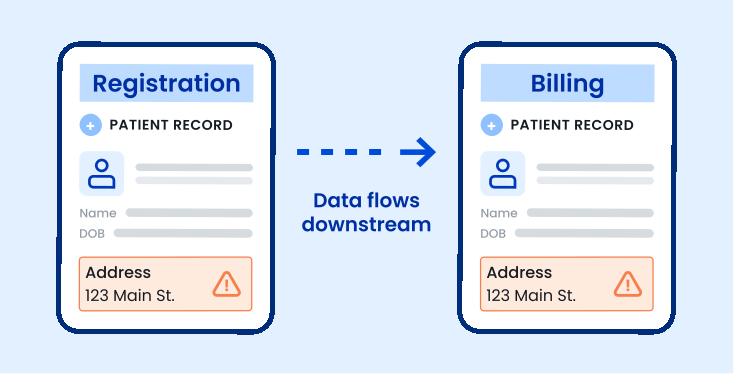
| Poor EHR data quality | Errors introduced during registration can spread into billing, communications, analytics, payer systems, and other downstream workflows. | Validate critical information as early as possible and establish processes to correct existing records. |
| Outdated provider information | Incorrect locations can affect provider directories, networks, patient access, and operational workflows. (See physician data management customer story.) | Regularly validate provider and facility data against reliable reference sources. |
| Unstandardized data | Different versions of the same information are harder to compare, exchange, and match across systems. | Define standardized formats and apply validation when information is collected or updated. |
| Legacy and siloed systems | Older EHRs and disconnected platforms may use different formats, definitions, or versions of the same data. | Define authoritative data sources and organization-wide standards that apply across systems. |
| Manual data entry | Typos, omissions, abbreviations, and inconsistent formatting can introduce errors at the point of collection. | Use structured fields, autocomplete, and automated validation where appropriate. |
| Vendor integrations | Data moving between third parties can create additional risks to privacy, security, quality, and consistency. | Establish vendor requirements for access, security, data handling, quality, retention, and applicable agreements. |
| Changing patient and provider data | Addresses, contact information, provider locations, affiliations, and other healthcare data can become outdated over time, reducing data accuracy and disrupting downstream workflows. | Revalidate high-value patient and provider information periodically, and establish processes to update records when changes are identified. |
| Changing regulatory requirements | HIPAA requirements, enforcement priorities, related state laws, and organizational obligations can evolve, making outdated governance policies a compliance risk. | Assign responsibility for monitoring applicable regulatory changes and regularly review governance policies, procedures, and controls to keep them current. |
Address data illustrates how several of these challenges overlap. A misspelled or inconsistently formatted address can create duplicate records, complicate patient identity resolution, disrupt communications, and spread across connected systems.
Address standardization and validation APIs help organizations create consistent records and identify information that requires correction seamlessly and in the background. They are set-it-and-forget-it solutions that keep your data accurate and consistent across the software and forms you already know and love. Teams evaluating where these problems originate can also review 13 address data mistakes in healthcare for a deeper dive.
These issues can also create privacy risks. If inaccurate patient information causes PHI to reach the wrong person, the organization may need to determine whether an impermissible disclosure or reportable breach occurred. That’s why healthcare data quality should be treated as an ongoing governance responsibility, not a one-time cleanup project.
Conclusion: Build HIPAA data governance on better data
Strong HIPAA data governance protects healthcare data by establishing who is responsible for it, who may access it, how it should be secured and maintained, how quality is monitored, and how risks are addressed throughout the data lifecycle.
Those protections are strongest when the underlying patient information is accurate, too.
The goal is not simply to protect information from unauthorized access. Organizations also need clear standards for who owns data, how it should be maintained, when it should be corrected, and how quality and risk are measured over time.
Address data is only one part of that strategy, but it touches patient registration, identity matching, communications, billing, analytics, and many other healthcare workflows.
Smarty's US Address Verification helps healthcare organizations validate, standardize, and correct address information, while US Address Autocomplete helps prevent common address-entry errors before they reach downstream systems.
Start a 42-day free trial of Smarty's US Address Verification to see how cleaner patient address data can strengthen your HIPAA data governance strategy.
HIPAA data governance FAQ
What is HIPAA data governance?
HIPAA data governance is the framework an organization uses to define responsibility, policies, standards, and controls for managing healthcare information in ways that support HIPAA requirements and business needs.
How is HIPAA data governance different from HIPAA compliance?
HIPAA compliance focuses on meeting applicable regulatory requirements. HIPAA data governance defines how an organization assigns ownership, establishes policies, manages data, and monitors those responsibilities over time.
Why is healthcare data quality essential for HIPAA compliance?
Accurate, consistent data helps authorized users work with reliable patient and provider information. Poor healthcare data quality can contribute to returned communications, duplicate records, identity matching problems, billing errors, and other operational issues.
How does address verification support HIPAA compliance?
Address verification can support HIPAA data governance by standardizing patient information, identifying inaccurate addresses, reducing address-related mailing problems, and helping organizations consistently enforce data quality standards.
It is one control within a broader HIPAA compliance program, not a substitute for one.
What are the core components of an effective healthcare data governance program?
Common components include data ownership, classification, access controls, audit controls, security, data quality management, lifecycle management, vendor governance, workforce responsibilities, and ongoing monitoring.
Was this helpful?