
Provider data accuracy: Provider location data and member experience



Part two of our provider data series featuring thought leadership from Dave Medlock, Founder & CEO of Maven One Health
If you’ve ever searched your health plan’s provider directory only to find your “nearby” doctor is actually a residential home—or worse, a PO Box—you’ve experienced firsthand why clean provider data matters for more than just compliance.
Provider data accuracy is also one of the most important aspects contributing to member experience.
In part one of this series, we explored how accurate provider location data fuels regulatory compliance.
Now, in part two, we’re diving into the member experience—how real-world address accuracy, smart use of metadata, and the rise of virtual care are reshaping how people find and access care.
We sat down again with Dave Medlock, Founder and CEO of Maven One Health, a company that works to boost provider data accuracy through data analysis and consulting, to understand how messy provider data erodes member trust and how payers can fix it.
The member experience starts with location
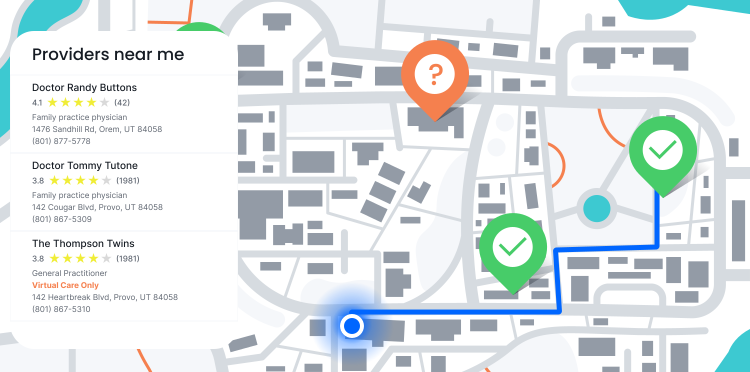
Members find care through health plan directories. Most intuitive and innovative directories utilize geocoding data to help members find doctors “near me,” complete with maps, pins, and distance calculations.
As Dave put it, “When someone searches for a provider, they’re really saying, ‘Help me get care that’s close, covered, and convenient.’ The address data powering that search drives everything about what that experience looks like.”
Without accurate geocoding, members get misleading results. A plan might list multiple in-network providers nearby, but if half (or more) of those addresses are invalid, residential, or commercial mail receiving agencies (CMRAs), the map doesn’t accurately reflect reality.
It’s more than frustrating; it’s unsafe. “You don’t want to send a member to a PO Box or a private home when they’re expecting a clinic,” Dave said. “It’s confusing and creates risk for both provider reputations and patient health.”
Virtual care complicates the map
The COVID-19 pandemic of 2020 shook the globe and changed society’s approach to healthcare in a major way. The explosion of telehealth and virtual behavioral health services became essential for providers and patients alike.
Confusingly, the immense growth we’ve seen in virtual care options has blurred the distinction between physical and virtual care locations.
Providers offering telehealth often list their home address or a CMRA as their official practice location during the credentialing process. While that’s fine for back-office records, it’s not a location members should be driving to. They can’t receive the care they need there.
Virtual care scenarios are where metadata shines.
Tools like Smarty’s US Address Verification API return metadata that flags addresses as residential, CMRA, PO Box, or PBSA (Post Office Box Street Address). With that information, directories can automatically suppress those addresses from public display or, better still, mark them clearly as “virtual care only.”
Dave explained: “You can still show the provider as available for care, but you need to show that it’s virtual. That small step reduces confusion and protects privacy.”
When data is wrong, everyone feels it
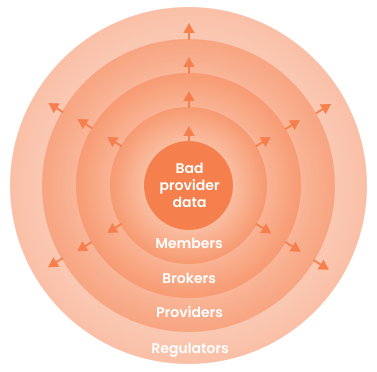
Bad provider data hurts member trust, and it even hits every stakeholder in the healthcare ecosystem.
- Members waste time showing up at the wrong location or virtual non-clinical locations.
- Brokers lose confidence in health plans whose directories mislead prospective members.
- Care coordinators and providers struggle to connect patients to the right care.
- Regulators notice—and fines can and often do follow. (See our first blog post about regulatory compliance.)
As Dave summed it up, there’s a capacity concern: “If your directory lists a dozen providers but only two are real, that limited access means longer waits. Urgent needs usually get squeezed in, but routine appointments—like physicals or follow-ups—end up delayed for months.”
Dave further pointed out that these routine care checks are necessary to keep people OUT of our emergency care system. They are the checks and balances that we need to catch underlying health concerns before they become life-threatening.
How over-reporting and claims data make things worse
It’s not uncommon to find one provider listed at 33 different locations in a directory. Why? Because claims and directory data often come from the same source.
“Health plans sometimes load every doctor at every clinic into their directory,” Dave said. “They’re trying to make claims processing easier, but that over-reporting ends up inflating your directory. It creates the illusion of access where none exists.”
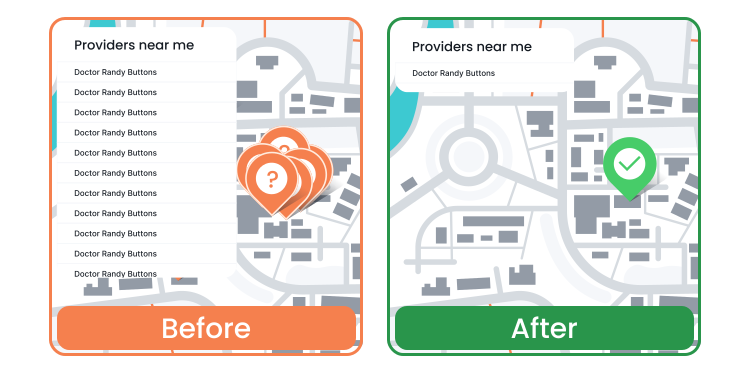
For example, think of clinics that have rotating physicians, such as CVS or Northwell Health. There might be upwards of 20 or even 30 locations where one provider may practice, but that doesn’t equate to 20 or 30 physicians. One practitioner can only help one person at one location at a time.
This happens because claims systems, which are designed for billing, often feed directly into public-facing directories without filtering out irrelevant or non-clinical sites (like surgery centers).
Dave explained that the fix lies in creating a clear separation between claims data and directory data, leaning into highly accurate address data and metadata fields to distinguish between valid healthcare locations where patients can potentially receive care and an average PO Box or CMRA.
Claims data should inform operations and not directories.
Directory information should come from a custom-curated list of verified providers and addresses. Directory data should be kept clean and clear to guide member care decisions.
Metadata’s importance in maintaining accurate directories
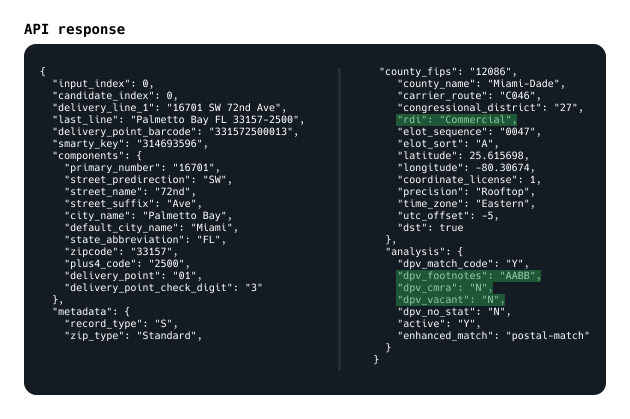
Smart directories use metadata to decide which addresses belong and which don’t.
For example, Smarty’s metadata can identify:
- dpv_cmra: Whether or not the address is a commercial mail receiving agency
- rdi: Whether it’s a residential or commercial address
- dpv_footnotes: Whether or not it’s a PO Box, including PBSAs
- dpv_vacant: Whether or not the address is vacant
When payers integrate this metadata into their workflows, they can automatically flag, suppress, or correct bad data without waiting for a member complaint or a compliance audit.
“You should be looking at your metadata for clues about what you should be doing with the data that you have,” Dave said. “It gives you the opportunity to say, this is what we have, and this is how we need to clean things up before they become problematic for our members.”
Both payers and providers can easily integrate address verification into their existing systems using Smarty’s APIs. Smarty’s address validation, autocomplete, and geocoding tools are designed for smooth implementation and fast, accurate results across healthcare workflows—from patient intake and provider onboarding to claims routing and member communications.
For organizations that don’t want to integrate an API but still need their existing address databases cleaned, standardized, and enriched, a healthcare directory–cleanup service—such as Maven One Health—can handle one-time or ongoing remediation. Think of it as choosing between adding a powerful module to your own system (Smarty) or calling in a specialized crew to deep-clean the data vaults for you.
Building trust through reliability

Every inaccurate directory listing erodes trust. Dave explained that after enough failed attempts to find an in-network provider, members ditch the healthcare platform altogether, opting instead to use Google Maps, calling providers directly to ask, “Do you take my insurance?”
Over time, that lack of trust affects enrollment, retention, and regulatory standing.
But there’s a better way: maintaining clean, validated, enriched, and geocoded data.
When payers combine address validation, metadata, and consistent updates, they don’t just avoid fines, but more importantly, they create a frictionless experience for members, brokers, and care teams alike.
“Accurate data builds confidence,” Dave said. “It means you can trust your map, your member experience, and your reputation.”
And the members are your most important stakeholders to appease.
The path forward: standards and automation
Fixing this problem at scale will require industry-wide collaboration. Dave sees parallels to what happened with HIPAA and claims standardization in the 2000s.
“Before HIPAA, everyone exchanged claims data differently,” he explained. “Once we standardized claims formats and protocols, accuracy and automation improved dramatically. We need the same thing for provider data.”
Until that day comes, health plans that are intuitive enough to invest in address validation, geocoding, and automated metadata analysis will stand out as leaders, offering members a smoother and more trustworthy experience both internally and externally.
Coming up next
This was part 2 of our 3-part series on provider location data.
In the final post, we’ll explore how accurate provider data improves claims processing and operational efficiency—and how technology like SmartyKey®, a persistent unique identifier (PUID) for addresses, facilitates the tracking of address changes over time.
Stay tuned. The future of clean provider data is already here, and it’s powered by validation, metadata, and automation.
Was this helpful?