



Know Your Customer (KYC) processes can be complicated, specific, and critical for organizational success and risk management, but they don’t have to be. Here’s a checklist that financial institutions (and other businesses using KYC) can use to quickly conduct identity verification and assess potential risks without missing a step. The key components to any KYC checklist are:
- Customer ID programs (CIP): Collecting customer information, verifying that information, and creating or updating a record containing the information.
- Customer Due Diligence (CDD): Understanding the nature of the business your customer is involved in, assessing risk associated with that business for your business, identifying additional involved parties or owners, and gathering any supporting documentation for higher-risk customers.
- Ongoing monitoring: Reviewing transactions, updating customer information, and reporting suspicious activity.
- Documentation and recordkeeping: Keeping all KYC processes maintained and tracked for easily accessible compliance and auditing purposes.
A strong Know Your Customer (KYC) program begins with a risk-based approach, where businesses adjust their level of due diligence based on each customer's assessed risk.
Technology and staying aligned with evolving regulations play pivotal roles in modern KYC. You can try some of our tools for free below, or continue reading to get a more detailed KYC checklist and understanding of how address intelligence tools can support KYC compliance for your organization.
This article will cover:
- Understanding the importance of KYC compliance
- Key components of KYC
- Best practices for KYC implementation
- Challenges in implementing KYC procedures
- Importance of customer trust in KYC
- Building a robust KYC framework
- FAQ
Understanding the importance of KYC compliance
Know Your Customer (KYC) is most often associated with banking, where it’s a legal requirement that ensures institutions can accurately identify customers and assess risk. In order to comply with KYC, banks must also comply with two cornerstone requirements: the Customer Identification Program (CIP) and Customer Due Diligence (CDD).
These measures help financial institutions detect and prevent crimes such as identity theft, money laundering, and fraud.
But KYC extends well beyond banking.
Fintech companies, for example, use KYC verification to protect digital payment platforms and peer-to-peer lending services from being exploited by fraudsters.
Insurance providers rely on KYC best practices to verify policyholders, prevent false claims, and comply with Anti Money Laundering (AML) obligations.
In real estate and property technology, KYC verification helps confirm buyer and seller identities, minimizing risks of money laundering through property transactions.
Even ecommerce and online marketplaces have adopted KYC best practices to reduce fraudulent accounts, improve user trust, and safeguard transactions.
Across all of these sectors, KYC best practices follow a risk-based approach—applying more scrutiny to high-risk customers while streamlining onboarding for low-risk ones.
This balance helps organizations meet regulatory standards and build stronger, more trustworthy customer relationships.
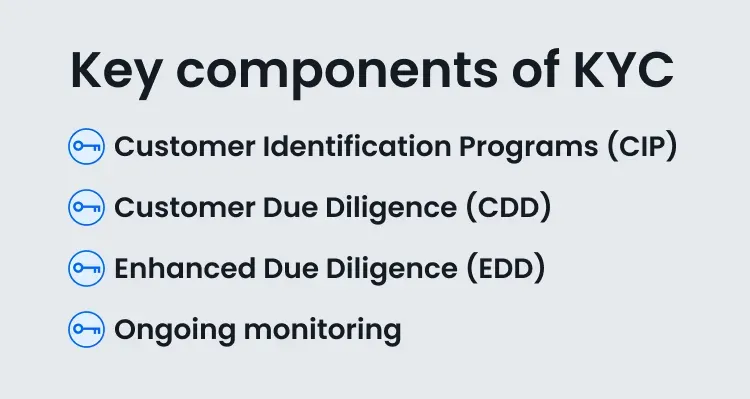
Key components of KYC
The key components of KYC boil down to the steps required for our KYC checklist above, but we can do a quick reminder here. KYC components are Customer Identification Programs (CIP), Customer Due Diligence (CDD), Enhanced Due Diligence (EDD), and ongoing monitoring. We’ll dig into these below.
Customer Identification Programs (CIP)
CIPs are the first step in KYC checklists and form the foundation of customer verification, helping financial institutions ensure customers are who they claim to be. Every bank, fintech, or business relying on CIP will require certain documents to help them with customer verification. In the U.S., this often includes Social Security Numbers (SSNs), along with documents like passports, driver’s licenses, or business licenses, to confirm a customer’s identity.
Here’s a common list of CIP documents you may need to ask customers to provide:
- A passport or driver’s license
- Certified articles of incorporation
- Government-issued business license
- Partnership agreement
- Trust instrument
- Financial references
- Information from a consumer reporting agency or public database
- A financial statement
A CIP is the front gate of KYC. It makes sure only legitimate customers get through while keeping fraudsters and criminals out. Without it, banks, insurers, fintechs, and even real estate firms would be leaving the door wide open to identity theft, money laundering, and regulatory penalties.
Customer Due Diligence (CDD)
The second step in our KYC checklist is Customer Due Diligence (CDD). While CIPs handle initial customer verification at onboarding, CDD is more focused on answering the question, “What level of risk does this customer pose, and how should we treat them going forward?” It’s more about assessing the customer’s risk profile and monitoring activity over time.
Things that assist with this process, which go beyond CIP documents, might include understanding:
- Occupation or business type
- Source of funds or wealth
- Nature and purpose of the account (why the customer needs it)
- Expected transaction patterns (volume, frequency, geography)
- Customer type (individual, business, PEP—politically exposed person)
- Geographic location (countries under sanctions or with high corruption risk raise red flags)
- Products/services being used (e.g., international wire transfers = higher risk than a basic savings account)
- Watchlist screening status
This collection of information helps to inform an ongoing monitoring process. Institutions must continuously monitor customer activity to spot unusual or suspicious behavior, like transactions that are inconsistent with the customer’s profile, sudden spikes in activity, or even transfers to or from high-risk jurisdictions.
Enhanced Due Diligence (EDD)
The third step in our KYC checklist is Enhanced Due Diligence (EDD), where if a customer’s regular due diligence process is showing red flags—like large international transactions, complex corporate structures, or connections to high-risk countries—your financial institution or business might need to dig much deeper into this customer’s profile.
The processes involved in EDD are:
- Beneficial ownership verification: Drill into corporate registries and company filings to identify individuals who ultimately own or control 25%+ of a business (threshold varies by jurisdiction). Also, confirm that declared beneficial owners match official records and are not fronting for others.
- Source of funds (SoF) analysis: Collect evidence on where the money comes from (e.g., salary slips, business revenue, sale of assets). Additionally, ensure that deposits, wire transfers, or investments align with the declared source of income, investigating sudden, unexplained inflows that don’t fit the customer’s profile.
- Source of wealth (SoW) verification: Go beyond individual transactions to determine how the customer acquired their overall wealth.
- Detailed transaction reviews: Conduct retrospective analysis of past activity, looking for structuring (breaking large sums into smaller deposits), rapid fund movement, or round-tripping (money leaving and re-entering accounts to look “clean”). Support this endeavor by applying AI/AML monitoring tools to flag suspicious transaction patterns and uncover potential financial crime.
- Enhanced customer interaction: Request additional documentation directly from the customer, such as contracts, invoices, tax records, or proof of business operations. This step strengthens identity verification and validates legitimacy through “know your business” (KYB) assessments.
- Heightened screening: Check against expanded watchlists, PEP databases, adverse media, and sanctions screening tools more frequently than for standard customers, including ongoing negative news monitoring (not just at onboarding).
- Senior management approval: Accounts that require EDD often need sign-off from senior compliance officers or even board-level committees before they can be onboarded or maintained.
Ongoing monitoring
A core requirement of CDD, ongoing monitoring keeps bad actors at bay and your financial institutions, banks, retail locations, etc., safe from undue risk. Ongoing monitoring is required, but a whole other level of ongoing monitoring is necessary for your EDD clients.
Instead of periodic reviews (e.g., once every 1–3 years for low/medium risk customers), EDD customers may be reviewed quarterly or even monthly with far stricter alert thresholds. This is essentially the continuation and reinforcement of EDD measures over the lifetime of a customer relationship. Make sure that ongoing monitoring is included in your KYC checklist, and maybe weave it into your calendar for those higher-risk profiles.

Best practices for KYC implementation
There are countless best practices you can use to strengthen your KYC verification implementation strategy. We’ve already discussed ongoing monitoring, but you should also take steps to mitigate KYC fraud, adopt technology and automation that reduces manual effort, keep pace with ever-evolving regulatory compliance directives, and still prioritize your customer experience. It can feel frustrating not to know where to start.
Leveraging technology and automation
Manual KYC checks are often slow, error-prone, and frustrating for both compliance teams and customers. Automation removes much of that friction by verifying documents, cross-checking watchlists, and monitoring transactions in real time.
Advanced tools like AI and machine learning can quickly detect unusual behavior patterns that humans might miss, reducing the chance of fraud slipping through the cracks. Facial recognition and liveness detection add another layer of protection by ensuring that identity documents match the real person behind them, lowering the risk of impersonation or stolen credentials. Document verification is also faster and more reliable with automation, using optical character recognition (OCR) and biometrics to confirm authenticity.
When these processes are automated through intuitive APIs, they become not only faster but also more accurate. APIs connect KYC checks across systems, eliminating redundant data entry and ensuring information flows seamlessly. The result is a stronger identity verification process, reduced human error, and improved compliance outcomes—plus faster onboarding, fewer errors, and more confident risk assessments.
Balancing customer experience and compliance
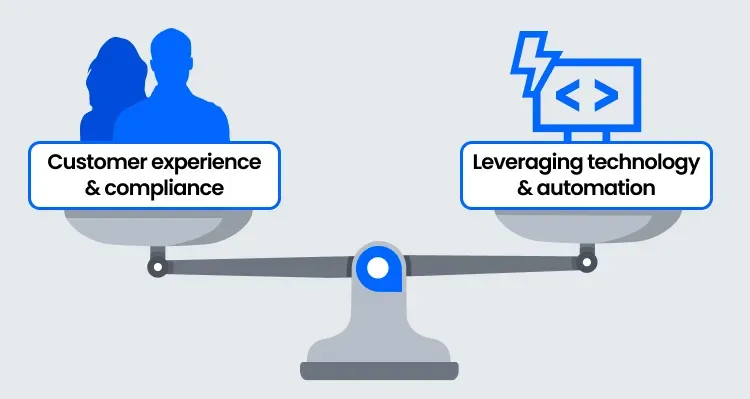
For many businesses, the hardest part of KYC is finding the sweet spot between rigorous compliance requirements and a smooth customer journey, manual checks and balances, and automated fraud prevention. Customers expect fast, digital-first onboarding, but regulators expect airtight customer verification. If one side is prioritized too heavily, either compliance gaps or customer churn will follow.
How Smarty helps with both
When it comes to KYC, addresses play a bigger role than most people realize. Fraudsters often rely on fake, outdated, or mismatched addresses to slip through onboarding, commit identity theft, or launder money. That’s why address intelligence is at the heart of a strong KYC program. Software tools in these categories can help simplify verifying, validating, and enriching address data at scale:
- Address verification tools confirm that customer-provided addresses are real, deliverable, and properly formatted; they catch typos, fake entries, and outdated addresses before they become part of your database.
- Address autocomplete tools reduce onboarding friction by suggesting valid addresses as customers type. This increases address accuracy and improves the user experience while lowering the chances of form abandonment or invalid/incomplete data.
- Geocoding tools translate customer addresses into precise latitude/longitude coordinates to validate location accuracy. They also help to detect inconsistencies when an address doesn’t match the actual physical location and thereby also strengthen fraud detection.
Property data tools enrich KYC checks with additional context, such as property type, occupancy, and ownership details. This helps your teams spot anomalies, like someone claiming residency at a vacant lot or a commercial property. It also adds another layer of due diligence, especially for high-risk or high-value accounts.
Challenges in implementing KYC procedures
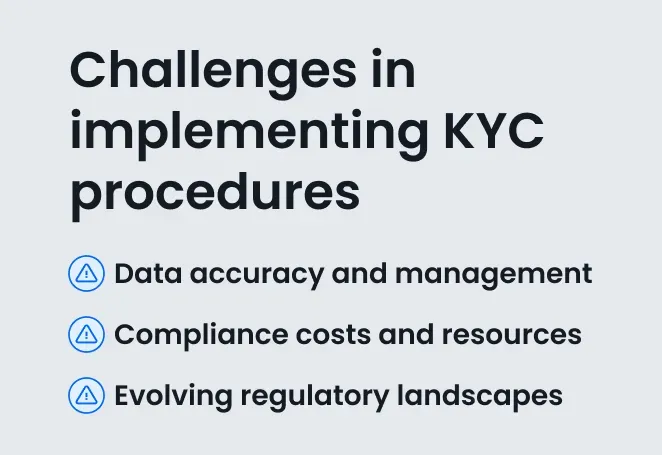
You might encounter several roadblocks when implementing your KYC procedures or making a tweak to your existing processes. Smarty is here to help you side-step those pitfalls before you get there. Let’s talk about the 3 most common mistakes your organization can avoid making: bad data accuracy, high compliance costs, and not keeping up with the times (legally speaking).
Data accuracy and management
Fragmented data sources, human error in data entry, constantly changing customer information, global variations in data formats, fraudulent or synthetic data, compliance audit pressures, and scalability issues.
How is any organization supposed to know how to navigate this?
All of these are common messes found in any database where aggregate or human-entered data is stored. If you start with bad data, you’ll end up making poor decisions based on that data, and your KYC compliance will suffer.
Investing in reliable address data solutions can help you side-step this pitfall:
- With address verification, you can ensure every customer record starts clean, standardized, and deliverable.
- Autocomplete eliminates typos and formatting errors at the point of entry, stopping bad data before it ever lands in your system.
- Geocoding validates exactly where on a parcel the address actually exists in the real world.
- Property data enrichment gives you a deeper context to confirm whether customer claims line up with reality.
Together, these tools transform messy, error-prone records into accurate, reliable data you can trust—making your KYC compliance stronger, smarter, and far less stressful.
Compliance costs and resources
One of the steps on your KYC checklist that can’t be ignored is KYC compliance, and sadly, that often isn’t cheap. Between staff training, manual reviews, regulatory reporting, and technology investments, costs can skyrocket quickly—especially if your processes are inefficient.
Many organizations overspend because they’re still relying on manual verification, redundant systems, or outdated methods that eat up time and resources. You don’t have to!
Address intelligence tools help cut those costs by automating address verification at scale. By reducing the need for manual reviews, catching errors before they become compliance issues, and speeding up onboarding, you’re able to free up your compliance teams so they can focus on higher-value investigations.
Less wasted time means fewer wasted dollars, turning compliance from a budget drain into a streamlined operation.
Evolving regulatory landscapes
If there’s one constant in KYC and AML, it’s change. Laws, standards, and enforcement expectations shift regularly. Whether it’s new FATF recommendations, updates from FinCEN, or region-specific requirements like GDPR, the landscape is constantly moving. Falling behind can be inconvenient, but it also means potential fines, sanctions, and reputational damage.
Smarty can’t rewrite the laws for you (sorry, we left our superhero cape at home), but we can make sure your customer data is accurate, standardized, and audit-ready at all times.
Clean, enriched address data reduces the risk of non-compliance by making it easier to demonstrate due diligence during audits.
And since Smarty’s solutions scale globally, you’ll have the flexibility to keep pace with international standards as your compliance needs evolve.

Importance of customer trust in KYC
Customer trust in KYC is important for everyone involved. It is what builds your brand’s reputation with your customers and anyone else they might refer to you. A few areas where customer trust can be established and strengthened are having a transparent and efficient onboarding process and safeguarding personal information.
Transparent and efficient onboarding
Transparency is one of the fastest ways to build trust during KYC onboarding, and it naturally makes the process more efficient, too. Instead of leaving customers guessing, set clear expectations up front: outline what steps are involved, what documents may be required, and how long verification typically takes.
As customers move through the pipeline, provide updates on their progress and flag any roadblocks right away. For example, if income verification is going to take longer than expected, share both the reason and a revised timeline. Customers are far more patient when they understand what’s happening and why.
Transparency also streamlines operations. When you proactively inform customers about where they are in the checklist, they’re less likely to flood your support lines or inbox with “status update” requests. The result is a smoother process for both sides—a win-win that builds trust while freeing up your team to focus on what matters most.
Safeguarding personal information
Transparency also goes hand in hand with safeguarding personal information. Customers are far more willing to share sensitive data if they know what it’s for, how it’s protected, and what’s happening with it. Customers want to know that when they hand over their ID, income documents, or address, it’s being collected for a clear purpose and stored securely.
This proactive communication helps safeguard personal information in two ways:
- Fewer unnecessary touchpoints – When customers know where they stand, they’re less likely to resend the same documents multiple times or ask for status updates over unsecured channels like email. It helps your organization know that you aren’t inadvertently putting your customers at risk because they know when and where to send sensitive information.
- Increased trust in data handling – Explaining why you need certain information and how it’s protected reinforces confidence that their sensitive data won’t be misused. Customers see that you value both their time and their privacy, which strengthens trust and reduces friction in your KYC process.
Building a robust KYC framework
At the end of the day, “Know Your Customer” is about protecting your organization, your clientele, and the financial system at large. A robust framework balances regulatory demands with customer experience while staying adaptable to evolving risks and shifting regulations.
The strongest KYC programs are built on three pillars: integrating automation tools, conducting risk assessments, and continuous employee training.
Automation reduces human error, speeds up verification, and helps compliance teams focus on high-value work.
Risk assessments ensure you apply the right level of scrutiny to the right customers, keeping resources efficient and fraudsters out.
Continuous employee training fosters a culture of compliance and ensures your staff knows how to respond to emerging threats, regulatory changes, and customer needs.
When you combine these best practices with reliable data management—powered by Smarty’s address verification, autocomplete, geocoding, and property data tools, of course—you create a KYC checklist that strengthens identity verification, remains compliant, and is transparent, efficient, and trusted.
KYC will always be a moving target, but with the right framework in place, your organization can stay ahead of regulations, safeguard customer trust, and scale with confidence.
Ready to see how Smarty can strengthen your KYC program?
Start verifying, standardizing, and enriching your customer data today for faster, smarter, and more compliant KYC processes than ever.

KYC FAQ
What is a KYC checklist?
A KYC checklist is a structured guide that organizations use to ensure all steps of identity verification and due diligence are completed consistently. It helps verify customer identities, assess risk levels, and monitor ongoing activity, reducing exposure to financial crimes like money laundering, fraud, and identity theft while keeping the organization compliant with regulatory requirements.
What are the 6 KYC documents?
The exact list may vary by country or institution, but six commonly accepted KYC documents used for identity verification and compliance are:
- Passport – government-issued photo ID, often preferred for international verification.
- Driver’s license – a widely accepted form of photo identification.
- National ID card – official identity card issued by a government authority.
- Utility bill – used as proof of address (e.g., electricity, water, or gas bill).
- Bank statement – another proof of address and financial legitimacy.
- Government-issued business license or tax document – for companies and organizations verifying legal operations.
What are the 5 steps of KYC?
Based on what we discussed above, the 5 steps of KYC can be boiled down to these:
- Customer Identification Program (CIP) – Collecting and verifying customer information to confirm they’re who they claim to be.
- Customer Due Diligence (CDD) – Assessing the customer’s risk profile, including occupation, source of funds, and expected account activity.
- Enhanced Due Diligence (EDD) – Applying deeper scrutiny for higher-risk customers, such as verifying beneficial ownership, sources of wealth, and conducting detailed transaction reviews.
- Ongoing monitoring – Continuously reviewing transactions, updating customer information, and flagging unusual or suspicious activity.
- Documentation and recordkeeping – Maintaining accurate, accessible records of all KYC checks and updates to support compliance and audits.
What is a KYC list?
A KYC list is a reference of customers, entities, or documents that organizations use to support identity verification and compliance checks. It can include lists of accepted identification documents, high-risk individuals (such as politically exposed persons), or sanctioned entities. KYC lists help businesses ensure they are verifying identities properly, screening against regulatory databases, and reducing exposure to money laundering, fraud, or other financial crimes.
Was this helpful?