
What you need to know about cities



Understanding cities seems simple until you try to validate an address.
Most people think of a city as a place on a map with boundaries, a local government, and maybe a fierce rivalry with the town next door. They aren't wrong.
But in address validation, “city” can mean something a little different.
Sometimes it means the default city assigned to a ZIP Code. Sometimes it means an alternate city name that USPS recognizes. Sometimes it means a neighborhood, a census-designated place, or a local name people use even though it isn’t technically a city.
That distinction matters because address validation isn’t just about confirming whether a city exists. It's about understanding which city names are acceptable, which ones are returned, and how those values affect the standardized address.
This blog focuses specifically on cities and their role in address validation. When we mean something broader, like municipal boundaries or local governments, we’ll call that out.
Today, we’ll cover these different types of “cities”:
- Default cities
- Alternate cities
- Override (preferred) cities
- Non-mailable (underride) cities
- Neighborhood names
- Census-designated places
- Why this matters for address validation
Default cities

When validating an address, every ZIP Code has a default city associated with it. This is the city that will be returned with a validated address when no city is provided in the input.
But here’s the important part: the default city does not necessarily mean the address is physically located within that city’s boundaries.
The default city is simply the default city value for that ZIP Code. In rural areas, it is often the city where the post office is located or the largest community served by that ZIP Code. So if one ZIP Code covers several towns, communities, or unincorporated areas, addresses across that ZIP Code may all share the same default city.
1 ZIP Code = 1 default city
For example, ZIP Code 84651 includes addresses in both Payson and Elk Ridge, Utah. The default city for 84651 is Payson.
So even though Elk Ridge is a distinct city, and would probably prefer not to be treated as Payson, the default city for addresses in that ZIP Code is still Payson.
There are exceptions, which we’ll cover below.
Alternate cities

A single default city is not always enough.
As we saw above, ZIP Code 84651 includes more than one community, but only one default city. That‘s where “alternate” cities come in.
Alternate cities are other city names associated with a ZIP Code. These may include incorporated cities, neighborhoods, census-designated places, abbreviations, local names, or other recognized place names.
1 ZIP Code = many alternate cities, though some ZIP Codes may have none
For ZIP Code 82301, the default city is Rawlins. Alternate city names for this ZIP Code include Creston, Fort Steele, Muddy Gap, and Riner.
For addresses in 82301:
- If you enter Rawlins, the validated address returns Rawlins.
- If you leave the city blank, the validated address returns Rawlins (see Default cities).
- If you enter Creston or any other alternate city, the validated address will return that alternate city.
- If you enter an unrelated city, like New York, the validated address returns the default city, Rawlins.
In other words, alternate cities give address validation tools more flexibility. They allow users to enter a city name that’s locally meaningful while still matching the address to the correct deliverable location.
Override (preferred) cities

Sometimes the default city is not the city that should be returned. This is a fairly rare exception, but one worth mentioning.
In certain cases, an alternate city is preferred for specific addresses. When that happens, the alternate city overrides the default city and is returned, regardless of which city was entered.
For ZIP Code 80504, possible city names include:
- Longmont (the default city)
- Frederick
- Firestone
- Mead
- Niwot
For some addresses in this ZIP Code, the alternate city is the only appropriate returned value.
For example:
4816 Eagle Blvd, Frederick, CO 80504
For this address:
- If the city is left blank, Frederick is returned.
- If Longmont is entered, Frederick is returned.
- If Firestone is entered, Frederick is returned.
At Smarty, we refer to these as override cities because they override the default city and any other alternate city for that specific address.
Non-mailable (underride) cities

Non-mailable cities work in the opposite direction.
Some alternate city names can help identify or match an address, but they’re not returned as the standardized city name.
Formally, these are called non-mailable cities.
However, at Smarty, we sometimes refer to them as underride cities because they can help with matching, but they don’t override the returned city value.
Using 84651 again, the city values include:
- Payson, the default city
- Elk Ridge, an alternate city
- Spring Lake, a non-mailable city
If someone enters Spring Lake, any address validation process may still use that information to help find the correct address. However, Spring Lake won’t be returned as the city in the standardized and validated address. Instead, the returned city will still be Payson.
That distinction is important. A city name can be useful for matching, even if it isn’t valid as the final standardized mailing city.
Neighborhood names
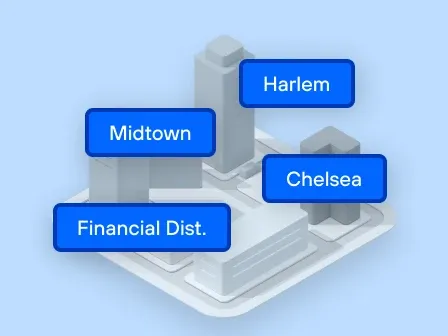
Some alternate cities are not cities at all.
They may be neighborhood names, local areas, or commonly used place names that people recognize and use in everyday life. Hell’s Kitchen in New York is a good example of this.
These names may be matchable and, in some cases, returnable, but they don’t necessarily represent formal municipal boundaries. They’re useful because people use them, not because they’re always official cities.
For address validation, that matters. A good validation tool needs to understand how people actually enter addresses, not just how addresses appear in a government boundary file.
Census-designated places
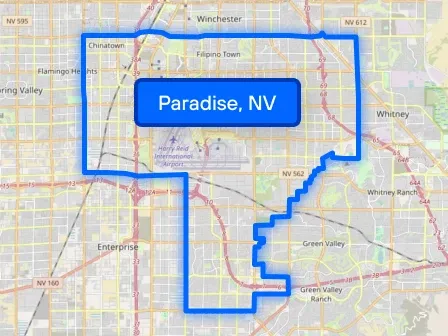
Some alternate city names refer to census-designated places, or CDPs.
A census-designated place is a named area used for statistical purposes, but it isn’t an incorporated city. It may feel like a city, look like a city, and appear in address data, but it does not have the same legal status as a municipality.
One famous example is Paradise, Nevada, a census-designated place and unincorporated town that includes much of the Las Vegas Strip. Many people think of that area as Las Vegas, and the mailing city is typically Las Vegas, but Paradise itself is not an incorporated city. It’s a CDP.
For address validation, census-designated places can still matter because they reflect real place names people recognize and use. But they should not be confused with city governments or municipal boundaries.
Why this matters for address validation
City names are not as straightforward as they look.
A single ZIP Code can have one default city, multiple alternate cities, non-mailable city names, neighborhood names, census-designated places, and address-specific overrides.
Some names can be used to match an address, but not returned.
Others may be returned only for certain addresses.
And some city names may describe how people talk about a place rather than where a municipal boundary begins or ends.
That’s why address validation needs more than a simple “does this city exist?” check.
Smarty’s address validation tools are built to understand these relationships and address intricacies so that you don’t have to. A great data provider should enable you to match, standardize, and return addresses in the correct regional format.
Whether a user enters the default city, a recognized alternate city, a neighborhood name, or a city that should not be returned at all (such as a CDP), Smarty helps turn messy real-world input into clean, usable address data so you and your team can focus on what you do best.
Try Smarty’s US Address Validation or International Address Validation tools live on our site or in our 42-day trial to see our city-validating magic in action.
Was this helpful?