
Ambiguous address matches: What they are and why compliance teams should care



If you’ve ever run into an address that seems to exist in more than one place, congratulations—you’ve discovered the world of ambiguous address matches. They’re the Schrödinger’s cat of location data: valid, yet potentially two distinct locations.
This blog will focus on a few key things:
- What are ambiguous address matches?
- Why ambiguous address matches matter for compliance and customer service
- How to handle matches with address ambiguity
- Why you should inform your customers of ambiguous address matches
- Our final thoughts on ambiguous address matches
What are ambiguous address matches?
An ambiguous address match occurs when an entered address resolves to two or more valid locations with slight but meaningful differences. (A match occurs when our tools find a valid address in an authoritative dataset that matches the one a user entered). These matched addresses aren’t aliases (like “Main St” vs “Main Street”)—they’re entirely separate delivery points on different parts of the map.
Take a few of these real-world examples:
Type “1 Rosedale, Baltimore, Maryland” into Smarty’s US Address Verification tool without a ZIP Code. You’ll see two legitimate results appear:
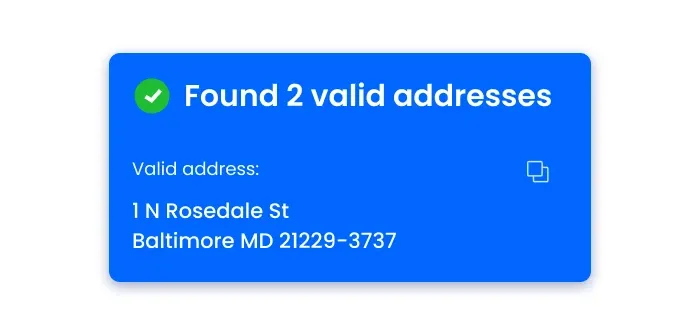
You can toggle between each result by clicking on the address drop-down menu, and as you toggle through, your raw output will change depending on which address you’re looking at:
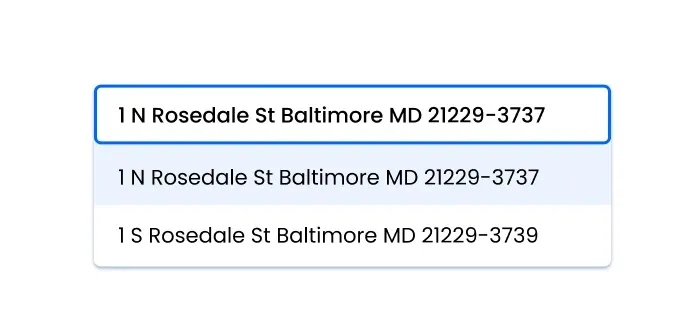
The two valid address matches that appear are:
- 1 N Rosedale, Baltimore, MD
- 1 S Rosedale, Baltimore, MD
Both are mailable locations.
But, unless your system is configured to handle multiple address candidates, you’ll only see one—and it might not be the one you actually need.
Another example works if you type in “1 Rocky Irvine, CA”. You’ll see 3 results populate using Smarty’s tools:
- 1 Rocky Glen
- 1 Rocky Knoll
- 1 Rocky Ridge
All of these are in Irvine, California.
Additional examples you could test are:
- 100 Peachtree, Atlanta, GA (3 results will populate).
- 81 Peachtree, Atlanta, GA (5 results will populate).
- 100 Park, New York, NY (Multiple results will populate).
And don’t even get us started on PO Boxes!
How many addresses do you think start with 'PO Box 1', 'PO Box 10', or 'PO Box 123' in metropolitan areas like New York (20,004), Seattle (5,285), or Massachusetts (6,149)?
That’s address ambiguity in action.
If you're only accepting the first address match, you might be using the wrong one. Without a way to know which address you’re looking for, this can be hazardous in terms of compliance and maintaining a sparkling customer experience.
Why ambiguous address matches matter for compliance and customer service
In regulated industries like fintech, healthcare, education, and insurance, sending documents to the wrong address is equally embarrassing and a compliance violation. Every industry that deals with personally identifiable information (PII) depends on accurate delivery:
- Fintech: Know-your-customer (KYC) and fraud prevention rely on precise address data.
- Healthcare: Misrouted records containing personal health information (PHI) or billing statements can violate HIPAA and result in steep fines per incident.
- Insurance: Policies and claims must be directed to the correct insured party.
- Education: Transcripts and student data need to land securely.
Address disambiguation is crucial.
For customer experiences, a delayed package or mailpiece (think of ecommerce purchases for birthdays or holidays, insurance statements, or college degree documents, etc.) due to address ambiguities is a poor experience. The customer isn’t going to blame themselves for not entering the entire address before sending; they’ll blame your organization for the mistake.
Yet, most companies using address validation tools aren’t even aware that ambiguous address matches exist in their datasets, and even after gaining awareness, aren’t sure of what to do about it.
That’s because many address autocomplete and verification APIs default to returning only one match (often candidates=1).
When you bump your candidates setting up to 10—the maximum for Smarty’s API—we’ll show every valid possibility. (PSST. This won’t work in the demo tool, only on our 42-day free trial or using a paid Smarty account.) That visibility enables address clarity, allowing your users (whether internal or external) to confirm the correct destination before sensitive information or expensive gifts end up in the wrong mailbox.
How to handle matches with address ambiguity
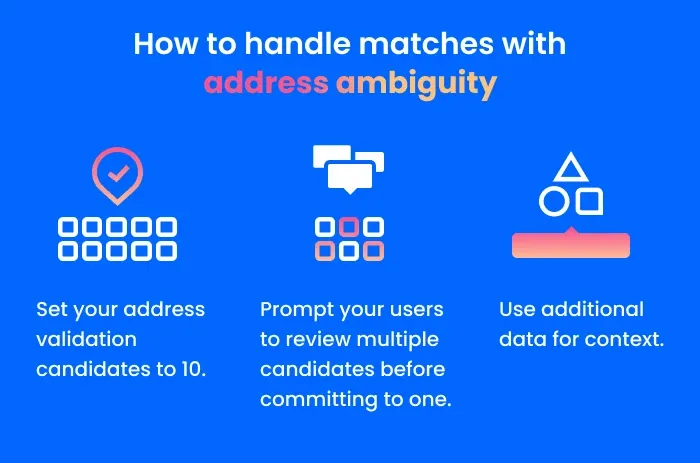
The fix is simple:
- Set your address validation candidates to 10.
This tells the API to return up to 10 valid variations of an address. (If there are only 3, that’s all your user will see.) - Prompt your users to review multiple candidates before committing to one.
Especially if your industry requires verified delivery or deals in time-sensitive announcements or materials. - Use additional data for context.
Combine address verification or autocomplete capabilities with metadata like rooftop-accurate geocodes, property type, or USPS Residential Delivery Indicator (RDI) to confirm that they (and essentially you) have the correct location.
For example, if a user enters “1 Rosedale,” your system can prompt:
“Did you mean 1 North Rosedale or 1 South Rosedale?”
That’s address disambiguation done right—and it prevents a world of compliance pain and customer distrust later.
Why you should inform your customers of ambiguous address matches
It shouldn’t be only on your end user’s shoulders to untangle address ambiguity.
They are very likely unaware that an ambiguous address match is commonly confused with their address.
Especially if this is the first time you’re learning about it, you can assume they have never heard of it before.
Whether they’re applying for a loan, signing up for telehealth, or receiving a shipment, it’s your responsibility to show your customers that an ambiguous address match exists, let them choose the one they intended, and let Smarty validate and confirm the correct destination behind the scenes.
When it comes to security and risk management, you should take the reins in informing your customer that ambiguous address matches exist, and THEN hand the reins to the customer to let them pick the right option.
Smarty is here to support you by making sure that the address is standardized and validated, as well as to make that process as streamlined, automated, and the most accurate that it can be.
Our final thoughts on ambiguous address matches
Ambiguous address matches are silent, unintentional troublemakers hiding in your data. But once you know how to spot and handle address ambiguity, they’re easy to manage.
Set your parameters up correctly (candidates=10), prompt your customer to review all possible matches, and use address disambiguation to keep your deliveries—and your compliance—airtight, and to build a lasting trust with your customers.
Want to see if ambiguous address matches are lurking in your system?
Run your data through Smarty’s US Address Validation API and discover what you’ve been missing.
Was this helpful?