


In the US, voter registration typically requires citizens to provide a residential address. Residential addresses help governments verify voter eligibility, assign voters to the right jurisdiction, and determine which ballot voters should receive.
Governments need to verify that voters’ addresses exist. Beyond that, they also need to confirm that those addresses are complete, residential, and reflect where the voter actually lives.
That process starts with address verification, which checks an address against an authoritative database. If an address matches one in the database, it’s considered verified.
However, verification alone doesn’t confirm a voter’s address is eligible for registration.
That’s where address metadata comes into play.
Address metadata is additional information returned alongside verified addresses. With Smarty's US Address Verification, you’ll receive up to 55 fields of metadata describing the delivery information, location, and geography associated with an address.
Many of these metadata fields can help governments quickly determine whether an address is residential, complete, and verified, and then better catch noncompliant addresses before they lead to voter registration fraud.
In this post, we’ll explain which metadata fields are most relevant to governments looking to tackle voter registration fraud head-on. Feel free to jump straight to our summary table, or keep reading for a full breakdown of each metadata field.
Confirming residential addresses
When a non-residential address is used as a voter’s residential address, a voter may appear eligible to vote in a jurisdiction they don’t actually live in, enabling bad actors to commit voter fraud.
With address metadata, governments can better determine whether the address a voter provides is residential, so non-residential addresses can be flagged for further investigation.
Here are the most relevant metadata points to analyze in Smarty’s US Address Verification outputs.
CMRA
A Commercial Mail Receiving Agency (CMRA) is a private company, like UPS or FedEx, that offers mailbox rental services to businesses and individuals. After a business or individual rents a mailbox, their CMRA will receive their mail and deliver it to their private mailbox.
Addresses associated with CMRAs will never be home addresses, so they shouldn’t be used to register to vote. They can be included in a registration form as a mailing address, but only as an addition to a voter’s home address.
However, CMRA addresses can appear to be secondary addresses—addresses that include an apartment, building, suite, or other sub-unit number.
Take the address 3214 N University Ave #409, Provo, UT 84604-4405, for example. Without address verification, this address may appear to be a valid apartment address, but with verification, it could be quickly flagged as associated with a CMRA. That way, a government would catch the CMRA address before it was used to register a voter or commit voter fraud.
Smarty's US Address Verification returns verified addresses with a positive, negative, or blank value for the dpv_cmra field. So you can quickly identify addresses that shouldn’t be used to register voters, this field indicates whether the address is:
- Associated with a CMRA
- Not associated with a CMRA
- Pending CMRA verification
Record type
Like CMRA addresses, PO Box addresses aren’t residential and shouldn’t be used to register to vote.
Governments can flag PO Box addresses before they’re used to register voters with the record_type field. This field indicates that the address is one of six record types:
- Firm: the most accurate record type available
- General delivery: a record associated with a local post office
- High-rise: a record containing apartments or other sub-units
- PO box: a record associated with a PO Box
- Rural route or highway contract: a record for a mailbox or a range of mailboxes in a rural area
- Street: a record for a valid primary number range
Sure, PO Box addresses are easy to spot when they start with “PO Box,” but some PO Box addresses include a post office’s address followed by a PO Box number, making them look like a street address. We call these addresses PO Box Street Addresses.
Manually reviewing every voter registration form for PO Box or PO Box Street Addresses is unrealistic at scale for governments. With the record_type field, governments can automatically flag PO Box addresses and prevent their use in voter registration.
Building default indicator
The building_default_indicator field can also help governments flag addresses that aren’t residential.
Here’s how it works.
Let’s say you verify the address 1600 Pennsylvania Ave SE, Washington, DC 20003-3228. The record_type field shows that the address is associated with apartments or other sub-units.
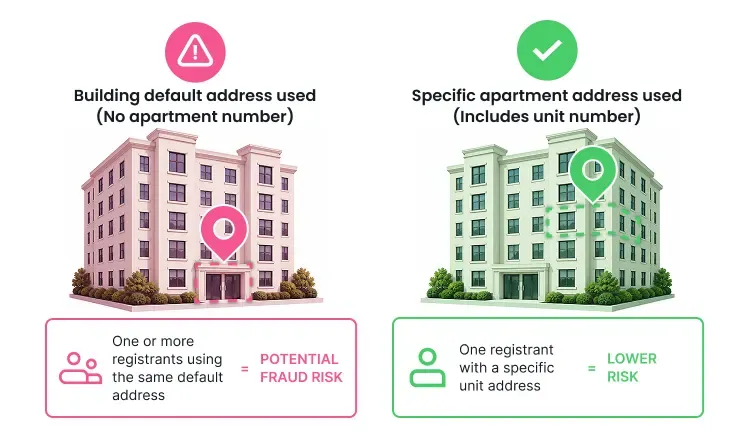
Additionally, the building_default_indicator field indicates that the verified address is the building’s default address—the main delivery location for a multi-unit building. In this case, the default address is the main lobby of an apartment building.
That could be a red flag for voter fraud.
Typically, residents don’t live in an apartment building's lobby. If multiple registrants use the same default address and don't provide specific apartment numbers, it’s worth investigating. After all, not everyone in the building can live in the lobby.
Vacant & EWS match
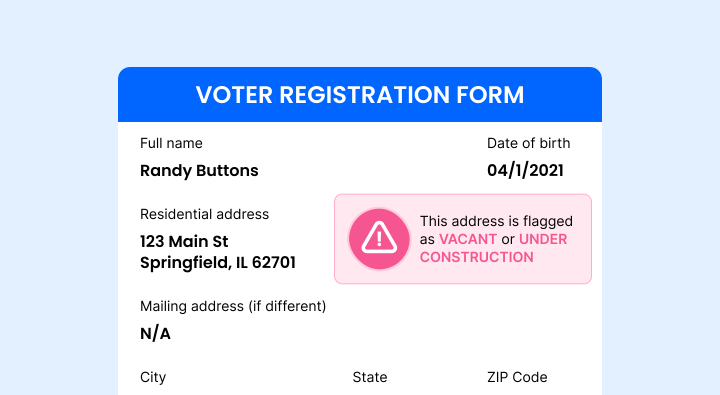
Similarly, governments can utilize the dpv_vacant field to identify suspicious addresses. The dpv_vacant field indicates whether a delivery point was active in the past but is currently vacant, meaning it has been unoccupied for at least 90 days. Because no one lives at a vacant address, it can indicate fraud when used to register voters.
Addresses for new residential construction are also considered vacant until the USPS begins delivering to them.
The ews_match field indicates whether addresses were flagged by the USPS early warning system (EWS). EWS indicates that the address isn’t ready for mail delivery, but will be in the coming months or weeks.
Generally, the USPS is ready to deliver to new homes before residents move in. If the USPS doesn't deliver to an address yet, chances are no one lives there.
When these addresses are used to register voters, it can indicate fraud. A fraudulent voter registrant could look for unfinished residential construction sites and register to vote under those addresses.
Identifying partially matched addresses
Just because an address is verified and residential doesn’t mean it couldn’t be fraudulent. This is especially the case for secondary addresses.
In some cases, address verification may indicate a possible match if the provided secondary information is removed. In others, a primary address is verified but still missing secondary information that would make it even more accurate. These cases are known as partial matches.
When a verified address includes altered or missing secondary information, it could allow a voter to register with a residential address that isn’t actually their residence, leading to voter fraud.
Governments can use address metadata to catch partially matched addresses and make corrections before they become problems downstream. Let’s break it down.
DPV match code
Delivery Point Validation (DPV) is the process of verifying that an address is deliverable. As part of that process, DPV match codes indicate whether an address is present in the USPS database.
When an address is verified, the dpv_match_code field returns one of 4 responses that provide additional context:
- Y: The entire address is present in the USPS database.
- S: The address is present in the USPS database, but the submitted secondary information wasn’t recognized.
- D: The address is present in the USPS data, but it’s missing secondary information.
- N: The address isn’t present in the USPS database.
At first glance, an “N” DPV match code may seem like a strong fraud signal. However, addresses that aren’t in the USPS database aren’t necessarily fraudulent. They could be non-USPS addresses.
Non-USPS addresses aren’t recognized as deliverable by the USPS, but are valid addresses that FedEx, DHL, UPS, and other delivery services deliver to. When non-USPS addresses are both valid and residential, they are eligible for voter registration.
There are 20 million legitimate, non-USPS addresses, so it’s important to select a provider with an extensive address database that includes all of them. Otherwise, you could end up spending a lot of unnecessary time manually reviewing non-USPS addresses.
For fraud detection, “S” and “D” DPV match codes are more useful.
For example, a registrant could provide the address:
62 Ea Darden Dr Apt 1000000, Anniston, AL 36201-2119
While the address verifies at the primary address level, the “S” dpv_match_code shows that secondary information was ignored to verify the address. That means the USPS database doesn’t recognize the address when it includes apartment number 1000000.
Another registrant could use the address:
75 Canal St, San Rafael, CA 94901
This address also verifies at the primary level, but this time the “D” dpv_match_code shows that it's missing secondary information. That means the USPS database recognizes a version of the address that includes secondary information.
In both cases, the voter would register under the address of an entire multi-unit building rather than a residential address for a unit within that building. To prevent that potential voter fraud, governments can use “S” and “D” DPV match codes as red flags for manual investigation.
DPV footnotes
DPV footnotes help you better understand why an address passed or failed delivery point validation. The dpv_footnotes field returns a wide range of responses, but when it comes to voter registration, the “U1” footnote is especially important.
The “U1” footnote means that an address has a unique ZIP Code.
Unique ZIP Codes are given to large organizations or institutions that have their own internal mail delivery system, such as college campuses, major corporations, and government buildings.
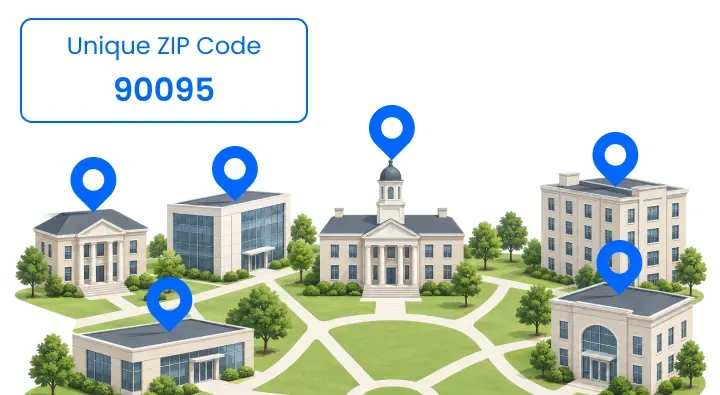
Since those organizations are large enough to handle their own mail distribution, delivery services will always deliver to the organization’s mail unit, rather than a geographic location specified by a street address.
That means an address will still verify even if any components before the city, state, and ZIP Code are fabricated. When an input address ends with a unique ZIP Code, it’ll always be returned as valid, even if that address is 1 Gajillion Bogus Avenue, I’m a Fraudster Hahaha, Schenectady, NY 12345.
To prevent those synthetic addresses from slipping through the cracks, governments can flag and review verified addresses that return with the “U1” footnote.
Checking alias locations
Alias locations are two or more active addresses that refer to the same location or delivery point. Alias locations are typically created when:
- A building has two main entrances on the same street
- A building next to an intersection has entrances on both streets
- A building is on a street that has multiple active names (e.g., 7th Ave being called Fashion Ave in New York)
- A building is on a street that’s renamed (e.g., 1230 N becomes Martin Luther King Blvd)
To prevent alias locations from being used to unfairly game the voter registration system, governments can use the Smartykey, footnotes, and LACSLink indicators metadata fields.
Footnotes
Like DPV match codes, the footnotes field explains how an address was changed during verification.
For governments, Z# footnotes are especially useful because they flag when an address has been matched with ZIPMove, a USPS product that tracks retired ZIP Codes. ZIPMove ensures that deliveries sent to addresses with outdated ZIP Codes are automatically rerouted to their corresponding updated addresses.
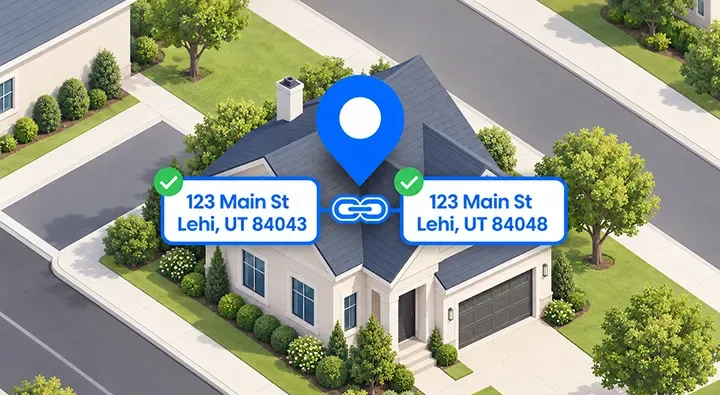
However, that means both versions of the address are active. When used to register voters, these alias addresses could appear to refer to completely different residences, even though they refer to alias locations.
A Z# footnote gives governments the context they need to catch and correct addresses that use outdated ZIP Codes before an alias location becomes voter fraud.
LACSLink indicator
Addresses can also change over time.
In fact, many rural addresses have been reformatted in order to help emergency response teams locate people in need. To keep these changes, the USPS created LACSLink®, which identifies these rural addresses and matches them to their updated versions.
For instance, when submitted, the rural address, RR 1 Box 194, San Augustine, TX 75972, is flagged by the lacslink_indicator field as present in the LACSLink database, then matched to its updated address, 2744 FM 1279, San Augustine, TX 75972-3619.
These addresses are alias locations, meaning they both refer to the same valid delivery point for a single address. The LACSLink indicator alerts governments to aliases that warrant further investigation.
SmartyKey®
The easiest way to identify alias locations is to use SmartyKey, a unique, 10-digit code assigned to every USPS and non-USPS address in Smarty’s database. These codes, known as persistent, unique identifiers (PUIDs), stay constant regardless of how many times address components change.
All valid alias locations share the same SmartyKey. Even if an address has changed 30 times, the most recent version will have the same SmartyKey as all of its historical versions. That makes it easy to flag alias locations that fraudsters may use to obtain duplicate ballots.
Summary table
If you skipped ahead to this section, don’t worry. The table below breaks down what each metadata field returns and how those results can be used to combat voter fraud.
| Metadata field | Description | Use case |
|---|---|---|
| CMRA | Flags Commercial Mail Receiving Agency addresses | Flags potentially fraudulent addresses to prevent voters from entering non-residential addresses during online registration |
| Record type | Flags PO Box addresses | |
| Building default indicator | Flags default addresses (ex. the lobby of an apartment building) | |
| Vacant | Marks an address as unoccupied for the last 90 days | |
| EWS match | Flags an address as not yet ready for mail delivery | |
| DPV match code | Notes that an address was confirmed only by omitting or adding secondary information | Stops voters from providing partially matched addresses during online registration by flagging potentially fraudulent addresses |
| DPV footnotes | Flags addresses with unique ZIP Codes | |
| Footnotes | Identifies alias locations created when ZIP Codes are updated | Tracks alias locations so a single delivery point isn’t used to register multiple voters |
| LACSLink indicator | Identifies alias locations created when rural addresses are updated | |
| SmartyKey | Identifies all alias locations associated with a USPS or non-USPS address |
Conclusion
Governments can use address metadata to determine whether a registrant’s address is truly residential, complete, and valid. To access those metadata fields and take the first step towards catching voter fraud, governments can implement Smarty’s US Address Verification and Autocomplete.
When configured in a voter registration form, US Address Autocomplete suggests real addresses as citizens type, speeding up form fill and reducing address errors from the start.
If a citizen bypasses autocomplete or edits the address they selected from the dropdown, US Address Verification will either let you know that their entry won’t verify or confirm that the address is valid and formatted to meet USPS guidelines.
After verification, up to 55 metadata points are attached to each address. Using those metadata fields, governments can easily flag addresses that are non-residential, partially matched, or alias locations to help teams weed out voter registration fraud during address entry, rather than down the line.
Discover how Smarty can help you clean up your voter registration data by starting a 42-day free trial or contacting an address expert.
FAQ
Yes! Addresses that return with a J# footnote contain dual addresses. For example, verifying the address 119 S 1 N 30th St, Philadelphia, PA 19104 would return two separate addresses, 119 S 30th St, Philadelphia, PA 19104-5001 and 1 N 30th St, Philadelphia, PA 19104. The original, fabricated address could indicate fraud, so a J# footnote could prompt further investigation.
Absolutely! Everything from delivering tax bills to reporting utility outages runs more smoothly when governments rely on accurate address data. To learn how governments can utilize address verification, autocomplete, geocoding, and enrichment, check out our comprehensive guide.
Was this helpful?