


Is there any preference between a street address and a PO Box?
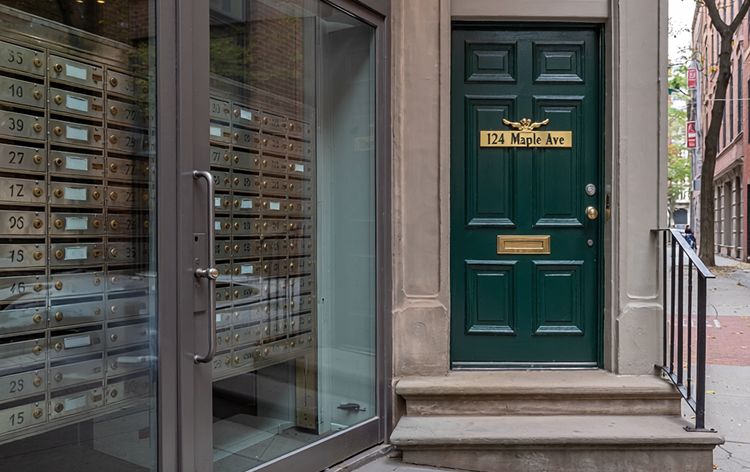
From a financial standpoint, the USPS prefers to deliver mail to a PO Box. A letter delivered to a PO Box costs the USPS less because they don't have to transport it to a street address. They just deposit it in the PO Box at the same post office where the letter is sorted.
So, if you provide a valid street address AND a valid PO Box and ask them to choose, they'll almost always go with the PO Box. (Want to verify an address with the USPS?)
But what if YOU want to decide which one the post office delivers to?
In this article, we'll share three hacks that show you:
- How to get the post office to deliver something to your physical address instead of your PO Box
- How to get the post office to deliver something to your PO Box instead of your physical address
- How to get UPS and FedEx to deliver a package to your PO Box
How to get the USPS to deliver to a physical address instead of a PO Box
What do you do if you want the USPS to deliver to your preferred PO Box or physical address? There are a few "tricks" you should know to determine whether a piece of mail will go to the PO Box or to the physical location.
Let's look at some addresses and see how to direct the USPS to deliver to a PO Box vs a street address, and vice versa.
345 Airport Rd
PO Box 1242
Malta, MT 59538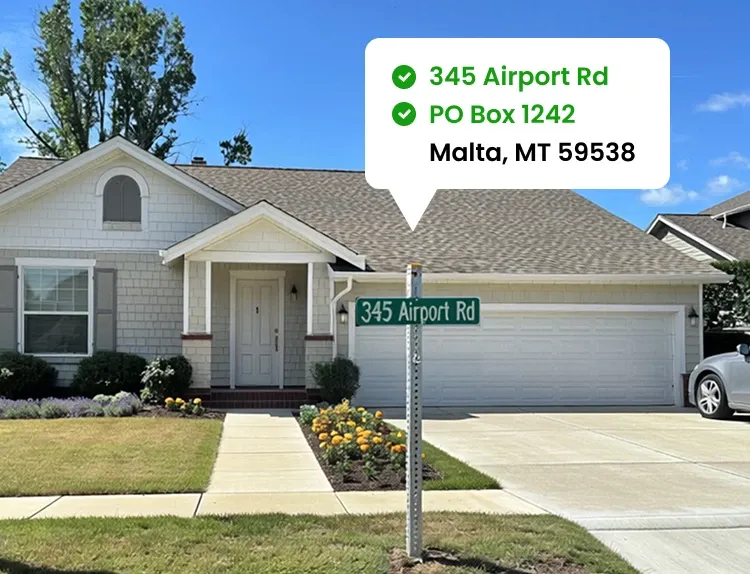
This address is valid in both the first and second address lines. Since both are valid, and the physical address is listed first, the letter will be delivered to the physical address. (Disagree because Pub. 28 says otherwise? Take a look at our reasoning.)
How to get the post office to deliver something to your PO Box instead of your physical address
To get the post office to deliver the same letter to your PO Box, simply swap the two address lines and put the PO Box address first.
PO Box 1242
345 Airport Rd
Malta, MT 59538
Since both address lines still contain valid addresses, by listing the PO Box first, you're telling the post office to deliver the letter to your PO Box.
Having already established that the post office does have a slight preference, let's see what happens if the two addresses are combined on the same line:
345 Airport Rd PO Box 1242
Malta, MT 59538
or
PO Box 1242 345 Airport Rd
Malta, MT 59538
When these addresses are normalized to USPS standards, they are both converted to:
PO Box 1242
345 Airport Rd
Malta, MT 59538
Preference is given to the PO Box address, with the other address listed on address line 2.
Thus, if you prefer a street address over a PO Box, put the preferred address on the first line and the "backup" address on the second line. (More detail)
Let's look at one more example.
PO Box 1844
16346 E. Graham Circle
Palmer, AK 99645
16346 E. Graham Circle
PO Box 1844
Palmer, AK 99645The two address lines are swapped. However, the Graham Circle address isn’t valid according to the USPS. Thus, the first address is valid and the second one isn’t. The USPS treats address line 2 as just "extra information," information that’s helpful to the person actually delivering the mail but not to the system that’s routing and processing it.
However, if Address Line 1 and Address Line 2 were combined:
PO Box 1844 16346 E. Graham Circle
Palmer, AK 99645or
16346 E. Graham Circle
PO Box 1844
Palmer, AK 99645It will always return:
PO Box 1844
16346 E Graham Circle
Palmer, AK 99645
Notice that the Graham Circle address is on the second line. Even though that isn’t a valid USPS address, it may still be valuable data, so our address verification API system doesn't discard it. It just relegates it to address line 2, where the "extra data" lives.
How to get UPS and FedEx to deliver a package to your PO Box
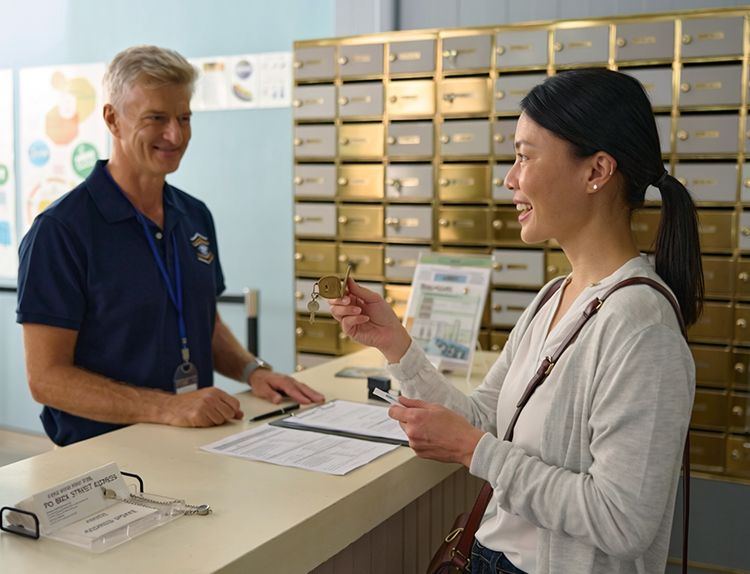
However, some retailers won’t ship to PO Box addresses, since UPS and FedEx deliver only to physical street addresses. So what does a PO Box owner do if they want something shipped to their PO Box and not their physical address?
PO Box owners can get retailers and shipping companies to send packages to their PO Box, by using a slightly different format. The format is called a PO Box Street Address.
What Is a PO Box Street Address?
The format of the PO Box Street Address (PBSA) is simply the post office's street address, plus the PO Box number. For example, if your post office is located at
222 Main St
Atlanta GA 30301
and your PO Box number is 99, your PBSA would be
222 Main St #99
Atlanta GA 30301
When a PBSA address is processed using CASS-Certified address-matching software (like the kind we have at Smarty), the PBSA address is standardized using the word "Unit" instead of the # sign, like this:
222 Main St Unit 99
Atlanta GA 30301
If you have a PBSA, both Street Addressed mail and PO Box addressed mail can be delivered to your PO Box. When large items are shipped to your PO Box, they are stored in a back room of the post office, and a postal worker puts a slip of paper in your PO Box.
How do I set up a PO Box street address?
PO Box holders who want to use the PBSA option will need to visit their local post office and complete a customer agreement outlining the allowable uses of the PBSA.
Things to know when using a PBSA
It's important to note that if you use a PBSA-style address, and then close your PO Box, you must submit change-of-address forms for both the PO Box format and the PBSA format. And, both forms should show the same forwarding address.
To determine whether a given address is a PBSA address, submit it to our US Street Address API and check the output. Look in the dpv_footnotes for footnote PB, which means "Confirmed as a PO Box street style address."
Another place to check the output is the carrier route. PBSA addresses always use the carrier route C770 through C779.
Important: Not all “PO Box signals” mean what you think
At this point, it’s tempting to assume that certain USPS metadata fields can reliably tell you whether an address is a PO Box. This is one of the most common misunderstandings we see—and it leads to making many bad assumptions in production systems.
Here’s the reality:
zip_type
This describes the ZIP Code as a whole—not the specific address.
In Smarty’s metadata, a zip_type of “P” means the ZIP Code is designated for PO Box delivery, but that doesn’t mean every address in that ZIP Code is a PO Box.
Non-postal addresses (USPS won’t deliver there) and R7 addresses (confirmed as valid but not receiving USPS deliveries) can still exist there.
carrier_route
This is primarily for USPS internal routing. While routes starting with “B” are often associated with PO Boxes, this alone isn’t technically reliable.
For example, PBSA addresses (PO Box Street Addresses) use carrier routes between C770–C779, even though they look like street addresses.
dpv_footnotes
DPV footnotes are designed to describe delivery validation results—not to classify address types. While they include useful signals (like identifying PBSA addresses), they’re incomplete on their own. That’s why we recommend using them alongside record_type for reliable PO Box detection.
If you need to determine definitively whether an address is a PO Box (including edge cases like PBSA), the recommended approach is to use a combination of fields:
An address should be considered a PO Box if:
dpv_footnotescontains:P1,P3, orPB
ORrecord_typeequals:P
Here’s why this works:
- record_type = "P" identifies the vast majority of standard PO Boxes
- dpv_footnotes helps catch:
- Invalid PO Box inputs
AND - PBSA addresses (
PB), which are PO Boxes disguised as street addresses
- Invalid PO Box inputs
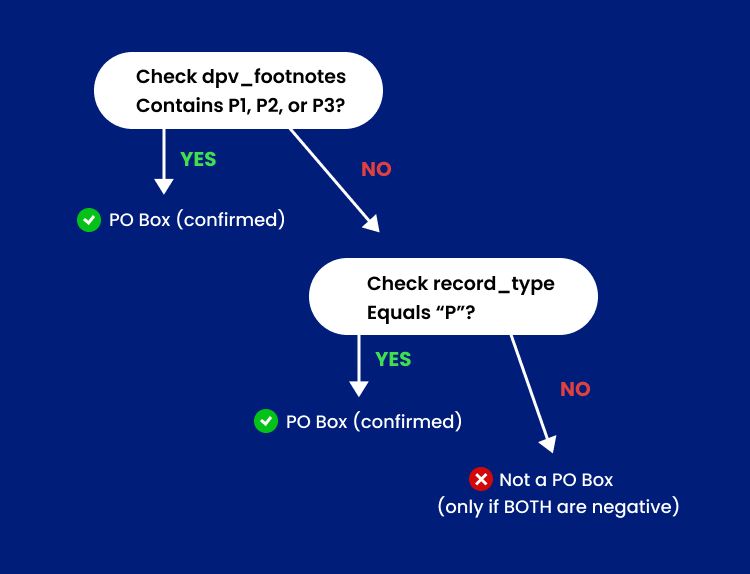
To be perfectly clear: these fields can each provide helpful clues about whether an address may be a PO Box. But if your business logic depends on knowing with confidence if the submitted address is NOT a PO BOX, the most reliable approach is to evaluate DPV footnotes and record type together.
*The key takeaway is that these fields are meant to definitively identify PO Boxes, but not declassify them on their own. If either one returns a PO Box indicator, no additional investigation is needed—you can safely classify the address as a PO Box. To confidently rule out a PO Box, though, both the DPV footnotes and the record type must return a negative PO Box result.
Summary
In this article, we shared three hacks with you to help you master using a PO Box.
If you have a PO Box and a street address, you can decide which one the USPS will deliver your mail to, simply by putting your preferred delivery location on the first address line. Sounds so simple. And, it really is.
We also clued you in on how to get FedEx and UPS to deliver a package to your PO Box. The secret is in using a PBSA.
And just as importantly, you now know that not all USPS metadata signals mean what people think they mean. If you need to reliably identify PO Boxes (especially the sneaky ones), you need the right combination of signals instead of just one.
So now you know. And knowing is half the battle.
(Admit it, you just said 'G.I. Joe' to yourself, didn't you?)
Was this helpful?