
How paid subscriptions work
A paid subscription is valid for a set period of time or number of lookups, whichever comes first.
If you exceed your subscription limit (monthly or yearly, depending on your plan), we charge your card for a new block of address lookups and renew your subscription starting on the current date. We do this to ensure the service is always available to you.
For example, suppose that on December 1, you set up a monthly subscription for 50,000 lookups. Normally, your subscription would auto-renew after December 31. But, because your website is so wildly popular for holiday sales, you use all 50,000 lookups by December 10—well before the subscription renewal date. We automatically renew your subscription at the same level on that day. This new subscription is valid for one month from the new date.
Free subscriptions must be renewed each month manually from the account subscriptions page. If you would like an automatically renewing subscription, simply sign up for any of our paid plans.
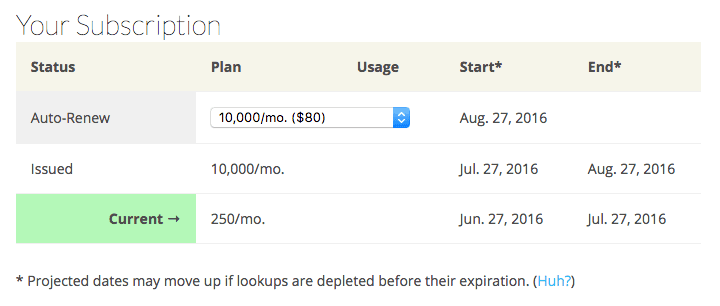
Subscriptions renew periodically or when you run out, whichever comes first.
Please be aware that if a subscription is depleted more than three times within 24 hours, further auto-renewals will be disabled. For example, if you purchase a 500-lookup-per-month plan and, within 24 hours, you use more than 2,000 lookups, the subscription will not auto-renew; it’ll be disabled, and any downstream systems that depend on an active subscription will be impacted. This helps to protect against "runaway" subscriptions. Bottom line: choose a larger plan if you think you might need it.
We automatically send an email when you have 10% of the lookups remaining on your account. This allows you to track usage before your subscription renews and decide whether to upgrade or keep your current subscription.
You can change your subscription at any time by logging into your account and updating your subscription information. The changes won’t take effect until the current billing cycle ends or the lookups already purchased are depleted.
Was this helpful?