


P&C insurance digital transformation

P&C insurance digital transformation involves modernizing workflows with better data, automation/AI, cloud-native technology, and digital experiences, replacing manual insurance processes and checks. The goal is to streamline core operations, reduce costs, and deliver faster, more personalized, and more accurate service through analytics, digital channels, IoT/telematics, and partnerships with insurtechs.
1. Technologies driving P&C insurance digital transformation
- Artificial intelligence (AI), machine learning (ML), and advanced data analytics: underwriting accuracy, fraud detection, pricing optimization, FNOL automation, and intelligent servicing
- IoT and telematics: usage-based insurance, real-time monitoring, dynamic pricing, and proactive risk mitigation
- Cloud and API ecosystems: scalable infrastructure, faster deployment, and seamless integration with insurtech and data partners
- No-code/low-code tools: rapid workflow automation and accelerated application development
2. Core areas of impact in the P&C insurance industry
- Customer experience: digital quotes, self-service portals, and proactive communication
- Underwriting and risk assessment: data enrichment, geospatial intelligence, and automated triage
- Claims processing: structured FNOL, straight-through processing, and fraud analytics
- Operational efficiency: reduced rework, fewer workflow interruptions, and improved expense ratios
Smarty’s APIs provide address validation, rooftop-level geocoding, and enriched property data that feed clean, structured location intelligence into underwriting, claims, and compliance workflows—strengthening the data foundation of P&C insurance modernization.
Want to skip ahead to the part of P&C insurance digital transformations that you need? Use these quick links:
- What is digital transformation in P&C insurance
- The most common areas of P&C insurance digital transformation
- The four types of digital transformation (and one that should be more common)
- Challenges of digital transformation in insurance
- A practical roadmap for P&C insurers
- Example of digital transformation
- Driving P&C insurance digital transformation forward
- P&C insurance digital transformation FAQs
What is digital transformation in P&C insurance?
Digital transformation in P&C insurance integrates modern technologies, structured data practices, and API-driven workflows across underwriting, claims, customer service, and analytics functions. It replaces fragmented, manual processes with connected systems operating on validated data.
At the executive level, digital transformation should be more about preserving margin in a volatility-driven market. As loss trends shift and customer expectations accelerate, carriers need operating models that are faster, more precise, and more resilient than legacy workflows allow.
While most carriers may not be focused on the novelty of the technology itself, increasing volatility and margin pressure are difficult to ignore. Loss drivers are evolving faster than traditional workflows can adapt, while digital-first policyholders and agents increasingly expect speed and transparency as standard.
That combination pushes digital transformation to the point where it becomes an operating model necessity.
The most common areas of P&C insurance digital transformation
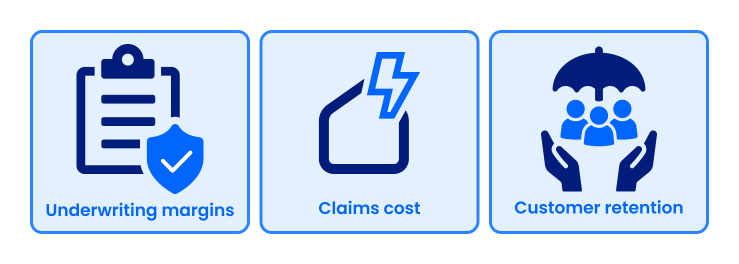
While digital transformation can feel abstract, in the P&C insurance industry, it consistently concentrates on a handful of operational domains. These are the areas where legacy friction, data silos, and manual workflows most directly affect underwriting margins, claims costs, and customer retention.
Below are the core transformation zones where carriers are investing, and where measurable impact on efficiency, profitability, and resilience is most often realized.
Core systems modernization
Core modernization remains foundational to P&C insurance digital transformation. Legacy policy, billing, and claims systems often operate in batch cycles with limited integration flexibility. They are also more difficult to maintain, update, and audit.
However, modern cores enable:
- API connectivity
- Real-time rating updates
- Configurable product design
- Streamlined financial reconciliation
And that modernization reduces operational drag while accelerating product innovation.
Claims transformation
Claims transformation is one of the highest-ROI components of P&C insurance modernization.
Starting with FNOL intake, structuring your data in a standardized, machine-readable format that’s validated on input reduces the risk of making decisions based on incomplete forms or inconsistent/duplicate inputs. This affects downstream processes and enables more intelligent triage, automated document ingestion, and straight-through processing.
The benefits are clear: reduce cycle time, minimize leakage, and improve customer satisfaction. Faster, cleaner claims workflows also generate better feedback data for underwriting and pricing models.
Underwriting modernization
Underwriting modernization focuses on integrating enriched property data, geospatial intelligence, automated risk scoring, and decision-support tools into submission workflows. Each of these elements is powerful on its own, but their combination provides a fuller, more precise address profile to analyze during the underwriting stages of the insurance lifecycle.
By validating and enhancing data at intake or renewal, insurers reduce rework, increase straight-through processing, and improve pricing precision—directly strengthening underwriting profitability. Underwriters are also empowered by accurate and expanded data to more easily spot fraudulent applications for insurance and stop potential bad actors from collecting on claims they don’t truly qualify for.
Customer experience and digital servicing
Digital servicing capabilities—such as self-service portals, instant endorsements, proactive notifications, and embedded chat—are now central to competitive positioning. This is because customers now expect an instantaneous process that’s personalized to them. They want to take control of a part of their lives that feels chaotic (filing insurance claims during a crisis), and many want the power to advocate for themselves and track the progress of their claims.
P&C insurance digital transformation ensures that customer interactions are consistent across channels and supported by real-time data rather than siloed systems, and it improves the customer experience by giving them digital servicing capabilities to monitor and advocate for their claims.
Ecosystem connectivity
Modern insurers operate within interconnected ecosystems. API-first architecture enables integration with insurtech platforms, data providers, reinsurers, and distribution partners. Ecosystem connectivity reduces integration friction and accelerates innovation. It also allows carriers to continuously upgrade their digital capabilities without rebuilding their entire technology stack.
The consequences of weak data across these domains are rarely immediate, but they compound.
Poorly validated addresses distort the precision of catastrophe modeling and pricing.
Inconsistent identifiers create reconciliation errors between policy and claims systems.
Fragmented data silos reduce trust in analytics outputs, forcing manual overrides that erode automation gains.
And over time, these small inconsistencies translate into higher loss volatility, lower straight-through processing rates, and avoidable operational leakage. Digital transformation built on unstable data only redistributes risk rather than dissolving it.
The four types of digital transformation (and one that should be more common)
Digital transformation in insurance rarely happens in a single dimension. Most carriers pursue multiple forms of transformation simultaneously, with some aimed at efficiency, others at growth, and the rest at long-term, structural resilience.
Process transformation focuses on doing existing work faster, cheaper, and with fewer errors. In P&C insurance digital transformation, this shows up as automating submission intake, digitizing FNOL, enabling straight-through processing, and embedding validation checks early in workflows so errors do not cascade downstream. The primary impact is reduced cycle time, lower expense ratios, and greater operational consistency.
Business model transformation changes how value is created or distributed. In P&C insurance, this appears through usage-based insurance powered by telematics, embedded insurance partnerships, parametric products triggered by verified event data, and flexible coverage structures. This type of transformation prioritizes differentiation, distribution leverage, and revenue growth rather than pure efficiency.
Domain transformation expands or deepens capability within a specific risk category. For insurers, this can include advanced catastrophe modeling, cyber aggregation monitoring, geospatial segmentation strategies, or sophisticated fraud analytics. Domain transformation strengthens underwriting precision and competitive positioning within targeted lines of business.
Cultural and organizational transformation reshapes how teams operate and sustain change. Employing a P&C insurance digital transformation means shifting to product-oriented delivery teams, formalizing data governance and model risk management, training underwriters to work alongside AI-assisted tools, and creating feedback loops between claims and underwriting. Without organizational alignment, even well-funded technology initiatives stall.
- Data transformation is often overlooked in the quest for digital transformation in P&C insurance. It should be more common because, while often treated as a supporting initiative, it’s foundational to all other workflows or transformations functioning properly. Data transformation standardizes, validates, enriches, and structures information so it becomes usable across underwriting, claims, analytics, compliance, and finance. It replaces fragmented, inconsistent inputs with authoritative, scalable datasets that support automation and advanced modeling.
At Smarty, data transformation means converting raw address strings into validated, rooftop-level geocodes; enriching properties with structured, normalized attributes; and attaching persistent unique identifiers that maintain continuity across systems.
Our APIs return corrected addresses, delivering hyper-accurate location intelligence with detailed metadata, confidence indicators, and standardized formatting that improve downstream automation reliability. By transforming address and property data into clean, interoperable, and scalable assets, Smarty strengthens the entire foundation of P&C insurance digital transformation.
Challenges of digital transformation in insurance
Even strong strategies can flounder when drowned by foundational constraints: legacy core systems built for batch processing, fragmented data architectures, inconsistent identifiers across policy and claims systems, rigid integration layers, and governance models not designed for real-time automation.
Most transformation programs don’t fail because the technology is unavailable, but because insurers underestimate the integration effort, overestimate data readiness, or fail to plan for adoption across underwriting, claims, and operations.
Legacy tech + integration constraints
Many carriers still run critical workflows on legacy core platforms and custom integrations built over years of patchwork upgrades. These environments are reliable in the narrow sense that they run, but they’re often brittle: changes are slow, data is locked in silos, and integrating new tools can introduce risk.
This is why many successful initiatives modernize around the core first—using APIs and modular services to reduce pressure on legacy systems—while building a longer-term path to core modernization.

Data quality and governance gaps
Digital transformation without the ability to audit and track that transformation increases regulatory exposure.
Advanced analytics and AI can’t compensate for inconsistent inputs. If addresses are unverified, property attributes are incomplete, or identifiers don’t match across systems, automation will amplify errors rather than eliminate them.
Governance also matters: clear data ownership, standardized definitions, and auditable decision trails are required for reliable automation and defensible underwriting and claims decisions. Without these controls, insurers end up with impressive dashboards built on unstable assumptions.
Change management and adoption
Even well-designed tools fail when teams don’t trust them or when workflows aren't redesigned to match new capabilities. Underwriters and claims leaders need training, transparency into how decisions are supported, and clear guidance on when to override automated outputs.
Adoption improves when transformation is tied to measurable outcomes that teams feel—reduced rework, faster cycle times, cleaner submissions—and when leaders reinforce that automation is meant to remove friction, not remove accountability.
A practical roadmap for P&C insurers
The fastest path to meaningful P&C insurance digital transformation isn't a "rip and replace" program. Rip-and-replace core transformation programs routinely exceed budget and stall production. High-performing carriers instead modernize around the core using API-driven services.
Start with high-volume workflows
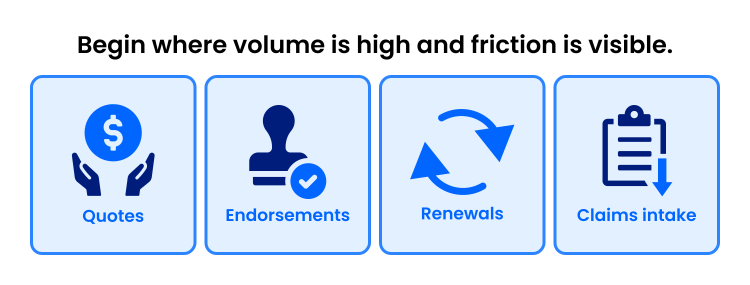
Begin where volume is high and friction is visible.
- Quotes: Incomplete addresses, missing property attributes, or inconsistent submission details create back-and-forth with agents and customers, slowing quote-to-bind and increasing abandonment.
- Endorsements: Address changes, occupancy updates, additional insureds, and coverage adjustments often require manual review because the information arrives inconsistently or doesn’t match the policy record.
- Renewals: Renewal workflows benefit from automated exposure refresh, property-level data updates, and exception-based handling—so standard renewals move through quickly while material risk changes are flagged for review.
- Claims intake: When FNOL data is incomplete, unstructured, or inconsistent—especially location details—adjusters spend time correcting inputs instead of moving the claim forward.
These segments are ideal places to start because they produce immediate savings when rework is reduced and cycle time improves. These workflows, when empowered with digital transformation, also generate the cleanest before-and-after metrics—straight-through processing rate, time-to-quote, time-to-close, and operational touches per transaction.
Prioritize “data reliability” before automation
Automation works best when inputs are validated and standardized at the point of entry. Address quality is a common failure point: inconsistent formats, missing units, invalid locations, and mismatched identifiers force downstream exceptions.
By validating and enriching address data at intake—before underwriting or claims decisions are made—insurers reduce workflow interruptions, increase confidence in model outputs, and improve defensibility of compliance.
Use APIs to modernize around the core, then modernize the core
APIs allow carriers to add modern capabilities without destabilizing legacy systems. Insurers can layer in address validation, rooftop-level geocoding, property enrichment, hazard scoring, and fraud screening as modular services while keeping the core system stable.
Over time, this creates a cleaner architectural boundary: data is normalized upstream, services are reusable across lines, and core modernization becomes a controlled decision rather than an emergency.
Example of digital transformation
Hippo’s risk modeling work is a good example of what practical P&C insurance modernization looks like when it starts with the data foundation.
Hippo needed precise location intelligence to improve catastrophe modeling for pre-construction homes and to support reinsurance conversations where accuracy and defensibility matter. By integrating Smarty’s rooftop geocoding and verified address intelligence into their workflow, Hippo could evaluate risk exposure with greater confidence and reduce downstream friction caused by ambiguous or imprecise addresses.
For a related perspective on claims acceleration—especially how better address data reduces rework and downstream friction during intake and resolution—see: https://www.smarty.com/blog/marrying-accelerated-insurance-claims-with-address-data
Driving P&C insurance digital transformation forward
Digital transformation works when it improves speed and decision quality without breaking production. That means modernizing in a way that reduces operational friction, strengthens risk precision, and makes automation safer to scale.
AI, IoT, advanced analytics, cloud platforms, and low-code tools can all move the needle—but only when they run on data you can trust. When foundational inputs are inconsistent, teams end up with more exceptions, more rework, and less confidence in the outputs.
The practical win is straightforward: validate and normalize critical data early, connect systems through APIs, and automate the high-volume work first. That approach improves ROI, reduces workflow interruptions, supports fraud prevention, and strengthens compliance defensibility.
The carriers that win from implementing digital transformation will be those who automate on the most reliable data.
P&C insurance digital transformation FAQs
What is digital transformation in P&C insurance?
P&C insurance digital transformation involves updating:
- Underwriting
- Claims
- Customer experiences
- Operations
The digital insurance solutions and methods used in this transformation are:
- Implementing AI/LLMs
- Transitioning to cloud infrastructure
- Using IoT
- Tapping into API-driven systems operating on structured data
What are four types of digital transformation in P&C insurance?
The four types of digital transformations are:
- Process transformation
- Business model transformation
- Domain transformation
- Cultural/organizational transformation
- BUT, don’t forget about the most important and often overlooked digital transformation: data transformation.
How can insurers measure the success of their digital transformation initiatives?
Success can be measured through reduced claim cycle time, improved straight-through processing rates, lower expense ratios, reduced fraud leakage, improved loss ratios, faster product deployment, and improved customer satisfaction metrics.
Was this helpful?