
Puerto Rican urbanization codes: Meaning, USPS use, & lookups
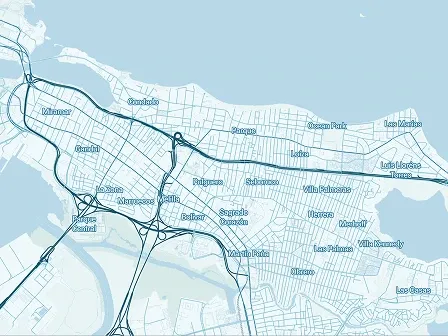


Puerto Rican urbanization codes (URB) are a necessary part of Puerto Rican addresses that signify a specific residential development or neighborhood. Puerto Rican URB codes are the crucial address component that helps the USPS to differentiate locations with identical street names and house numbers within the same ZIP Code.
But you don’t want to have to remember every unique eccentricity about international formats.
Smarty does that for you.
Here at Smarty, we pride ourselves on providing you with the most up-to-date, easy-to-use, transparently-priced international address data intelligence available. Go ahead and test out our address verification for Puerto Rico now, check out our international address formatting guides, or continue reading below to learn everything you can about Puerto Rican urbanization codes, how they’re used, and why they’re important.
Ready to dive into Puerto Rican urbanization codes? Here’s what we’ve prepared for you:
- What is a Puerto Rican urbanization code?
- What does “URB” mean in an address?
- Why USPS uses urbanization codes
- Puerto Rico address format explained
- Example of a properly formatted Puerto Rico address
- How to find an urbanization code
- What to do if USPS doesn’t recognize the address
- How address verification tools help
- Conclusion
- Puerto Rican urbanization code FAQs
What is a Puerto Rican urbanization code?
Puerto Rican urbanization codes (URB codes) appear between the addressee line (the organization or person to whom the address is attached or who receives the mail) and Address Line 1. It’s a descriptive term that helps the USPS differentiate between urban areas with duplicate street names, identifying the neighborhood/sector required for delivery accuracy.
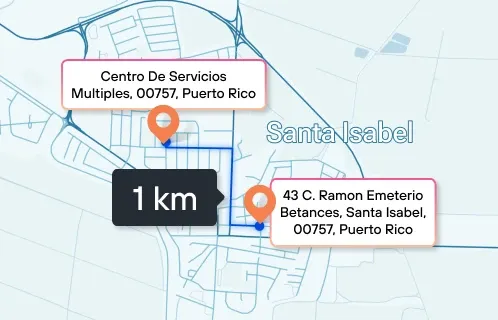
| URB Praderas del Sur 50 Calle Roble Santa Isabel, PR 00757 | URB Alborada 50 Calle Robie Santa Isabel, PR 00757 |
What does “URB” mean in an address?
URB is simply an abbreviation for Puerto Rican “urbanization” codes. It’s how all Puerto Rican addresses with urbanization codes begin.
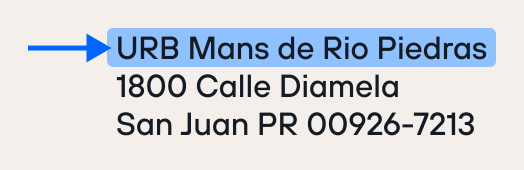
In some cases, URB codes are necessary for delivery. Many addresses in Puerto Rico’s urban areas have the same premise number and street name, only differentiated by a ZIP Code.
And in extremely rare cases, Puerto Rican urbanization codes are required because these unique addresses share the entire Address Line 1 and ZIP Code, differing only by their urbanization codes. Here’s an example of such an instance:
Why USPS uses urbanization codes
So why do they have urbanization codes in Puerto Rico?
According to the USPS, “it describes the location of a given street,” which assists them in their delivery process. Many of Puerto Rico’s urban areas have identical street names and premise number ranges. Very rarely, as we just saw above, the ZIP Code even overlaps.
Historically, Puerto Rico has dealt with standardization and formatting issues, with some rural areas resorting to sorting out duplication issues by memorizing or finding the kilometer marker.
A committee was even formed in 2019 to help resolve addressing issues, called the Puerto Rico Address Data Working Group (PRADWG).
The initiative was led by the US Census Bureau, which was joined by the United States Postal Service, the Department of Housing and Urban Development, the US Army Corps of Engineers, and the Federal Emergency Management Agency after a particularly devastating hurricane season in which Puerto Rico suffered over 42,000 landslides, with estimated repairs totaling over $132 billion.
This natural disaster cluster showed interesting data—that around 35% of Puerto Rico’s addresses relied on the urbanization name to distinguish them from another address on the island.
PRADSG’s goal now? To work together to improve federal efforts to collect and manage Puerto Rico’s address data, improving emergency response, and that has the added bonus of improving mail delivery systems, too.
Puerto Rico address format explained
Here’s the official format for Puerto Rican addresses:
- Addressee line - Which organization or person is the recipient)
- Urbanization code - Capital URB, followed by the name of the urbanization
- Street address - Starting with the premise number, then the street name, and finally any secondary indicators (like suite, apartment, unit number, etc.) if applicable. No commas needed to separate those components.
- City, State code and ZIP Code - The city (also known as the locality in some regions), followed by a comma, then the state code “PR” followed immediately by the ZIP Code.
Puerto Rico address format example:
Señor Randy Buttons
URB Villa Lissette
B4 Calle Benitez
Guaynabo PR 00969
Example of a properly formatted Puerto Rico address
Oh, you want more examples of Puerto Rican address formats? Mk! Here, we’ll provide you with business address examples, residential address examples, and unique address examples with secondary indicators.
Residential Puerto Rican address example
Here’s an example of a valid residential address you might see in Puerto Rico that contains a URB code.
Señora Sandy Buttons
URB Villa Lissette
B4 Calle Benitez
Guaynabo PR 00969
Business Puerto Rican address example
Note that in this business PR address example, no urbanization code is required, so we left it out.
Buttons' Funeral Home
3 Ave Casto Perez
San German PR 00683-4435
Puerto Rican address example with subunit
Señorita Mandy Buttons
URB Ramey
155 Fifth St Apt A
Aguadilla, PR 00603-1250
How to find an urbanization code
The most reliable way to know a Puerto Rican urbanization code might seem like just asking the recipient, but sometimes, even they don’t know the answer.
USPS also provides tools to uncover this information, though they’re somewhat limited in speed, have use-case restrictions (they only let you use their address verification API for shipping), and offer fewer database matches than many other address data providers, as they only store addresses that fit in their delivery routes and established addresses. The USPS address database might be a great place to start, but it lacks address data for rural locations or new construction/new builds.
Property records, local municipal sources, and other official or semi-official records can also help identify an urbanization code.
However, the downside is that local research can be slow, inconsistent, and hard to scale. Names may be spelled differently across sources. Some records may be outdated. And in many cases, the format that appears in a local record isn’t the same as the format a carrier expects on a mailing label.
So what should you do?
Use an address validation API
For most businesses, the best option is to use an address validation API that can find, confirm, or append a Puerto Rican urbanization code during the address verification process. Instead of asking your team to research address components one by one, an API can check the submitted address against reference data, standardize the format, return the correct address components (like a Puerto Rican urbanization code), and identify missing or questionable information.
This is especially useful at the point of entry. If a customer enters a Puerto Rican address in a checkout form, onboarding form, CRM, or shipping workflow, validation can help catch the issue before it becomes a delivery failure.
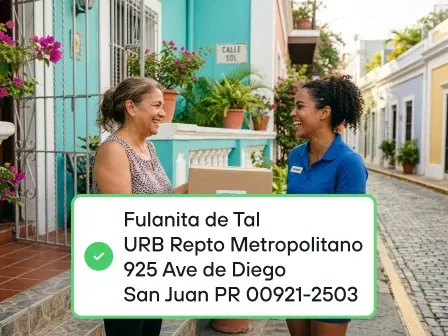
A strong API may be able to recognize an incomplete address, suggest a standardized version, and include the correct urbanization when the data supports it.
Address validation APIs can also help with batch cleanup. If you already have Puerto Rico’s addresses stored in a database, you can process them in bulk to find missing URB lines, inconsistent street formatting, invalid ZIP Codes, or records that need manual review.
That’s much easier than waiting for failed deliveries, returned mail, or customer support tickets to reveal the problem.
How to use Smarty’s Puerto Rican address verification tools to get URB codes
Finding Puerto Rico’s urbanization codes is simple using Smarty’s tools.
Single address Puerto Rican URB code lookup
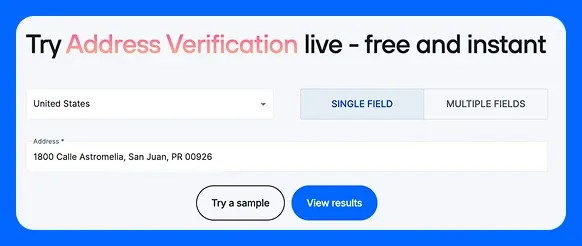
- Enter your Puerto Rican address into Smarty’s US Address Verification tool. We’ve chosen 1800 Calle Astromelia, San Juan, PR 00926. Click “View results.”
2. The standardized Puerto Rican address will display, along with an analysis of the results. The URB name, if one is applicable for this address, will be the first line listed at the top of the valid address. An urbanization code will also be listed under the components part of the “Raw Output” tab under “urbanization.”
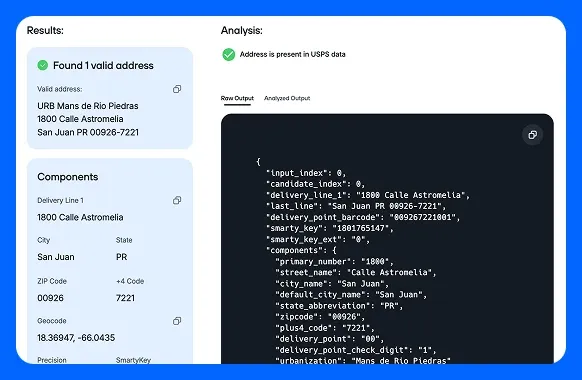
Need to be able to get lists of URB codes? Try validating lists of Puerto Rican addresses in bulk. You’ll be able to see any applicable addresses
What to do if USPS doesn’t recognize the address
If the USPS’s address verification doesn’t recognize a Puerto Rican address, don’t assume it's fake or unusable. It may be part of a new development, use informal local directions, include a nonstandard abbreviation, or simply be missing a key component, such as the urbanization code.
Start by checking the address for common issues: misspelled street names, incorrect ZIP Codes, missing URB lines, misplaced unit numbers, or informal landmark-based directions entered into the street-address field. If a validation tool returns a close match, compare it carefully against the customer-provided address before accepting or rejecting it.
When the address still can’t be confidently matched, collect more structured information from the recipient.
Address verification tools can assist in identifying what’s missing, standardize formatting, and determine whether the address is deliverable, incomplete, or requires manual review, freeing your organization to focus on what it does best.
How address verification tools help
Address verification tools help standardize Puerto Rican addresses, append missing urbanization data when there’s a confident match, and format each component correctly. That means customers don’t need to know every Puerto Rico-specific address rule before entering their information.
They can also improve deliverability by catching missing URB codes, incorrect ZIP Codes, inconsistent street formatting, and other issues before mail or packages are sent. For businesses, that means fewer failed deliveries, fewer manual corrections, and cleaner address data across shipping, billing, onboarding, and customer records.
Conclusion
Puerto Rican urbanization codes may look like a small address detail, but they can make the difference between a deliverable address and a confusing duplicate. When street names, house numbers, and ZIP Codes overlap, the URB line gives carriers the context they need to identify the correct neighborhood or development.
That’s why validating Puerto Rican addresses matters. The right tool can help standardize formatting, identify missing urbanization data, reduce failed deliveries, and keep customer address records cleaner from the start, as well as impact every downstream process that relies on accurate address information, from compliance to data analysis.
Smarty helps you handle Puerto Rico-specific address requirements without asking your customers, developers, or shipping teams to memorize every formatting rule. Try Smarty’s address verification tools to instantly validate Puerto Rican addresses, returning urbanization fields in the metadata, and move forward with cleaner data and more confident deliveries.
Puerto Rican urbanization code FAQs
Is the urbanization code required?
Yes, in many cases—especially where street names repeat within the same ZIP Code.
If an address has an assigned urbanization, the URB line should be included in the mailing address. It helps identify the correct neighborhood, development, or sector, and it may be necessary for the carrier to distinguish between otherwise similar addresses.
That said, not every Puerto Rican address has or needs an urbanization code. Some business, rural, PO Box, highway contract route, and other address types may be considered valid and deliverable without a URB line.
The best way to know whether one is required is to validate the address against reliable address data using an API.
How do I find a Puerto Rican urbanization code?
You can ask the recipient. They may know the urbanization name, have it on a utility bill, or have used it successfully for previous deliveries. You can also compare the address against property records, municipal information, or other local sources.
For business workflows, an address verification tool is usually the most efficient option. It can standardize addresses, identify whether a URB line is missing, and return the best available match without requiring manual research for each record.
Why doesn’t USPS recognize some Puerto Rico addresses?
USPS may not recognize an address if the address is incomplete, newly created, informally written, misspelled, missing an urbanization, paired with the wrong ZIP Code, or formatted in a way that doesn’t match the postal database. Rural and hard-to-standardize areas can also be more challenging.
Where does the urbanization go in the address?
It appears on the line above the street address, typically starting with “URB.”
Can address verification tools fill in missing urbanization data?
Yes, advanced tools can append and standardize missing urbanization information.
If the submitted address contains enough information to identify a confident match, an address verification tool may be able to add the correct urbanization, standardize the street address, and return a properly formatted Puerto Rican address. This helps reduce failed deliveries and improve the quality of customer data stored.
However, no tool should guess when the data isn’t strong enough. If multiple matches are possible or the submitted address is too incomplete, the tool should flag the issue so you can collect more information from the recipient or review the address manually.
Was this helpful?