

Residential address vs. commercial address: How they differ (and why it matters)

Residential addresses and commercial addresses are very different.
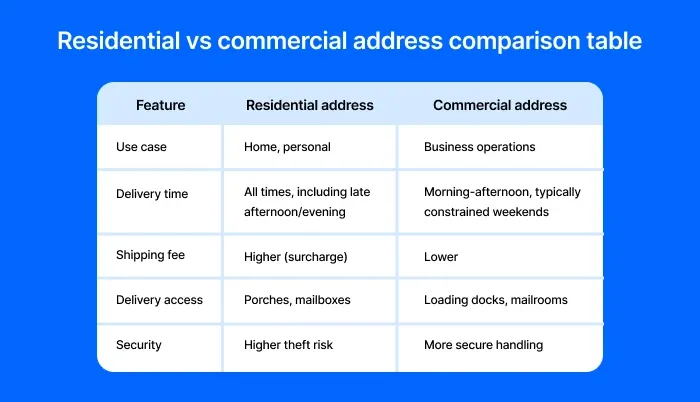
Residential addresses are used for personal use (typically a home).
Commercial addresses are used for businesses and organizations (typically suites in a business complex, warehouses, or offices).
Commercial addresses have different zoning land-use laws that they must abide by, and also slightly different taxation.
The differences between residential and commercial mailing addresses affect anyone who’s trying to send mail to these address types as well.
At Smarty, we make it simple to determine whether the address you’re mailing to/shipping to is labeled residential or commercial using the Residential Delivery Indicator (RDI) and other metadata. You can see what our results look like for both US and global address data using one of our tools below for free, or you can continue reading along to see how to find the RDI and other metadata fields in Smarty’s data.
Let’s get into it! Here’s our road map for everything dealing with residential mailing addresses and commercial mailing addresses:
What is a residential address?
What is a commercial address?
Residential vs. commercial address: key differences
Virtual office and virtual address edge cases
How carriers classify address types
How to tell if an address is residential or commercial
Residential vs commercial address comparison table
Residential address/commercial address FAQ
What is the Residential Delivery Indicator (RDI)?
What are the benefits of identifying the address type correctly?
Why does the USPS say my residential address is a business address when I live in an apartment complex?
Why does FedEx charge more for residential delivery?
What is a residential address?
What is a commercial address?
How do I write or format a residential address?
Is a mailing address the same as a residential address?
Is a PO Box considered a residential address?
How can I tell if an address is commercial or residential?
Residential addresses are different from commercial addresses, and it matters
What is a residential address?
A residential address is, generally speaking, somebody’s home (apartments, condos, single-family homes, multi-family residences, 4-plexes, duplexes, you get the picture). The primary use case for a residential address is for living purposes.
You might be asking, “But what if the person runs a business there? Does running a business out of your home change the address type to commercial?” Actually, carriers often still treat it as a residential location.
This is because the USPS often defines residential delivery as “one made to a home, including a business operating out of a home.”
Similar terms people use to describe residential addresses are:
- Home address
- Mailing address
- Residential location
- House address
- Private residence
- Personal address
- Residential delivery address
- Household address
What is a commercial address?
A commercial address is a place where a business operates (offices, warehouses, retail stores, clinics, and similar locations). The primary use case for a commercial address is for business activities, such as conducting business, selling goods, storing inventory, receiving shipments, and handling pickups.
Depending on the context, “commercial” can mean a few different things: a property’s legal status (like zoning or permitted use) and a location’s postal/shipping classification (how it’s categorized for delivery and mailing systems).
Similar terms people use to describe commercial addresses are:
- Business address
- Office address
- Work address
- Company address
- Corporate address
- Commercial location
- Business location
- Commercial delivery address
- Business premises
- Office location
- Warehouse address
- Store address
- Retail address
Residential vs. commercial address: key differences
We’ve touched on the different use cases for residential and commercial addresses, but other factors are affected by an address's status, including zoning requirements, delivery behavior, shipping costs, delivery access, and security.
Zoning and use
Zoning is a land-use law that cities and counties use to divide land into districts (residential, commercial, industrial, mixed-use, etc) and set rules for what can and can’t take place on that property based on its zoning classification.
It’s why you likely don’t have traffic-congesting strip malls or concert venues in the middle of your neighborhood.
Address zoning typically controls:
- Permitted land use (living, retail, office, warehouse, short-term rentals, daycares, etc.)
- Conditional uses or special permits (like daycares in residential areas, religious institutions, drive-thrus, short-term rentals, things that can be businesses that, with the right strings attached, can be run out of a residential location)
- Building form (height, setbacks, lot coverage, density, etc.)
- Neighborhood impact (lighting, parking, signage, noise, hours of operation, etc.)
Both residential and commercial mailing addresses must follow their zoning laws or can face some increasingly serious problems, such as:
- Notice, correction period, and a chance to contest
Most jurisdictions begin by sending a written notice that cites the violation and provides a specific date by which corrections must be made. There are also instructions included for contesting the citation (such as attending an administrative hearing). - Stop-work orders (especially for construction or active work)
The city can issue a citation that halts all active work until the necessary corrections are made. - Daily civil fines (often accrued per day as the violation continues)
Many cities and jurisdictions treat each day that zoning laws are violated as a separate violation, imposing daily fines of about $100. - Court action: injunctions, abatement, and shutting down
If ignored for long enough or in the case of a severe incident, municipalities can seek court orders to prevent occupancy and halt unlawful use. Some court actions also result in other actions, such as the suspension or revocation of licenses or permits, and even criminal penalties, including a misdemeanor fine.
Delivery behavior

Residential address delivery poses completely different risks and barriers to commercial address delivery, and as such, they’re treated differently by local postal services (like the USPS) and commercial services such as FedEx, DHL, UPS, and more.
Stop density and bulk delivery
Residential delivery typically has a significantly lower stop density than commercial delivery (more driving is required between stops, and multi-parcel drop percentages are also much smaller, as most people don’t order multiple items in bulk like a commercial property might).
Delivery access and security
Access to the delivery point is also unpredictable. Gates, call boxes, apartment buildings, no loading docks, and no truly secure place to leave higher-priced items (combined with dogs who may have strong opinions about you being in their yard) are significantly more complicated than commercial mail delivery.
Additionally, recipient availability is lower during business hours at residential locations. This increases the risk of missed deliveries due to signature failures and an increased cost, as postal authorities will now have to eat the cost of a delivery reattempt. (Not to mention the higher loss/theft exposure that naturally comes from unattended “front porch” deliveries.)
Shipping costs and surcharges
Due to the previously mentioned mailing and delivery issues associated with residential address delivery, commercial deliveries are typically cheaper for the sender. Here’s a table with head-to-head comparisons from some of the major players in the shipping and mailing business, and how much more residential address shipping costs compared to commercial address shipping.
| Carrier | Residential-specific add-ons | Delivery-area/remote fees that often stack | Summary of residential premium vs commercial |
| UPS | Residential surcharge: Ground $6.50 Air $7.00 | Delivery area surcharge: Commercial = $4.50; Residential = $6.55 Extended commercial = $5.70; Extended residential = $8.85 | Typically +$6.50/package for UPS Ground. If the address is also in a Delivery Area Surcharge (DAS) ZIP, add ~+$2.05 more vs commercial If Extended DAS, ~+$3.15 more |
| FedEx | Residential delivery charge: U.S. Package Services $6.95 FedEx Ground/Home Delivery/Intl Ground $6.45 | Delivery area surcharge: Commercial = $4.45 Residential = $6.60 Extended: commercial = $5.55 Extended residential = $8.80 | Typically +$6.95/package for U.S. Package Services (or +$6.45 for Ground/Home Delivery). If DAS applies, add ~+$2.15 more If Extended DAS, ~+$3.25 more |
| DHL Express (U.S.) | Residential address: $6.95/shipment | Remote Area pickup/delivery is listed as a surcharge category (applies based on remoteness, not address type) | Usually +$6.95/shipment when the delivery address is designated as a residential address. |
USPS pricing works a little differently from that of the commercial providers, so they need their own table to show the pricing difference. They don’t add separate residential-delivery surcharges. Instead, the USPS charges you via base postage and sometimes retail vs. commercial rate tiers, regardless of whether the destination is marked as home or business.
| USPS item/service | What it covers | Cost (Retail/“starts at”) | Typical delivery speed (USPS-stated) | Notes |
| First-Class Mail letter (1 oz) | Standard letter | $0.78 | 1–5 days | This is the common “Forever stamp” letter rate. |
| Postcard (standard) | Standard postcard | $0.61 | (Same general First-Class Mail timeframe) | Larger/square postcards can cost more. |
| First-Class Mail large envelope/flat | Large envelopes (“flats”) | $1.63+ | 1–5 days | Oversized/rigid/non-machinable flats can be priced as packages instead. |
| USPS Ground Advantage | Packages | $7.20+ | (Service page highlights domestic package shipping; timelines vary by origin/destination) | Weight/zone-based; main USPS ground option. |
| Priority Mail | Packages | $10.45+ | 2–3 days | Flat Rate options available; includes tracking. |
| Priority Mail Express | Packages | $32.50+ | 1–3 days (by 6 PM) | Money-back guarantee (with exceptions). |
Virtual office and virtual address edge cases
Sometimes the “business address” in your CRM isn’t where anyone signs for boxes.
A virtual office (virtual business office/VBA) lets a company present a professional storefront (and sometimes meet registration requirements) without running day-to-day operations at that location.
Some teams keep a virtual office for inbound mail and administrative work, while shipping inventory from a warehouse or home.
Some teams keep a virtual office to have one place where all of their documents and mail can be scanned and saved while working short-term in another country away from their primary business location.
A virtual address is often the mailing destination attached to that setup, and it’s commonly used as a correspondence address for registrations, banking, customer paperwork, mail sorting, advertisement shredding, and more.
Using a virtual address as a correspondence address can be perfectly fine, but it can also confuse shipping workflows when it’s treated like a true delivery point.
Sometimes a virtual address is only a staffed mailroom that can accept packages; other times it’s basically a forwarding setup with limited receiving rules.
If the virtual office is just “mail handling + forwarding,” don’t assume it behaves like a warehouse or staffed receiving desk.
Correspondence address vs. delivery address
A correspondence address is where you want letters, notices, and invoices to go, not necessarily where parcels should land.
That correspondence address might be tied to a virtual office provider, a registered agent, or a shared workspace—none of which guarantees dock access, signature coverage, or predictable receiving hours. In fact, many virtual addresses strictly say that they won’t accept parcels unless the registered owner of the address wants to pay extra money.
Carriers rate and route shipments based on the physical delivery point address, not the correspondence address.
The best way to avoid mishaps regarding these edge case addresses is to store a clear “ship-to” physical address, and keep the correspondence address as its own field for admin and compliance.
When you validate a virtual address (or any address), validate the location you actually expect drivers to visit, then link it to the right internal records, verifying in the metadata that there is Delivery Point Validation (DPV) before sending any packages or sign-for mail pieces.
How carriers classify address types

Those pricing comparisons show the drastic charges you could be paying if a package is incorrectly classified as being sent to a residential address—and that’s just the pricing for one mail piece or package. What happens when you’re a business dealing with bulk mailing or bulk shipping to commercial postal addresses? Prices go up.
To avoid being unfairly charged, it’s important to know how to tell whether an address is residential or commercial. The hard part is that the classification changes depending on who you ask, as different mailing and shipping companies classify addresses differently.
USPS
USPS uses the Residential Delivery Indicator (RDI) to indicate whether the address is residential or commercial. (PSST! You can find that information in Smarty’s address verification and address enrichment metadata.) USPS provides a postal delivery classification rather than a zoning determination.
USPS pricing is primarily driven by the service that you choose (Ground vs. Priority vs. Express), as well as weight, dimensions and shape of the package or mailpiece, and zone, plus any rate tiers you may have opted into.
FedEx, UPS, DHL
Commercial mailing and shipping companies classify mailing addresses by zone. They're asking the question, “How should we price and operationally treat this location?” through carrier rating classifications.
Many shipping and mailing businesses leave it up to the sender to designate if it’s residential or not, but they also correlate the address with zoning and delivery behaviors (access, staffing, receiving patterns, route efficiency, security, etc.)
They also often disagree with USPS’s assessments as they have different systems and goals. Carriers classify mailing addresses for pricing and operations, whereas USPS classifies according to which package you signed up for and their own Residential Delivery Indicator.
As such, carrier-specific rules can override ambiguity (UPS says any addresses that appear ambiguous will automatically be treated as residential), and shipper designation can override classifications. That’s why the same correspondence address can look “commercial” on paper but still be priced and behave like a residential stop in a carrier’s system.
How to tell if an address is residential or commercial
There are two reliable methods for determining whether an address is residential or commercial, including using a carrier validation tool and utilizing an address verification API. We’ll go over both here.
Use a carrier validation tool
UPS (WorldShip)
UPS has an address checker built into UPS WorldShip. Their Address Validation and Classification Tool “classifies addresses as either residential or commercial.” UPS and the WorldShip help docs note that it can classify your address book in bulk. If you’re shipping through UPS tooling, you can usually see the resi/comm classification before you finalize the shipment.FedEx (Address Validation API)
FedEx has a more direct tool called the FedEx Address Validation API, which “validates recipient address information and identifies it as either business or residential.” It also supports bulk checks—up to 100 addresses in one request—which is cool if you’re cleaning a small list of addresses before you ship.DHL (MyDHL API + “Residential Address” designation)
DHL’s approach is a bit different. In the MyDHL API, the ADDRESS capability is described as validating whether DHL Express has pickup/delivery capability at an origin/destination.And for “residential” handling, DHL describes it as something you designate: shipping to a home/private residence can activate certain delivery options “by designating the delivery address as residential.” In other words, DHL can help confirm serviceability, but residential vs. commercial may be more of a workflow flag than a universal truth.
Use an address verification API, like Smarty
If you’re shipping with multiple carriers (or you just want to avoid “surprise, that was residential” invoices), an address verification API can help upstream of rating/label creation by:
- Standardizing the address (consistent formatting)
- Validating it (the address is complete, real, and mailable, matching an authoritative database)
- Enriching it with metadata that supports shipping decisions (often including residential/business indicators, where available)
Using an address verification API to determine the status of an address is especially useful when you want to run one clean process for bulk lists, then let UPS/FedEx/DHL do their own rating on top of cleaner inputs.
While you don’t have to run it through both (Smarty and a shipping carrier) we highly recommend that you do! Even if you want to use these free tools, many of them specify that the information you put in must already be formatted/standardized correctly and be valid addresses.
Additionally, their throughput is significantly capped, so larger lists may eat up valuable operations time, especially if you haven’t cleaned your address database before attempting to submit to shipping carriers.
The best way to determine whether an address is residential or commercial is to use Smarty’s address verification tools! You can sign up for a free 42-day trial, you can test it out in our live API sandbox, or even schedule a demo with an address expert.
How to find residential vs. commercial in Smarty (by tool)
Depending on which Smarty tool you are using to find the residential or commercial indicator, you’ll have different processes to follow. Determine what kind of address verification you’re trying to perform (single vs. bulk) and which region your address list is in (USA addresses or international addresses), and let’s get started!
Single address verification
US Address Verification for a single address: This is how you find the RDI in Smarty’s data.
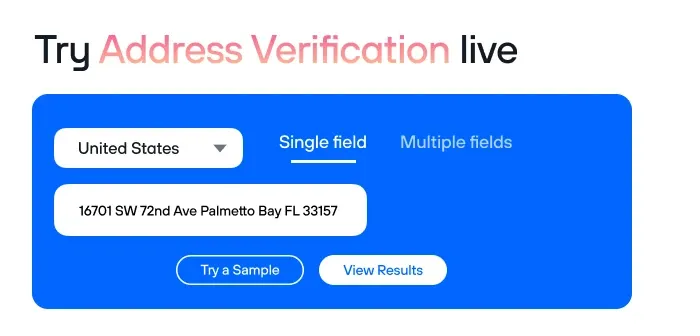
- Select “United States” and enter your address.
- Click “View results.”
- The results will populate two tabs: “Raw Output” and “Analyzed Output.”
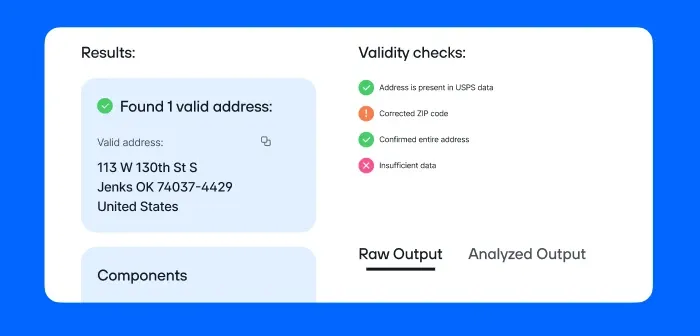
- You can find the RDI field in the metadata under “Raw Output” here:

Or “Analyzed Output” here: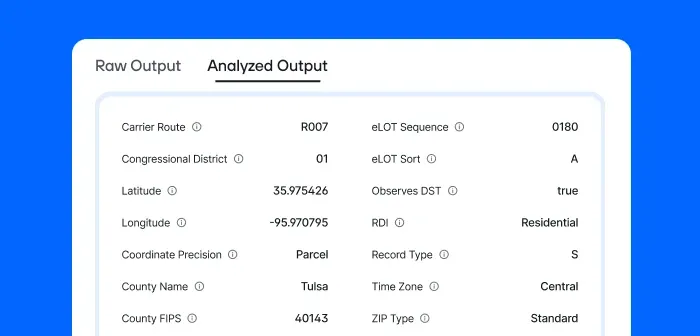
International Address Verification for a single address: Here’s how to find the RDI in Smarty’s international data returns.
- Select International from the dropdown menu.
- Enter the address’s country
- Enter the address. (You can do this in single-field freeform entry or in multiple parsed field entry.
- Click “View results.”
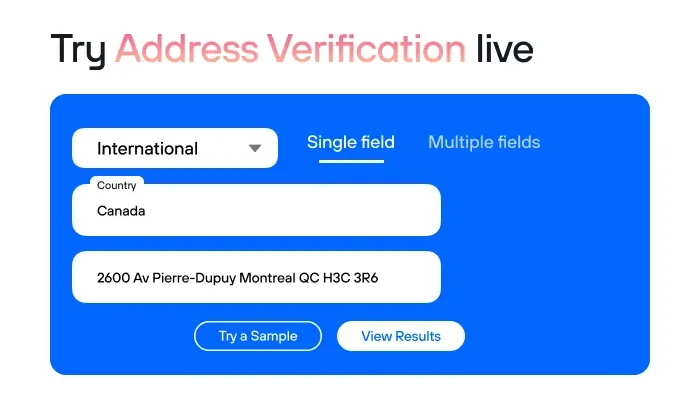
- The RDI is labeled here as “Occupant use” rather than RDI because RDI is a term specifically coined by the United States Postal Service. The address type is still important for international deliveries, though, so that’s where you can determine address type using Smarty’s tools.

*Note: The “Occupant use” is only available in supported countries. You can see a list of supported countries here.
Bulk address verification
Using Smarty’s bulk address validation tool, you can verify a list of physical addresses in one shot! Here’s how, and where you can find the residential address or commercial address indicator:
- Before you get started, first, you’ll need to create a free account. You’ll just need an email and a password.
- Sign up for a trial of either US Address Verification or International Address Verification from Smarty.com. We’ll instantly load your free address lookups into your account.
- Under "Quick Actions," click "Verify a list of addresses."
- Upload your list, then select the region (USA or International).
- Use the "Enhanced matching mode" toggle to turn enhanced matching on or off. Enhanced can improve match rates and includes access to additional, valid physical addresses beyond the USPS database.
- Click "Process Records."
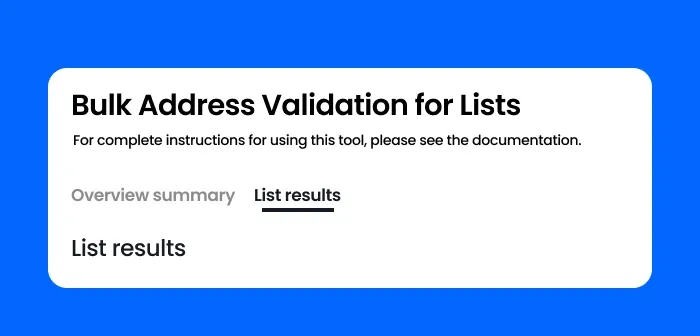
- Review your results in the "Overview summary" tab and the "List results" tab.
If you only need to find the RDI on a few addresses, the Residential Delivery Indicator for US addresses can be found by going to “List results,” finding the specific address, clicking the dropdown arrow, and then clicking “Show details” under the initial results.
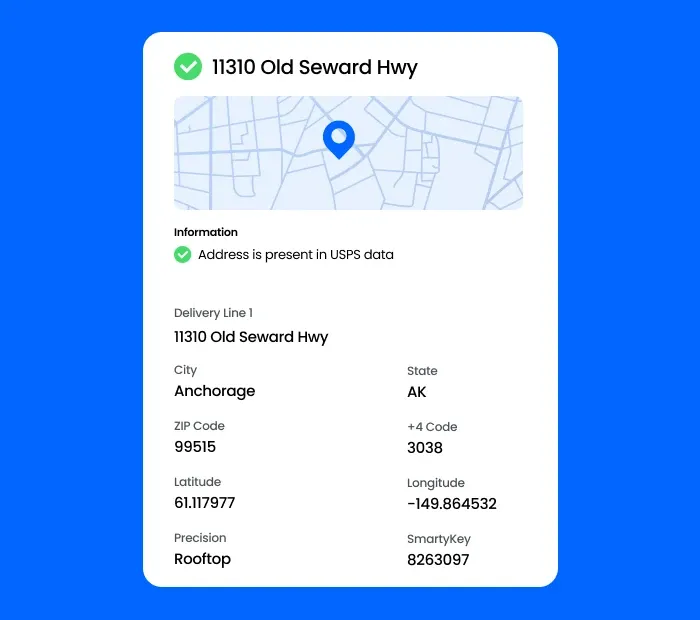
The information you’re looking for is found both in the “Raw Output” under rdi.

Or
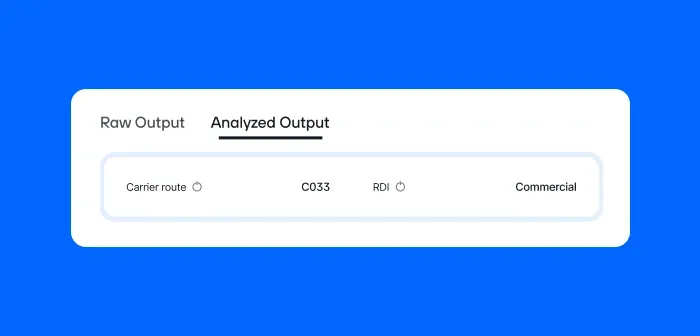
You can also find the residential and commercial address flag in the “Analyzed Output” under RDI.
- If you need to determine the residential or commercial address flag for every US address in your validated list, you’ll need to first download your results in a CSV

Once downloaded, you can open your CSV in any spreadsheet platform and look for the column titled “[rdi]” for the commercial address or residential address information.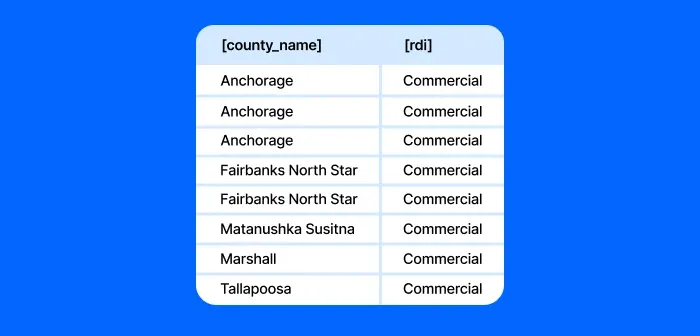
- For international physical addresses, remember that the column you’re looking for to determine if an address is residential or commercial is titled “occupant use” in Smarty’s data. You can follow the steps for US addresses that we listed above, selecting “International” as the region and uploading an international dataset. You’ll need to take additional steps to specify that you want to see this output field returned.
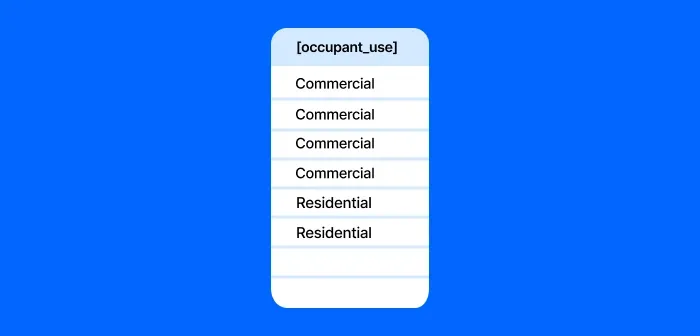
Where it appears in results/exports (and how to interpret blanks/unknowns if applicable).
Residential vs commercial address comparison table
Residential address/commercial address FAQ
What is the Residential Delivery Indicator (RDI)?
The Residential Delivery Indicator (RDI) is a USPS-created data point that flags whether a U.S. address is a residence where people live or a business location.
This matters to many organizations because private carriers often charge higher rates for residential delivery (and you may incur correction fees if the classification is incorrect). Knowing an address classification before shipping or mailing saves time and money, and also smooths out downstream operations.
RDI is maintained by USPS through its authoritative US address database, and access to the USPS RDI data is typically available through authorized organizations and programs that have become CASS-certified (Coding Accuracy Support System), meaning that they adhere to standardizing, correcting, and verifying address data according to a specific set of standardized instructions.
You can use Smarty’s tools to check if an address is residential or commercial.
What are the benefits of identifying the address type correctly?
We’ve covered several benefits that come from knowing the address type (residential address vs. commercial address) before you ship, but here they are again for all you busy skimmers out there. Identifying address types helps with:
- Reducing returned mail
You catch issues that commonly trigger undeliverables—like missing unit numbers for apartments, bad suite formatting, or sending shipments to a business that can’t receive after hours. Fewer address exceptions means fewer returns, fewer reships, and fewer customer complaints. - Saving on shipping fees
Residential and commercial deliveries can be priced differently. When you identify the address type upfront, you can choose the most cost-effective carrier/service, avoid unnecessary residential delivery fees, and reduce costly “rate adjustments” when a carrier reclassifies an address after the label is created. - Providing better CRM and logistics data
Clean address-type data helps you maintain consistent and actionable records, including accurate segmentation (B2B vs. B2C), clearer account hierarchies, improved lead routing, and fewer duplicate locations (e.g., “HQ” vs. “warehouse” vs. “billing office”). It also helps you keep a correspondence address for billing/compliance separate from the ship-to location. - Optimizing routes
Residential and commercial stops behave differently. Residential often requires more door-to-door time and has more access variability; commercial may concentrate packages into fewer stops but has receiving-hour constraints. Knowing the stop type enables you to plan routes and delivery windows more intelligently, thereby proactively improving stop density and reducing failed delivery attempts.
Assuring compliance advantages
Some processes depend on whether a location is a residence or a business—think licensing, service eligibility, tax documentation, age-restricted deliveries/signature rules, and internal policies for where certain items can be shipped. Address-type awareness helps you apply the correct rules automatically and maintain more accurate audit trails when questions arise later.
Why does the USPS say my residential address is a business address when I live in an apartment complex?
If your postal mail is delivered to a front office or mailroom/centralized lockers and then distributed internally by your apartment complex, the USPS system might classify the primary delivery point as a commercial one, even though residents live there, because the postal mail is handled similarly to how commercial addresses would be handled.
Rather than stopping at every apartment unit to drop off supplies, USPS can streamline the process by delivering everything attached to the main delivery point at once.
Another viable reason why your apartment might be marked as a commercial location might have to do with its prior use case. If your complex used to be non-residential but was then repurposed (e.g., converted hotels, former office buildings, student housing, or renovated properties), the USPS may still be confused about the type of your address, especially if the updates were not submitted cleanly.
Why does FedEx charge more for residential delivery?
Residential deliveries require more stops to complete their delivery load. More stops lead to increased wear and tear on their vehicles, employee time, gasoline consumption, the potential for getting lost, risk of mail theft, and more.
FedEx charges more for residential address delivery because they’re taking on more risk and utilizing more resources to carry out the delivery than for commercial address delivery, where security is in place, all deliveries go to the same drop-off location, and stops are minimized.
What is a residential address?
A residential address is a location where people live, such as an apartment, home, condo, etc.
What is a commercial address?
A commercial address is where business is conducted, such as manufacturing plants, warehouses, retail locations, public transportation, and more.
How do I write or format a residential address?
This depends on where you’re trying to send mail.
For US addresses, here’s the standard format for mailing and shipping to US residential postal addresses.
For UK addresses, here’s the standard format for mailing and shipping to UK residential postal addresses.
For French addresses, here’s the standard format for mailing and shipping to French residential postal addresses.
For German addresses, here’s the standard format for mailing and shipping to German residential postal addresses.
Have other countries you need residential shipping formatting for? Check out our global formatting guidelines here.
Is a mailing address the same as a residential address?
While postal addresses can technically be the same as a residential address, they’re not ALWAYS synonymous.
Residential addresses are where people live, and mailing addresses are where mail can be sent. So, if you live at a residential address and receive mail, these phrases can mean the same thing.
For example, a business might use a correspondence address as its mail address for invoices and registrations, while packages should go to a warehouse, storefront, or staffed receiving location.
However, commercial addresses can also receive mail.
The short answer is: half of the time they can mean the same thing, but the other half, they won’t, and that’s an important distinction to make.
Is a PO Box considered a residential address?
No. Because a PO Box isn’t a place where people reside/live, they are not considered residential addresses.
"But USPS's RDI says that they are!" you cry in incredulous confusion.
We're so sorry. USPS is wrong.
We could hypothesize that they chose to mark PO Boxes as residential simply because it matches the delivery density of a high-rise building like a condo or apartment complex.
Additionally, oftentimes, commercial deliveries require greater distances traveled in order to make the delivery.
Because of the shorter distance-to-delivery ratio that PO Boxes provide, they were classified as residential. Just a guess.
If we were in charge of the labeling, we would’ve done it differently.
USPS will record all PO Boxes as residential in their RDI fields, but just know that this is one field and input pairing that we feel is inherently incorrect.
How can I tell if an address is commercial or residential?
Use Smarty’s tools to determine if an address appears residential or commercial by examining the RDI datapoint in the results. You can do that for freeeeeee.
Residential addresses are different from commercial addresses, and it matters
Residential and commercial addresses might look identical on a shipping label, but carriers don’t treat them the same behind the scenes.
Address type impacts everything from delivery access and failed drop-offs to pricing, surcharges, and “surprise” rate adjustments after the fact. And to make mailing and shipping extra fun, USPS and private carriers don’t always classify the same location the same way.
The good news is that you don’t have to guess if an address is a residential vs. commercial address.
If you standardize, validate, and enrich postal addresses before rating shipments or sending bulk mail, you can make smarter routing and pricing decisions with fewer exceptions downstream.
Smarty helps you do exactly that by returning the Residential Delivery Indicator (RDI) and other address metadata so that you can confidently determine whether an address is labeled residential or commercial, catch missing unit numbers, and reduce costly corrections.
To see this in action, try one of the tools above to check a single address, run a bulk list, or integrate the API directly into your workflow. Your future self (and your shipping budget) will thank you almost immediately.
Was this helpful?