



The Royal Mail postcode finder is the UK’s official online tool for looking up accurate addresses and their corresponding postcodes in the United Kingdom. Many use it to fill in the postcode for a partial address or to confirm that an address and postcode pairing are accurate.
Smarty has comparable tools for addresses in the UK, as well as for any address in the 250 countries and territories we support. Feel free to try them out at no cost right here, or continue reading to learn more about the Royal Mail postcode finder and how to use it, as well as other faster alternatives you may prefer.
To address all of your UK postcode finder questions, we’ve written the answers in the sections mentioned here. Read it straight through if you’re a postcode finder diehard, but also, don’t feel guilty jumping around to the section that resonates with you:
- What a postcode finder is
- How the Royal Mail postcode finder works
- How to use the Royal Mail postcode finder
- Common problems with the Royal Mail postcode finder
- Using Smarty as a Royal Mail postcode finder alternative
- How to use Smarty’s single-address postcode finder
- Royal Mail postcode finder vs. Smarty comparison
- Final thoughts
- Royal Mail postcode finder FAQ
What a postcode finder is
For our United States readers, postcodes are similar to ZIP Codes. The difference is that the term postcode is a common international term for postal codes, whereas the term ZIP Codes specifically indicates the postal code system used by the United States Postal Service for US addresses.
However, international postal codes can be significantly more precise than USPS ZIP Codes and often provide much more granular information; identifying a building name isn’t uncommon, especially in UK postcodes.
A postcode finder/postcode checker is typically essential for sorting and delivering mail and packages efficiently and accurately, as well as helping you to avoid returned or misrouted mail, customer complaints, and reshipping costs.
How the Royal Mail postcode finder works
The Royal Mail postcode finder is based on the Postcode Address File (PAF®), the comprehensive database that holds millions of UK addresses and postcodes.
When a user enters a partial address without a postcode, the postcode finder checks it against PAF’s authoritative database and returns the correct postcode if it finds a matching address.
This can be a highly effective tool if you’re confident that the partial address you have is both specific and valid enough.
But, chances are that if you’re working with a partial address, your confidence in that address information is somewhat low.
How to use the Royal Mail postcode finder
You might have a lot of questions about how to use the postcode finder. This section will include screenshots and step-by-step instructions to hopefully answer all of them.
1. Where can I find the postcode finder?
The official tool can be found on the Royal Mail website: https://www.royalmail.com/find-a-postcode (Or you can search for it on a web browser like Google Chrome… or Internet Explorer, if you’re from the dark ages 😅.)
Simply accept the cookies and then start checking addresses.
2. How to search for an address or postcode
First, go to the site provided above. At the time of writing this article, the screen appears as follows.
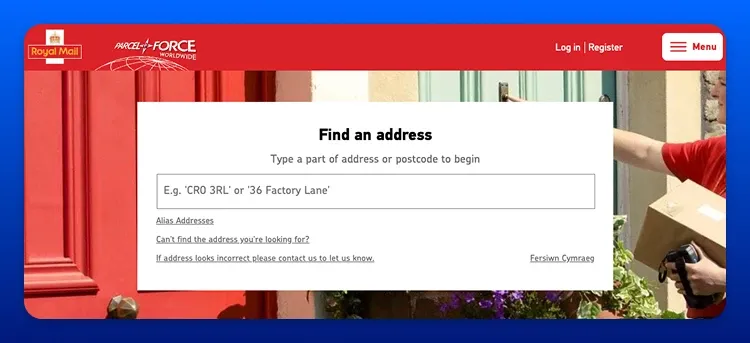
Next, type in the address you are hoping to find a postcode for into the box. As you type, the tool will attempt to provide matches for you to select from. When you’re finished typing, hit enter.
The results, if there are any, will populate below the box you searched in, like this: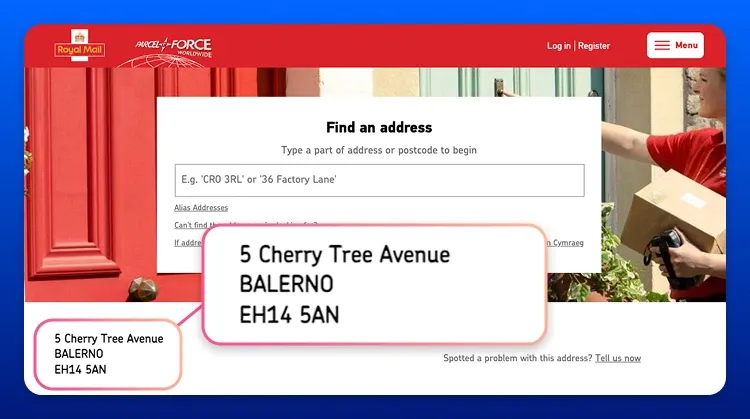
There will be a dropdown to see the postcode appear on a map. However, be aware that they have an asterisked warning at the bottom of the map that states that the “Postcodes are not intended to pinpoint an exact geographical location.” Keep in mind that the pin is located at the postcode centroid, not the address itself.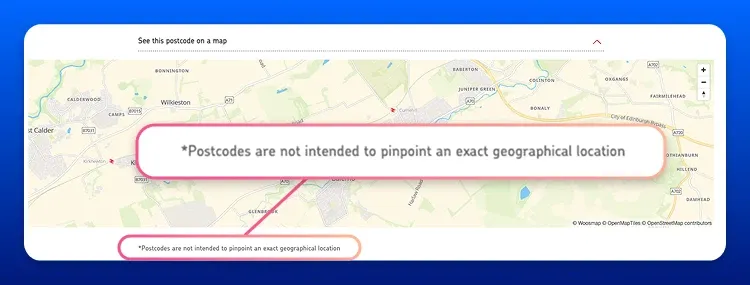
3. Why an address might not appear
There are a couple of reasons that the address you enter may not have a match or populate results:
- New builds: Royal Mail must verify addresses before adding them to the official address database, and in order to do that, they have to get a request from the local authority. New builds may take months to appear in the Postcode Address File.
- “Undeliverable” address flags: Even if the address you have is valid, if Royal Mail’s database has it recorded or flagged as an undeliverable location, the postcode may not populate as a match won’t be found.
- Incorrect or incomplete address components: If your search contains typos, incorrect data, alternate naming conventions, or incompatible formatting, the postcode search will fail as the Royal Mail tool needs an exact match to populate.
- Special postcode exceptions: Some postcodes (like service codes or certain business reply codes) won’t appear in the standard postcode finder and require a paid account to display.
4. Is the Royal Mail postcode finder free?
- Yes! The Royal Mail postcode finder is free for online use. You don’t need to sign up for an account or buy anything to use the tool through the web interface; however, for business use, searching addresses one at a time may be monotonous and time-consuming. Paid accounts with higher usability and functionality are available.
Common problems with the Royal Mail postcode finder
There are limitations associated with the Royal Mail postcode finder, such as:
- No built-in error correction or fuzzy matching: If a user enters an incorrectly spelled road name or partial address, the tool might fail to return results rather than suggest the likely right match, as the Royal Mail’s lookup relies only on exact address matches against the PAF. If you’re manually entering UK addresses in the hopes of getting a UK postcode for it, you might be turning away valid addresses when a match isn’t made because you are one character off from an exact match.
- No latitude or longitude: Although a postcode is tied to locations for mail sorting, the finder doesn’t provide GIS data or latitudinal or longitudinal coordinates for mapping precision or geolocation. If you don’t need that information for your use case, the Royal Mail tool may still be suitable for you.
- Scalability issues: The Royal Mail postcode finder specifically limits how many queries or address lookups you can do through the free postcode finder, as it’s designed for only occasional personal use. If you’re running a business or organization and need more than 50 street addresses per day, the price tag goes way up. You’ll need to purchase a commercial plan instead. Similarly, if you have a list of addresses that need postcodes appended, sorry. You’ll be out of luck using this tool. There’s also no automation with using the tool. Each address will be a manual process.
- Only UK addresses: If you only need UK postcodes, this tool may be enough. f you want a fast, fairly priced way to get postal codes for addresses in bulk—and also cover addresses across 250 countries and territories—Smarty can do that. Our data is updated monthly using multiple authoritative sources for higher accuracy.
- Flat/unit ambiguity: When a building has multiple flats or units, the postcode finder sometimes doesn’t clearly separate them, or may only list the main building rather than every individual flat, even when each flat has its own internal designation. That can lead to a poor customer experience, as users who type in their full address won’t see their exact flat listed.
Again, these limitations in the Royal Mail postcode finder might not affect you or your business use case. But if they do, there are alternatives out there that can help you get the most out of your address data.
Using Smarty as a Royal Mail postcode finder alternative
Smarty has advantages for days when it comes to postcode finding. We’re a commercial address data solution that offers:
- Unmatched, real-time accuracy
- Unparalleled service
- Simple integration
- Global coverage
- Expansive metadata
- Batch processing
- Insane processing speeds
- API flexibility
- Simple and thorough documentation
- And reliability that persists even when other major providers go dark
Postcodes are our wheelhouse. We focus on the details of address data so you and your team don’t have to
And for the US, we also cover “postcodes” in their American form—ZIP Codes—with a dedicated ZIP+4 knowledge base.
How to use Smarty’s single-address postcode finder
Using Smarty’s single address finder for the UK is simple:
- Go to Smarty’s postcode tool and select “International” from the top dropdown and then “UNITED KINGDOM” for the country.
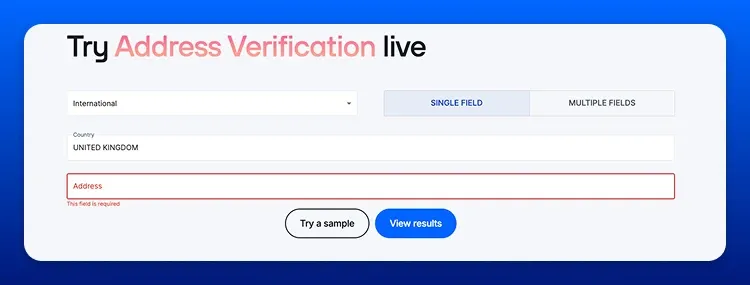
- Enter any UK address in free-form text or select “MULTIPLE FIELDS” to enter an address one field at a time and click “View results”.
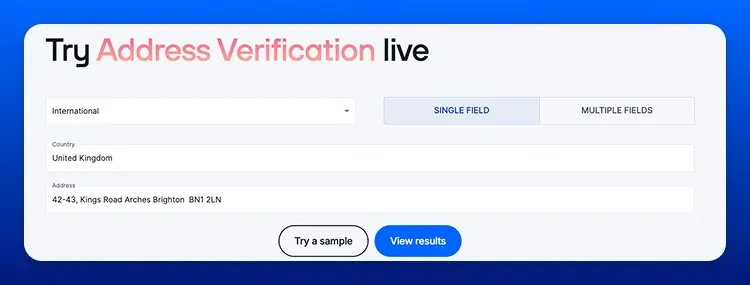
In the background and as fast as lightning, Smarty standardizes it, returns the verified postcode, and provides additional address details for your viewing pleasure. You’ll find the postcode you’re looking for at the bottom of the standardized “Results” section.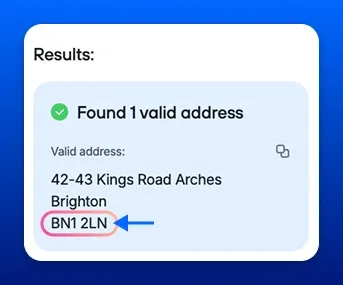
Click “Analyzed Output” to see metadata, such as the geocoordinates of the address.
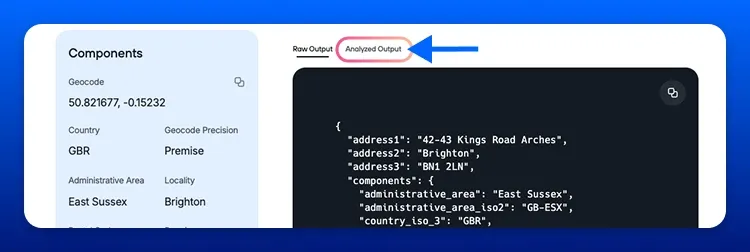
- Copy or export your results as needed with a paid Smarty subscription, or share your results via the link-sharing button at the bottom of the results.
Royal Mail postcode finder vs. Smarty comparison
The Royal Mail postcode finder is a free, web-only tool for looking up individual UK postcodes or addresses. It’s great when you just want to check a postcode one at a time, but it’s not built for software integration, automation, bulk data, fuzzy matching, or structured output.
Smarty is built for real-time form filling, batch cleansing, global support, and structured, delivery-ready address data with leading accuracy. It’s the address lookup tool you’ve been searching for. We’re designed for developers, platforms, and businesses that require accurate address quality at scale — including unit/flat clarity, validation of delivery points, and seamless integration into apps and databases.
Where the Royal Mail finder is like a phone book lookup, Smarty is an easily integrated, powerful address engine that validates, normalizes, and autocompletes addresses.
Here’s a comparison table that shows how the 2 stack up in a head-to-head comparison.
| Capability | Smarty | Royal Mail postcode finder |
| Speed | Instant API responses optimized for apps & forms, runs in the background | Manual web lookup, no programmatic speed or automation |
| Accuracy | High — validated against multiple authoritative data sets, fuzzy matching | Good for basic lookup, but limited by UI search logic and input matching |
| Coverage | Broad — UK + global addressing databases available | UK only |
| Business features | Yes — enterprise logging, SLA, usage tiers, analytics, responsive and knowledgeable support | No — personal, occasional use |
| Batch capabilities | Yes — bulk address validation (cleansing & verification) | No — one at a time, manual entry |
| API options | Yes — REST, SDKs, autocomplete, validation, batch, geocoding, enrichment | No official API for free finder, no BFPO locations |
| Data standardization | Yes — normalized, canonical, structured, deduplication assistance | No — basic unstructured results |
Royal Mail postcode finder FAQ
What is the Royal Mail postcode finder?
This is a UK-based and UK database-sourced tool that takes one-at-a-time, manual entry of partial addresses from a user to produce full postcodes that match that address. It references the Royal Mail Postcode Address File (PAF) to provide users with a postal code. If the address entered doesn’t match an address in the online tool, no postcode will be returned.
How does the Royal Mail postcode finder work?
A user enters a partial address, hits enter, and a postcode (if an exact match is found) is returned to the user.
Does every address have a unique postcode?
No. Not every UK address has a unique postal code. The Royal Mail Postcode Address File contains lists of UK postcodes that are very precise, but typically not one-to-one with addresses. While UK postcodes are designed to support mail delivery, they don’t identify every structure attached to them. That’s usually the job of a secondary designator like flat, Maisonette, Bedsit, etc., or a street address with a main property number.
Unique postcodes typically cover 1-15 addresses (give or take), a short section of a street, or multiple flat numbers within a single building.
However, they’re also often assigned to large organizations, government buildings, major businesses, and PO Boxes, similar to the US-unique ZIP Code structure.
How can I verify a UK postcode?
If you have 1-10 UK postcodes needing verification, and if you’re certain that the information you have on Address Line 1 is correct, the Royal Mail postcode finder is a great option to use for small, personal UK postcode verification.
If, however, you have a larger list of UK postcodes needing verification, or if you aren’t sure of the rest of the address’s accuracy, you may want to head on over to Smarty.com and sign up for a 42-day free trial of International Address Verification.
Not only will Smarty verify the UK postcodes in your list, but we’ll also return valuable metadata for you to analyze, like the correct UK address mailing format for every country in the world, residential or commercial use, and a precision meter for the geocode attached.
Are there errors with Royal Mail tracking?
Yes — Royal Mail tracking does have known limitations, and most of the issues people experience come down to how the service is designed rather than parcels actually being lost.
Pending
It’s very common for tracking to show “Pending” or long gaps with no updates, especially early in the journey. This usually means the item hasn’t been scanned yet or intermediate scans weren’t captured — not that anything is wrong.
Many Royal Mail services only record key milestone scans, so parcels often move through the network without visible updates and then suddenly jump to “Out for delivery” or “Delivered.”
Inconsistent/delayed status updates
The Royal Mail’s tracking information lags behind the parcel’s real location. During busy periods, scans may be uploaded late or skipped entirely, resulting in vague messages like “Item scanned” without a location or timestamp.
Integration issues also add confusion: tracking may work on Royal Mail’s site but fail to update properly on marketplaces like eBay or Etsy, which can delay confirmations or payments even though a delivery was successful.
Technical difficulties
Royal Mail’s website or app occasionally experiences outages or displays errors, making tracking temporarily unavailable or inaccurate. Combined with limited scan visibility and delayed data syncing, this can create the impression that tracking is unreliable — even when parcels are still moving as expected.
What is a postcode checker?
A postcode checker is just a tool people use to find a postcode for an address that is valid.
Final thoughts

The Royal Mail postcode finder is a reliable, free tool for simple, one-off UK postcode lookups when you’re confident the address data you have is already accurate. For individuals or very small use cases, it does exactly what it’s designed to do: confirm a postcode for a known address.
However, the tool’s limitations become clear the moment you need speed, scale, automation, data standardization, or international coverage. It isn’t the best tool to use for business as it doesn’t support batch processing, utilize automated APIs, employ fuzzy matching, provide geocodes, or produce structured output—especially when dealing with flat/unit ambiguity, which can introduce friction in real-world scenarios.
Smarty fills those gaps.
We’re built for fast, accurate, easy-to-integrate, and scalable postcode and address validation, whether you’re validating a single UK postcode, processing thousands of records in bulk, or integrating address intelligence directly into forms, applications, and workflows.
With global coverage across 250 countries and territories, structured standardized output, optional geocoding, and flexible API options, Smarty is designed for businesses that treat address data as critical infrastructure—not a manual task.
In short:
- Royal Mail postcode finder → great for quick, simple checks
- Smarty → best for complete, accurate, scalable, integrated, and internationally standardized address results
If you’re ready to move beyond manual lookups, try Smarty’s single-address tool, batch processing, or API integrations to see the difference for yourself.
Was this helpful?