


Selling globally should be exciting! Not exhausting. Without the right tools, cross-border ecommerce can feel like opening a neglected closet where old coats, soccer cleats, and broken umbrellas fall on your face. Ouch.
Choosing the right cross-border ecommerce solutions makes global shopping easier for your customers. It also helps your B2C ecommerce operations increase sales, reduce fraud, avoid routing errors, and save time, especially in customer service.
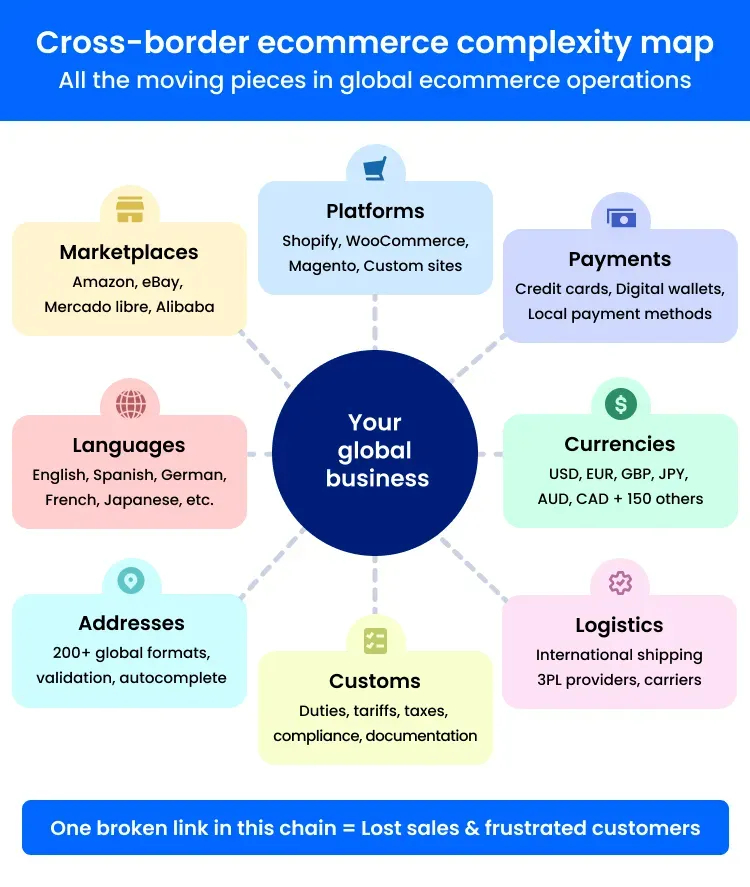
You can use cross-border ecommerce solutions in your whole process. This includes your ecommerce platform, sales channels, credit card processing, local payments, third-party logistics, international shipping, customs, duties, and shipping fees.
Smarty offers several cross-border ecommerce tools that make running your global market smoother. You can try them out below.
These tools help you speed up checkout and keep every address accurate in your database. It doesn’t matter if your customers are in North America or Australia; your addresses stay perfectly formatted according to each region's postal standards, so that international ecommerce transactions run smoothly.
Keep reading to learn about ecommerce marketplace services to common cross-border ecommerce challenges, and how to improve accuracy across your supply chains and enhance the overall customer experience.
In this article, we’ll answer these questions and address the complexities of international trade:
- What is address autocomplete, and why does it matter in global ecommerce
- Key benefits of smarter address autocomplete APIs for cross-border sales
- How to implement address autocomplete in your cross-border checkout
- Conclusion: The future of cross-border ecommerce with smarter address data entry
- Cross-border ecommerce solutions FAQ
- What is cross-border ecommerce?
- How does address autocomplete improve international checkout?
- What’s the difference between address autocomplete and address verification?
- How does Smarty’s global address completion API handle global formats?
- Why is international address validation important for ecommerce?
- How can I integrate Smarty’s International Address Autocomplete API?
- How much does Smarty’s International Address Autocomplete cost?
What is address autocomplete, and why does it matter in global ecommerce
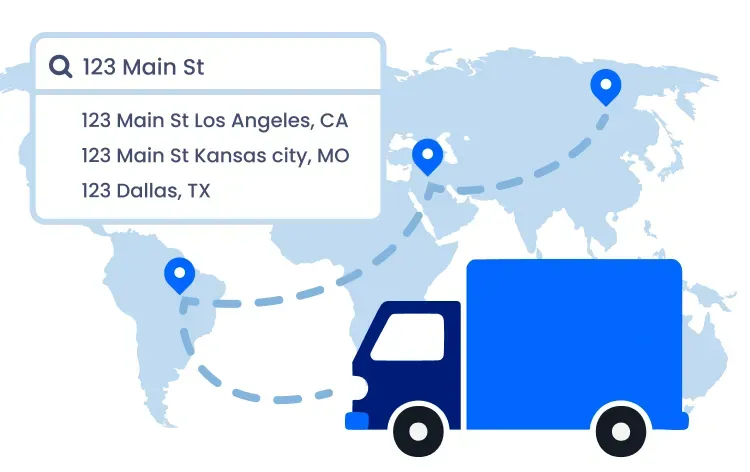
Address autocomplete suggests accurate addresses in a dropdown as someone types. Users select their address (within 5-6 keystrokes), and the address fields are automatically filled into your form, checkout page, or anywhere you have autocomplete implemented. This is especially helpful if you’re a B2C commerce brand selling through global marketplaces and mobile-first sales channels.
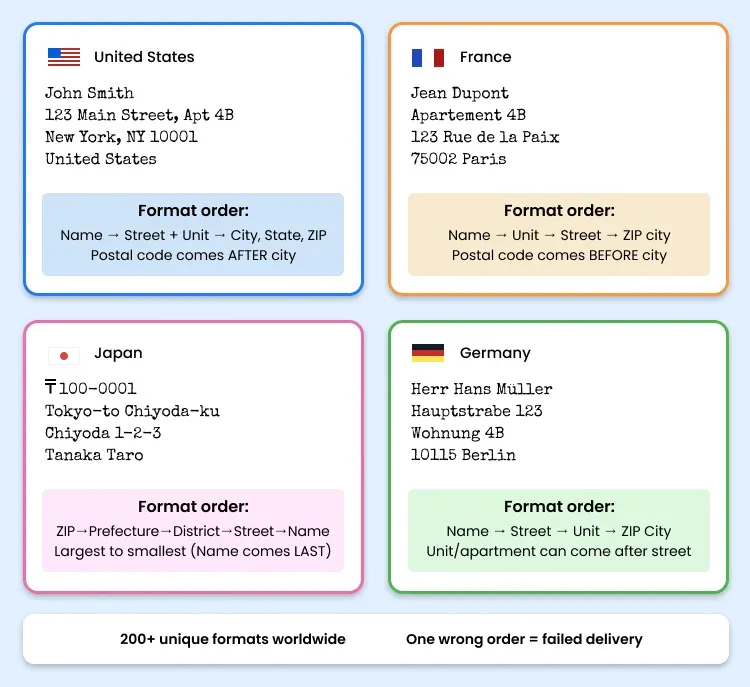
For business across borders, address autocomplete becomes even more important. Tariffs cause shipping problems. Customs clearance can delay deliveries. Address formats and abbreviations differ by country. Transliteration becomes complicated if you do it manually.
A basic address autocomplete tool suggests addresses as users type. Depending on data sources and the purpose of the tool, the addresses might be accurate, they might be formatted correctly, or they might not be.
Smarty prioritizes accuracy above all in every address product. These ecommerce tools provide the most precise address suggestions with cross-border intricacies built in. Each address is formatted correctly for each country and territory, with comprehensive documentation so you get the perfect configuration for your target market.
Address autocomplete helps customers finish checkout faster. When you add address verification, your business becomes more reliable. This also strengthens your international business plan.
Autocomplete increases conversions by simplifying the form-filling process. Verification checks that the address is correct for international markets. This helps avoid failed deliveries, shipping delays, and costly reships. Verification gives up to 55 data points for each address. This data helps with marketing research, ecommerce marketing, better ecommerce performance, and smarter logistics.
How address autocomplete works for US and global addresses
Cross-border ecommerce solutions like address autocomplete and address verification help eliminate many “oops” moments that come with running an online business. Also, using address verification brings in an added layer of protection, data points, and consistent, accurate address data.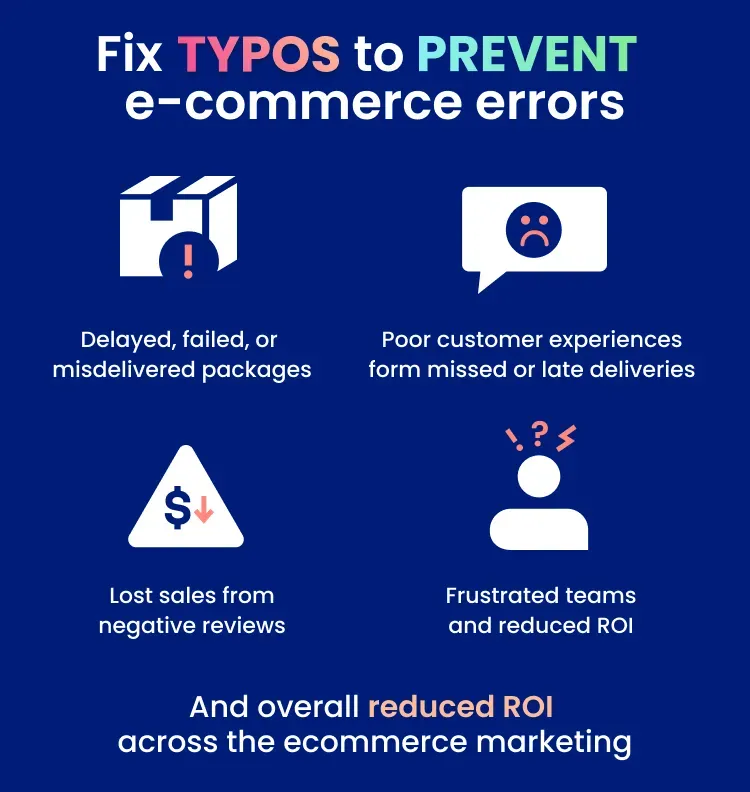
Here’s what they help you avoid:
Fix typos to prevent ecommerce errors
These tiny human errors can cause a huge chain reaction for your ecommerce platforms. One wrong keystroke and suddenly you’re dealing with:
- Delayed, failed, or misdelivered packages due to inaccurate address entry
- Poor customer experiences from missed or late deliveries show up in negative reviews
- Lost sales, both from customers who don’t come back and new shoppers scared off by negative reviews
- Reshipping costs, including new packaging, extra postage, etc, that impact profit after shipping
- Increased shipping surcharges and manual handling, wasted time
- Frustrated teams, from customer service reps fielding angry “Where’s my order?” calls to the poor fulfillment worker who swears if they have to bubble-wrap that same item one more time…
- And overall reduced ROI across the ecommerce marketing value
Update customer addresses regularly
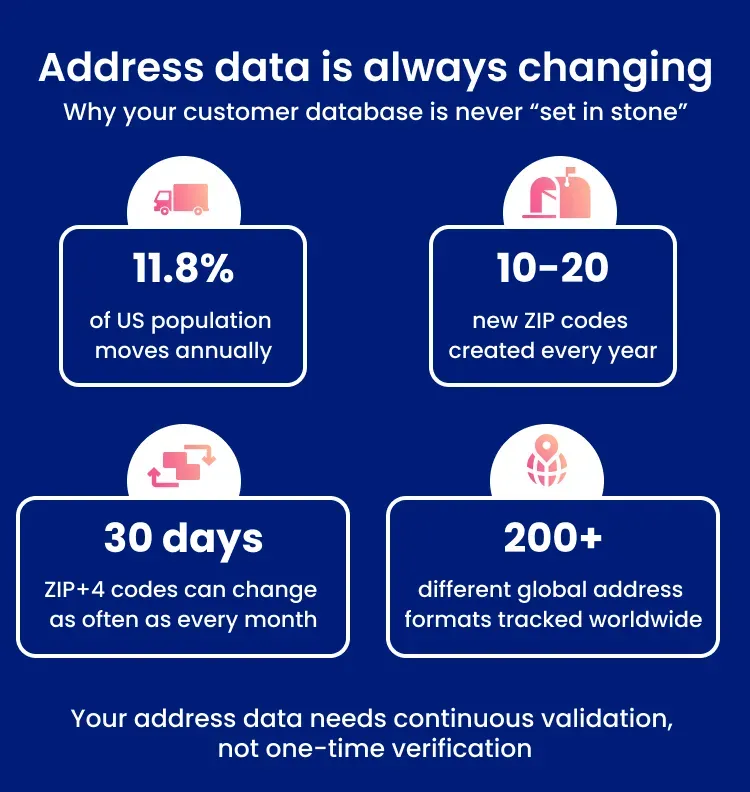
If you think your customer database is set in stone, think again. Addresses are constantly evolving. Streets are renamed, city boundaries shift, ZIP Codes change, and entire address systems evolve as infrastructure modernizes.
It’s not just little tweaks either. Millions of addresses change every year. According to the U.S. Census Bureau, about 11.8% of the U.S. population moved in 2024, which translates to about 40.1 million people changing residences in one year.
Every one of those moves creates new customer address data. On top of that, every new apartment complex, neighborhood, and business development that’s built needs to be assigned a new address.
ZIP Codes and delivery routes change even when people don’t move
Even if your customers never move, their addresses can still change without them ever knowing it. The USPS creates 10-20 new ZIP Codes each year to keep pace with growth and meet shifting delivery needs. A customer’s ZIP Code can change even when they stay in the same home.
And it’s not just the full ZIP Code that can change. The +4 portion of ZIP Codes changes, too. sometimes as often as every 30 days. Why does this happen so frequently? It’s because the +4 portion identifies the exact delivery path a mail carrier follows. As routes change due to new construction, rezoning, or changes in postal staffing, so do the ZIP +4s to accommodate. When those shifts happen, the ZIP+4 Code is updated to match the new route, even though your customer’s house didn’t move an inch, and most never even realize it happened.
With these address changes, domestic ecommerce transactions face instability, and the same is true for international ecommerce transactions.
Globally, the challenge is even bigger. The Universal Postal Union tracks over 200 different address formats, and many countries regularly update their addressing rules as they update their postal systems.
Address data is always in motion. That means you need two cross-border ecommerce solutions working together:
Address autocomplete helps your customers enter clean, correctly formatted addresses at checkout for a terrific customer experience.
Address verification confirms the address is real, current, and deliverable right now, not six months ago when it was last updated. A key ecommerce resource is being able to verify your address list in bulk regularly to make sure that you have the most up-to-date information to work from.
Understand mobile abandoned cart trends
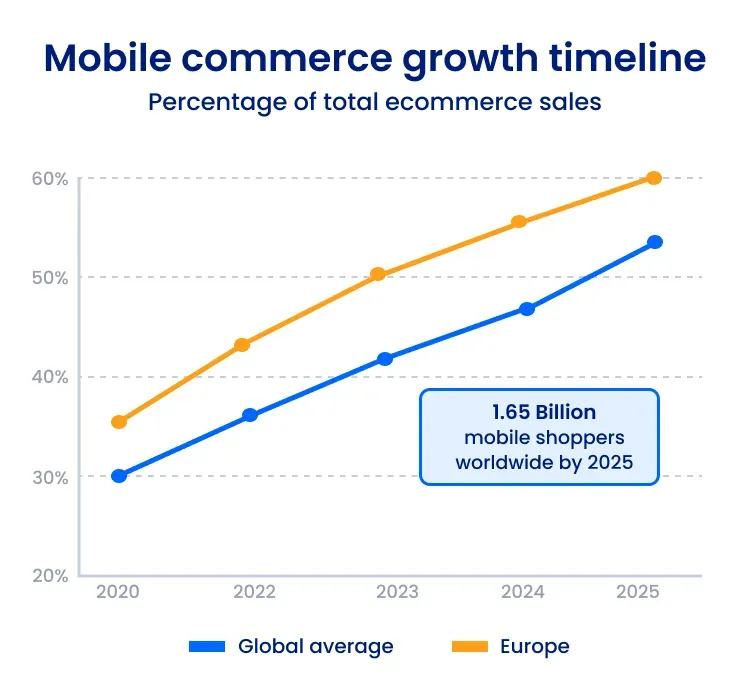
Tons of people make purchases from their phones. Mobile commerce is expected to account for 59% of all global ecommerce sales by 2025, and more than 1.65 billion people worldwide will shop on their phones next year. In many regions, including Europe, mobile already accounts for 60 percent or more of all online transactions, with no sign of slowing down.
With so many shoppers using small screens, nobody (and we mean nobody) wants to type a full address across multiple tiny form fields. Long, manual address entry is one of the fastest ways to lose a sale. Address autocomplete makes filling out any type of address form fast, easy, and accurate, especially on a phone.
Missing secondary address unit designators
People make mistakes. It’s easy to forget a new apartment number or accidentally skip over an address field. Autocomplete and address verification APIs make sure that every address entered is complete AND valid, and stays valid.
Not every address autocomplete product offers unit, suite, apartment numbers, etc, in their suggestions. If yours doesn't, you're setting yourself up for delivery failures and a bad customer experience. Not only does this affect your local shipments, but it’s just as critical for cross-border ecommerce.
When international customers land on your site, they're already navigating unfamiliar territory. Making the checkout experience top-notch is essential to securing the sale. A sophisticated autocomplete that knows how to handle different countries and territories formats, and suggests complete addresses with unit numbers, signals trust. It tells customers you're equipped to handle their order.
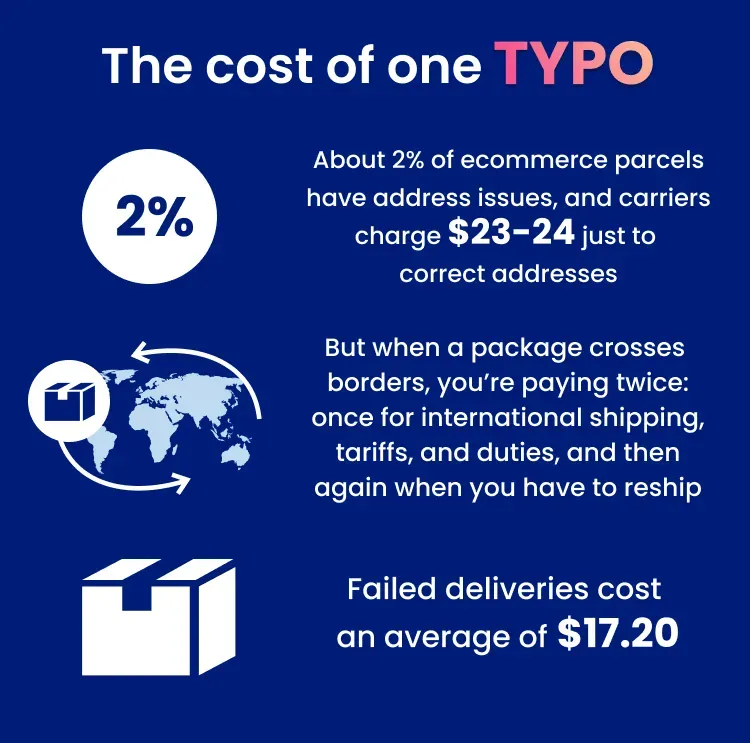
The stakes are even higher with International ecommerce transactions that end up with a misdelivery have even higher financial ramifications for you. Failed deliveries cost an average of $17.20, but when a package crosses borders, you're paying twice: once for international shipping, tariffs, and duties, and then again when you have to reship. About 2% of ecommerce parcels have address issues, and carriers charge $23-$24 just to correct addresses.
Cross-border ecommerce solutions like International Address Verification and Autocomplete help you build a good brand image. They also help you grow globally and get a good return on investment.
You get faster checkouts, higher delivery success rates, fewer complaints, and become known as an internationally trustworthy brand.
Key benefits of smarter address autocomplete APIs for cross-border sales
Address autocomplete makes doing business across borders easy for your customers by providing accurate address data at checkout. A faster checkout means higher sales volume. Address verification ensures that all customer addresses remain accurate and up to date every time an order is placed, so you scale faster across global marketplaces and international marketplaces.
Let’s see it in action.
Fabletics: Real-world use case and success story
Fabletics, the global activewear brand, is a perfect example of this. With over 80% of customers shopping on mobile devices, Fabletics needed a fast, easy, and accurate experience for customers all around the world.
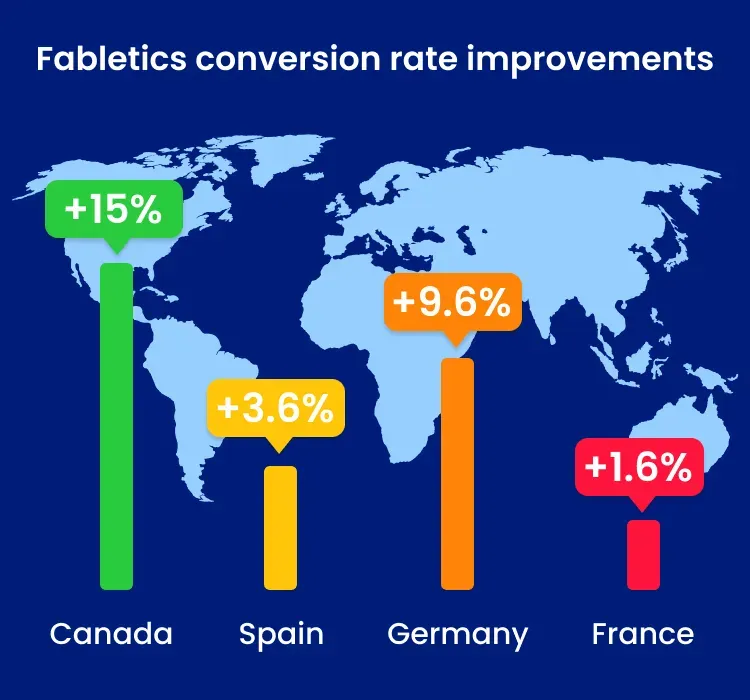
After integrating Smarty’s address autocomplete and verification APIs into the checkout flow, Fabletic saw immediate improvements in North America, but also in international conversion rates:
- 15% in Canada
- 9.6% in Spain
- 3.6% in Germany
- 1.6% in France.
Customers no longer had to wade through long forms, and Fabletics loved Smarty’s responsive support, ease of implementation, and global address coverage. The company has even higher customer satisfaction and a seamless, scalable checkout experience across regions. 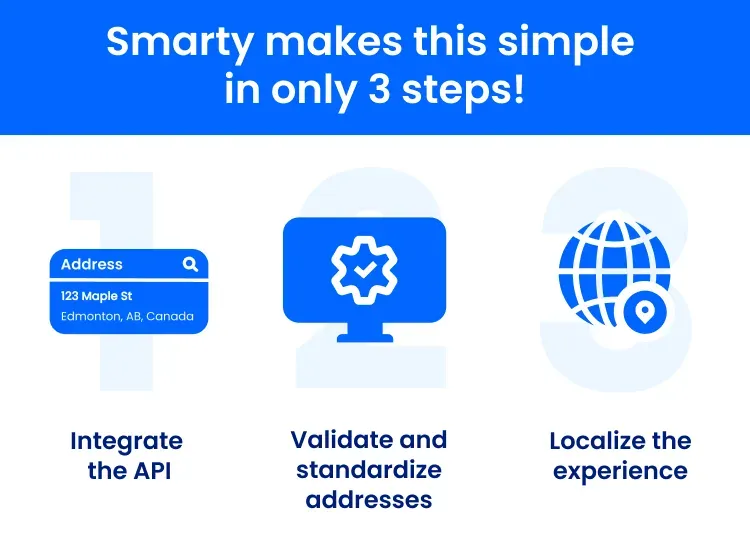
How to implement address autocomplete in your cross-border checkout
Not all address tools are created equal. To compete internationally, you need cross-border ecommerce solutions. These solutions must support every country you sell to. They must also correctly validate international address formats. Smarty makes this simple in only 3 steps! (4, if you count the happy dance we encourage you to do at the end! 🪇)
Step 1: Integrate the API into your checkout form
Start by signing up for a Smarty account or a 42-day free trial of International Address Autocomplete.
- Create the API key and connect the autocomplete endpoint to your checkout form’s address fields.
- As your customer begins typing, the API instantly returns clean, properly formatted suggestions according to the local postal authority in each country, such as Canada Post, La Poste, and Deutsche Post.
- When they choose an address, the rest of the form fills in automatically, including city, region, postal code, and country.
Tip: To save on your API usage, trigger autocomplete after the third character. Address suggestions still appear in real time, and it doesn’t have a negative effect on the user experience.
Before launching, test your checkout with different languages, devices, and address formats to ensure everything behaves exactly as expected.
Step 2: Validate and standardize addresses
Autocomplete gets your customers across the finish line faster, but it can’t guarantee that the address will stay accurate forever. That’s why validation is an essential cross-border ecommerce resource.
Validating an international address confirms that it’s real, current, and ready for you to use. Incorrect or incomplete addresses are a significant cause of delivery delays and failed shipments, resulting in additional costs, frustrated customers, and slow cross-border fulfillment.
When you pair autocomplete with full global address validation, you ensure that the address your customer selects is accurate before the package ever leaves your warehouse, and stays that way for their next order.
Step 3: Localize the experience
Localization is the final step to creating a checkout experience that feels comfortable and familiar to international customers. This means presenting addresses, languages, and characters in the way shoppers expect to see them.
Your autocomplete should change based on local rules. For example, postal codes come before cities in France. In Japan, prefectures come first. It should support both native and Latin characters using transliteration services. The level of detail you show to personalize your customer’s experience to their local context builds trust and encourages them to complete their purchase (and make more purchases in the future).
Tip: A fully localized checkout should also display prices in local currencies and offer payment methods that are go-to options for shoppers in that region. Maybe it’s a credit card or a digital wallet? Whatever it is, use it. Small touches like these can significantly improve your global conversion rates.
Conclusion: The future of cross-border ecommerce with smarter address data entry
Global ecommerce is growing fast, and your checkout needs to keep up. The companies that win internationally are those that remove friction at every stage of the buying process. Shipping products, managing shipping times, and coordinating shipping providers are already complex enough. Without accurate addresses? You’re looking at a big pile of mess. When your address data is accurate, everything in that shipping chain runs smoother, faster, and more reliably.
With the right tools, such as Smarty's International Address Autocomplete and Verification APIs, you can make every global shopper a happy customer. A simplified checkout is a foundational element of a successful international business plan.
When every address is entered quickly and correctly, the benefits ripple across your entire organization. You get happier customers, fewer delivery mistakes, faster processing, and fewer support tickets. From quicker form fills to fewer late-night “where is my package” calls, smarter cross-border ecommerce solutions keep your whole operation running more smoothly.
Sign up for Smarty and simplify your cross-border checkout experience today.
Cross-border ecommerce solutions FAQ
What is cross-border ecommerce, and how it works
Cross-border ecommerce is the practice of selling services or goods online from one country or territory to a customer in another. It involves managing different address formats, payment methods, currencies, languages, shipping methods, logistics, and more across international borders.
Businesses can engage in it through their own direct-to-consumer sales channels or by leveraging online marketplaces or established international marketplaces, like Amazon or Mercado Libre.
How does address autocomplete improve international checkout?
International checkout is streamlined, and friction is reduced with intuitive cross-border solutions, such as address autocomplete, which predicts and completes customer address data in real-time as it’s being entered online. This returns management hack reduces typing errors, which in turn reduces lost or returned-to-sender mail. It also increases conversion rates.
What’s the difference between address autocomplete and address verification?
Address autocomplete suggests valid, properly formatted addresses as a user types, making data entry fast and accurate.
Address verification goes a step further by checking if the completed address is real, mailable, and deliverable according to the official postal service of that country.
The best practice is to use both: autocomplete for a smooth front-end customer experience and verification on the backend to ensure data quality before shipping, and a smooth last-mile experience.
How does Smarty’s global address completion API handle global formats?
Smarty uses the country’s local postal authority to inform each address prediction. We support multiple languages and character sets through transliteration so that addresses look and function correctly, from Japan to Jamaica.
Why is international address validation important for ecommerce?
While autocomplete will predict accurate addresses, that doesn’t necessarily mean that you can send mail or packages there. International address validation is crucial for scaling a cross-border business.
Entering a new target market without a plan for data quality is risky. After doing market research and following international Positive List rules, validating addresses ensures your products reach new customers. It prevents failed deliveries, unexpected fees, and customer frustration, saving you money and protecting your brand’s reputation as you expand.
How can I integrate Smarty’s International Address Autocomplete API?
Simple! Just sign up for an account or free trial, get your API key, and have your developer connect it to your checkout form’s address fields. Our documentation is clear, and our support team is ready to help you get started on any of your ecommerce platforms.
How much does Smarty’s International Address Autocomplete cost?
Smarty offers a 42-day free trial with generous lookup limits. After that, pricing depends on your volume and use case, but none of us has to go talk to our manager here. You can see our very transparent pricing model here. Simply select the cross-border solutions on the left-hand side to see the cost. You can also browse through our US address-based products!
Was this helpful?