
Provider directory accuracy: How to improve healthcare directory data
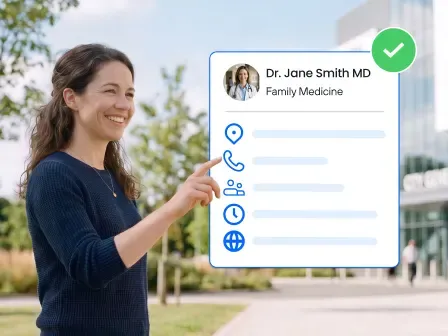


Patients depend on provider directories to find available, in-network providers, meaning payers and other provider network managers need to maintain an accurate directory for each health plan they offer.
However, because provider data is supplied by providers, the facilities they work for, or other medical groups, payers often end up with unstandardized or incorrect provider data. If payers include that bad data in a provider directory sent to members, they risk noncompliance, incur higher operational costs, and erode member trust.
With a repeatable workflow that improves provider directory data quality, payers can standardize and validate a provider’s location, contact information, availability, and network participation before inaccuracies lead to complaints, fines, or reputational damage.
In this article, we explain why provider directories become inaccurate and how you can improve provider directory accuracy, reduce ghost listings, and support provider directory compliance.
Since Smarty specializes in address data, we’ll also look at improving provider address accuracy as one part of provider directory management. While the remainder of the article covers the broader topic of provider data accuracy, feel free to take a moment to check out Smarty's APIs to see how you can automatically clean the provider address in your directories.
Table of contents
- What is provider directory accuracy?
- Why provider directory accuracy matters
- Provider directory accuracy requirements
- Why are provider directories inaccurate?
- How to improve provider directory accuracy
- How address verification supports provider directory accuracy
- Building a sustainable provider directory management process
- Conclusion: Make accurate locations the foundation of provider directories
- Provider directory data accuracy FAQ
What is provider directory accuracy?
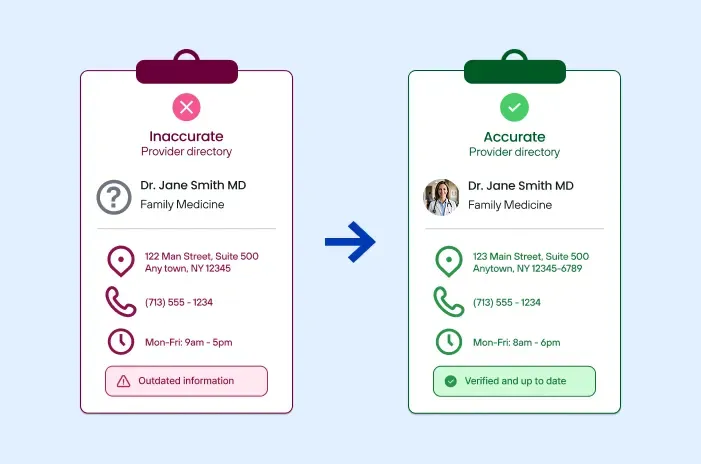
Provider directory accuracy measures whether a health plan’s directory correctly reflects current, in-network providers and the information members need to locate and contact them. Payers and other provider network managers maintain high provider directory accuracy by regularly updating and verifying a provider’s:
- National Provider Identifier (NPI)
- Specialty
- Secondary languages
- Network participation
- New-patient status
- Telehealth offerings
- Practice address
- Practice county
- Practice phone number
- Practice hours
- Practice website
- Practice accessibility
- Practice type (hospital, clinic, urgent care, etc.)
Currently, the No Surprises Act requires payers to “take steps to update and verify the accuracy of their provider directory information at least once every 90 days.” Beginning in 2028, the REAL Health Providers Act will also require payers offering specific Medicare Advantage plans to:
- Verify their provider directory information once every 90 days
- Indicate any information in their provider directory that they’re unable to verify
- Remove any provider they determine is no longer participating in the network from their directory within 5 business days
- Include a provider’s specialty, contact information, practice locations, new-patient status, accessibility, secondary languages, and telehealth offerings in their directory
Whew! That’s a big job for any payer, but with automation, it doesn’t have to be.
What information needs to be accurate?
Provider directory data accuracy isn’t limited to a provider’s name; it encompasses each point of provider data included in a directory. That’s why payers need a repeatable provider directory validation workflow that can verify provider addresses, specialties, phone numbers, hours of operation, website URLs, and other vital directory information.
What is a doctor directory?
The term “doctor directory” is often used interchangeably with “provider directory.” However, there is a difference between the two. While provider directories include both providers and facilities, doctor directories only list providers who work at a specific facility or who provide medical services through a foundation.
Why provider directory accuracy matters
Healthcare provider directory accuracy matters for payers, data teams, providers, and patients.
Payers need accurate provider directories to keep ineligible providers, whether they’ve left the network or lost their license and been flagged for criminal offenses, from appearing as available, in-network providers.
That prevents ghost networks, which occur when a directory appears to offer adequate access but lists providers that members can't meaningfully use.
For example, a ghost network might list an address for a surgeon’s office that’s within driving distance of members, but in reality, that address actually points to a pharmacy located inside a grocery store.
By preventing ghost networks, provider directory data accuracy helps payers confirm that every member can access nearby providers.
Data teams rely on accurate provider directories from payers to resolve mismatched, duplicate, and conflicting provider data across health plans, preventing downstream data-quality problems before they lead to reputational damage or compliance risk.
Providers need to be accurately represented in provider directories, so members can easily find up-to-date contact, location, and network information. That way, providers don’t lose patient opportunities.
Members who use accurate provider directories don’t lose trust in payers. Instead, they experience fewer failed calls, fewer trips to outdated locations, fewer surprise out-of-network costs, and fewer difficulties finding care.
Provider directory accuracy requirements
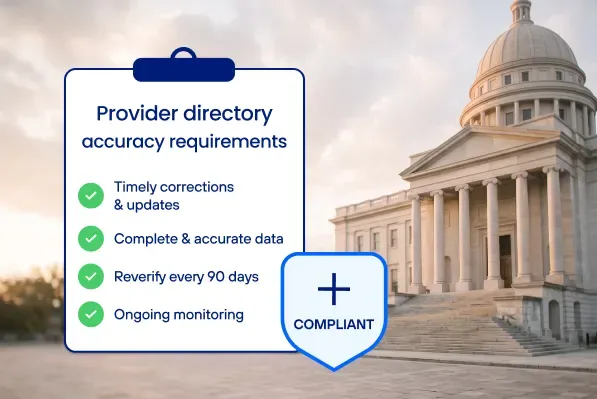
Provider directory accuracy also matters for payers' regulatory compliance with the No Surprises Act and the REAL Health Providers Act.
To maintain provider directory compliance with the No Surprises Act, payers need to improve their provider directory accuracy by:
- Verifying provider directory data every 90 days, not just after initial registration
- Updating provider data within 2 business days of receiving changes
- Including provider name, address, specialty, and contact information in public, online provider directories
In addition to federal requirements, state regulations ensure that payers maintain provider directory data accuracy.
For example, in California, payers are also required to include a provider’s NPI, California license number, license type, non-English secondary languages, and new-patient status in their provider directory.
What changed with the REAL Health Providers Act?
In 2028, additional provider directory regulations will be issued under the REAL Health Providers Act for payers offering specific Medicare Advantage plans. In addition to the requirements listed above, payers will ensure provider directory accuracy by:
- Flagging provider directory information that they can’t verify
- Removing providers that are no longer in their network from their directory within 5 business days
- Adding a provider’s practice locations, new-patient status, accessibility, secondary languages, and telehealth offerings to their directories
Why are provider directories inaccurate?

Provider directories become inaccurate when:
- Provider information changes: Providers regularly change practice locations, phone numbers, new-patient status, and network participation.
- Data arrives from multiple sources: Payers receive provider data from providers, hospitals, clinics, and other healthcare organizations. Formatting differences among those sources can prevent reliable record matching.
- Data isn’t verified before publication: Before it appears in a directory, provider data needs to be verified against an authoritative source. Otherwise, typos and other human errors may lead to provider-to-location relationships being incorrectly attributed.
- Updates don’t sync across systems: Updating a provider’s information for one health plan doesn’t necessarily update that information across others.
- Updates are delayed: Outdated information may remain in a directory while payers manually correct provider data.
Why provider addresses deserve special attention
Verified, standardized provider addresses can help payers solve several of those data-quality challenges.
Address standardization resolves minor formatting differences in a single provider’s address (e.g., 100 Main St Ste 100 Centre, AL 35960 and 100 Main Street #100 Centre, AL 35960). Consistent address formatting makes it easy to reliably match incoming provider records to existing ones, and sync updates across health plans.
Address verification confirms that a provider's address is complete and up to date. Combined with other provider identity data, that gives payers cleaner data for subsequent provider-at-location verification.
With these address data solutions, you can improve your provider directory accuracy, even when provider data arrives from providers in different formats.
How to improve provider directory accuracy
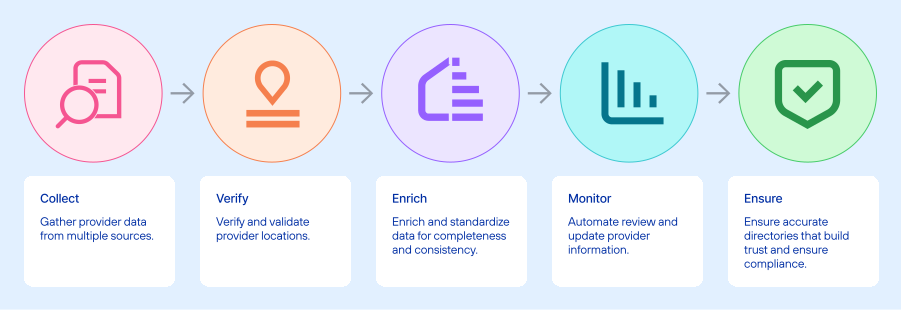 To improve provider directory accuracy, payers can implement a repeatable workflow that standardizes, verifies, and enriches provider data, then automates updates and monitors accuracy over time. Here’s a step-by-step workflow to help you get started.
1. Define a source of truth for every field
Provider data arrives from different sources. When sources disagree, you need an established source of truth for each field. That’s why your provider directory management workflow should start with identifying authoritative sources, such as the National Plan and Provider Enumeration System (NPPES), and then checking a provider’s NPI, credentials, network participation, provider status, address, phone, specialty, and other fields against those sources.
2. Verify healthcare-specific attributes
Next, verify each healthcare-specific provider data field against the authoritative source. That includes a provider’s:
- NPI
- Taxonomy
- Network participation
- Credentials
- Specialty
- New-patient status
- Telehealth offerings
- Secondary languages
3. Standardize provider and facility addresses
For provider addresses, the first step of an automated verification process is standardization. Standardization corrects spelling, abbreviation (e.g., changing “Florida” to “FL”), and capitalization errors, then converts addresses into a consistent format set by the local postal authority, or even Project US@. That helps payers match provider records across directories, identify duplicates, and merge them.
4. Validate physical locations
After standardization, verification confirms that an address is real and valid, without proving that a specific provider actually practices there. To keep incomplete or problematic addresses out of provider directories, payers can verify provider addresses at intake and flag any that fail verification. Verification can also return latitude and longitude coordinates, often putting a pin at the secondary address level, such as a doctor’s suite.
5. Reconcile provider-location relationships
As part of address verification, payers often enrich addresses with metadata, including a persistent, unique identifier (PUID) for each verified address. While they’re not provider identifiers, PUIDs identify addresses, no matter how many times they change. Payers can compare PUIDs with provider identities to reconcile provider-location relationships and flag duplicate, conflicting, stale, or improbable relationships for additional verification.
6. Enrich provider and facility location records
Payers can further enrich provider addresses with healthcare facility data, which adds context about the facility where the provider operates. Payers can better investigate discrepancies in provider records using this additional data—which includes a facility’s contact information, operating hours, classification, and parent-subsidiary relationships—and flag when a provider’s address doesn’t refer to their actual facility.
7. Automate discrepancy detection and updates
To keep up with constantly changing provider data, build automated processes into your provider directory management workflow that:
- Compare records on a regular schedule
- Flag discrepancies
- Route exceptions to the right reviewer
- Record each time provider data is verified
- Sync provider directory updates across health plans
- Monitor changes to provider attributes and physical locations
8. Measure accuracy continuously
After implementing a repeatable provider directory verification workflow, track its ROI with KPIs like:
- Percentage of fully verified records
- Address validation rate
- Provider-at-location verification rate
- Percentage of records with conflicting sources
- Time from reported change to published provider directory updates
- Percentage of stale or unverified listings
- Accuracy by data field
- Accuracy by provider, location, or network
Provider directory accuracy checklist
Use this checklist when validating new provider records, reviewing changed records, or conducting periodic directory verification.
| What to check | What to verify |
|---|---|
| Provider identity | Match the provider’s name and identity against an appropriate healthcare source. |
| NPI | Verify the provider’s NPI and associated provider information against NPPES. |
| Taxonomy and specialty | Confirm the provider’s taxonomy and specialty using a trusted healthcare-specific source. |
| Credentials and licensing | Verify credentials and licensing against an authoritative source. |
| Network participation | Confirm that the provider currently participates in the specific health plan and network indicated by the directory. |
| Contact information | Verify the provider’s phone number, website, and other relevant member-facing contact info. |
| Accepting-new-patients status | Check whether the provider is currently accepting new patients at the location displayed by the directory. |
| Member-access attributes | Verify relevant fields such as secondary languages, accessibility information, telehealth availability, and office hours. |
| Provider-location relationship | Confirm that the provider actually practices at each listed location. A valid address alone doesn’t establish this relationship. |
| Address standardization | Normalize street names, directionals, abbreviations, secondaries, and ZIP Codes so that duplicate addresses can be matched reliably. |
| Address validation | Verify that each listed location is real and capture secondary information, such as suite or building number. |
| Location type | Determine whether the provider’s address represents a practice or facility, rather than a mailing address, outdated location, or other non-compliant listing. |
| Facility information | Verify the facility name, type, hours, and other location-specific attributes separately from provider identity. |
| Duplicate records | Identify duplicate providers, locations, and provider-location relationships caused by formatting differences or records from multiple sources. |
| Conflicting sources | Flag disagreements among NPPES, payer records, provider attestations, licensing data, claims, operational signals, and other sources. |
| Source and verification date | Record which source supported each field, when the source was last verified, and the method used to verify it. |
| Changes since last verification | Flag new or changed information from previously verified, unchanged records so updates can be prioritized. |
| Exception review | Route ambiguous, contradictory, or low-confidence records for manual review, rather than automatically treating them as accurate. |
| Downstream synchronization | Make sure approved corrections propagate to member-facing directories and other systems that rely on provider data. |
| Ongoing monitoring | Monitor provider, location, network, contact, and availability changes and repeat verification according to applicable requirements and internal policies. |
Directory accuracy is a record-level and relationship-level problem. Directories that list a valid address and NPI for a provider may still be wrong. For example, a directory may still be wrong if the provider no longer practices at that location or no longer participates in the listed network. That’s why accurate directories require separate validation for provider identity, location, provider-location relationships, network participation, and other member-facing attributes.
How address verification supports provider directory accuracy
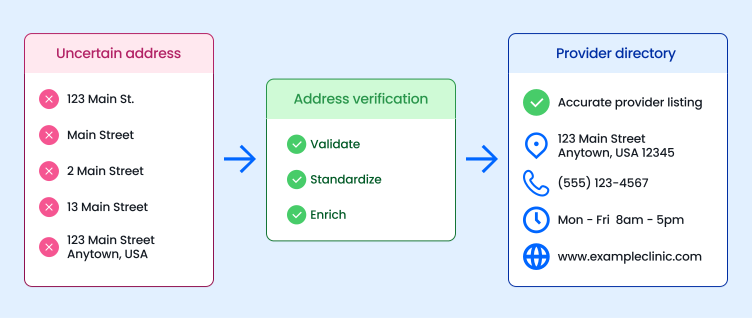
Standardizing, validating, and enriching provider addresses is a key component of improving provider directory data quality. With Smarty’s US Address Verification and US Business Data tools, you can resolve provider address chaos before bad addresses lead to member complaints, noncompliance fines, and lost trust. Here’s how.
Standardize inconsistent provider locations
Address standardization is part of the verification process. By default, US Address Verification standardizes addresses according to authoritative USPS formatting. For healthcare organizations, US Address Verification can return addresses formatted to match Project US@ guidelines, which require uppercase letters and spelled-out abbreviations.
Standardizing each provider address with US Address Verification creates a single source of location truth that helps payers identify and merge duplicate provider records and resolve conflicting provider addresses, creating more complete records before they’re included in directories.
Validate whether addresses are real
After standardization, US Address Verification validates addresses against Smarty’s authoritative database of over 210 million USPS, non-USPS, new-build, and provisional addresses.
Using US Address Verification, payers can validate one provider address at a time via an API or in bulk using Smarty’s:
- Bulk Address Validation: Upload and verify a list of addresses from an Excel file or a CSV file (up to 500,000 rows).
- Bulk Address Validation CLI: Verify several million addresses at once with a command-line interface.
- Microsoft Excel Address Verification Add-in: Verify up to 500,000 addresses inside Microsoft Excel.
- Google Sheets Address Validation Add-on: Verify up to 500,000 addresses inside Google Sheets.
- US QGIS Geocoding Plugin: Upload a CSV file and verify a list of addresses within QGIS.
Verifying addresses at data entry prevents invalid addresses from needing manual cleanup downstream. That also improves provider directory compliance.
US Address Verification can also enrich verified addresses with up to 55 metadata fields. Payers can utilize address metadata to flag problematic provider addresses before they reach consumer-facing directories. Relevant fields include:
- Residential delivery indicator (RDI): Classifies addresses as residential or commercial
- Commercial Mail Receiving Agency (CMRA): Identifies addresses associated with private mailboxes rented through a delivery service
- DPV footnotes: Indicates whether an address refers to a PO Box
- Vacancy status: Marks addresses as inactive or vacant
Directories shouldn’t send members to a provider’s residence, CMRA, PO Box, or former facility that’s now vacant. By flagging these addresses when they’re received, payers can make corrections that help members avoid traveling to the wrong provider location in the first place.
Improve provider and facility record matching
US Address Verification also returns each verified address with a PUID known as SmartyKey®. SmartyKey ties all valid versions of an address, known as aliases, to a single PUID, helping payers deduplicate and blend provider data. That way, payers keep multiple versions of the same provider address from appearing as separate entries on a provider directory, and members have a more accurate view of provider availability.
Add business context to provider locations
US Address Verification standardizes, validates, and adds metadata to addresses. US Business Data enriches those verified addresses with business identity, industry, contact, status, and relationship details.
While not a replacement for NPI validation, credentialing, network verification, or provider attestation, payers can use US Business Data to add up-to-date facility information to provider directories. Helpful fields—and what they help payers accomplish—include:
- NAICS code and NAICS description: Identify a provider’s specialty
- County name and County FIPS: Identify the county where a facility is located
- Phone, email, and URL: Access facility contact information
- Operating hours: Determine when a facility is open
Building a sustainable provider directory management process
Provider directory data management is an ongoing process. Here’s a framework for managing a repeatable provider directory data management workflow that you can use as a starting point:
- Ingest provider data
- Identify authoritative sources for each field
- Standardize provider and location data
- Validate addresses to keep bad healthcare address data from entering your systems in the first place
- Reconcile provider records
- Cross-check healthcare-specific authoritative sources
- Flag discrepancies
- Obtain required attestations and verifications
- Publish confirmed updates
- Monitor data drift
- Repeat based on regulatory and operational requirements
Conclusion: Make accurate locations the foundation of provider directories
Provider directory accuracy depends on the quality of the data used to create it and how well data updates are carried across systems. Provider directories become inaccurate when they’re built with unstandardized, unverified provider data, or when data updates fail to sync across systems.
To prevent those inaccuracies, payers can implement a repeatable provider directory verification workflow that cleans provider data before it reaches a directory and leads to complaints, fines, and reputational damage.
As part of that workflow, provider addresses need to be standardized, verified, and enriched. Smarty’s healthcare address solutions—US Address Verification and US Business Data—are built to help payers do just that.
With automated address verification and enrichment, payers can better match, deduplicate, correct, and complete provider records, so members have better access to in-network care.
Try US Address Verification to start standardizing, validating, and enriching your provider addresses today! Still have questions? Learn more about healthcare address data quality at scale.
Provider directory data accuracy FAQ
For payers, provider directory accuracy refers to how well their directory lists providers, their locations, and their contact information. An accurate provider directory lists current, in-network providers, along with all the information patients need to schedule and receive care.
Inaccurate provider directories are caused by:
- Typing errors
- Changes in provider information
- Provider data arriving from multiple sources
- A lack of provider data verification
- Provider data updates failing to sync across systems
- Delayed provider data updates
According to the No Surprises Act and the REAL Health Providers Act, provider directory information should be verified every 90 days.
Ghost networks are directories listing providers that appear available on paper, but in reality, members can't access due to network, location, contact, or availability incompatibilities.
Provider directories list every provider and facility (e.g., a hospital, lab, or urgent care clinic) that’s in-network with a provider. Doctor directories list only individual doctors, typically those who work at a specific facility or who provide medical services through a foundation.
Health plans can improve their provider directory accuracy by:
- Increasing data governance
- Verifying provider data points against authoritative sources
- Standardizing data formatting
- Reconciling provider-at-location relationships
- Eliminating discrepancies through data blending
- Continuously monitoring data quality
No. Address verification validates and standardizes the location layer. Provider identity, NPI, credentials, specialty, network participation, and availability need to be verified against authoritative, healthcare-specific sources.
Smarty standardizes provider addresses to improve record matching, verifies them to flag noncompliant addresses, and enriches them with SmartyKey® to deduplicate records and business data, helping payers improve provider directory data management. Smarty’s address autocomplete can further improve provider data by suggesting validated addresses at data entry.
Was this helpful?