


The future of P&C insurance underwriting

The future of P&C insurance underwriting may appear bleak as AI wreaks havoc on many jobs (writing, medical coding, data analysis, and software engineering, to name a few). However, experts in the P&C insurance industry understand and value human judgment and touch. The future of underwriting in insurance is definitely going to be different, but careful and judicious underwriters will be able to see how AI and predictive models are reshaping the landscape.
For P&C underwriters, the real shift isn’t just from paper to predictive models—it’s from processing information to interpreting it.
AI and data-centric underwriting platforms are increasingly absorbing the repetitive, rules-based tasks that once consumed entire workdays: data intake, risk scoring, document review, product comparisons, even portions of KYC and submission workflows. That labor redistribution changes the underwriter's value proposition. The competitive edge is no longer solely focused on who can manually assemble the cleanest file, but also about who can ask the best questions of the model, recognize where it may be blind, and apply contextual judgment in complex or emerging risk scenarios.
What’s hopeful is that this evolution doesn’t diminish the role of the underwriter—it elevates it.
At Smarty, we understand the importance of feeding pinpoint-accurate data and rooftop geocodes into the models you use so you can create the most comprehensive and accurate risk assessments, coverage terms, and pricing premiums. You can try our products absolutely free below, or continue reading to hear expert advice on what the insurance digital transformation has in store for you and your team.
Go ahead; click through to what you’d like to learn more about:
- Navigating a complex risk landscape: Rethinking exposure management
- How technology is transforming risk assessment in P&C insurance
- Hyper-accurate data as the cornerstone: Fueling intelligent underwriting
- Leveraging diverse and dynamic data sources
- Traditional vs. data-driven P&C underwriting
- What we are hearing from industry leaders
- Harnessing artificial intelligence and machine learning for enhanced risk assessment
- Architecting for agility: The cloud-native imperative
- Why the future of P&C insurance depends on claims automation
- Challenges and ethics in the future of P&C underwriting
- Conclusion
- The future of P&C insurance underwriting FAQs
Navigating a complex risk landscape: Rethinking exposure management
The future of P&C underwriting in insurance is being shaped by forces that are simultaneously environmental, digital, and systemic.
Climate risk is no longer an abstract actuarial variable—it is geographically precise, property-specific, and increasingly volatile. Underwriters are being asked to account for wildfire corridors, floodplain shifts, convective storm severity, and regulatory overlays in ways that were simply not required (or even possible due to a lack of technological know-how and availability) a decade ago.
Cyber exposure adds another dimension. Even in traditionally non-digital lines, operational downtime, ransomware, and supply-chain interruptions are influencing loss patterns. Interconnected loss drivers mean that a single event can ripple from physical damage to operational downtime, all while creating third-party liability and risking reputational fallout.
The insurance industry's future demands a more dynamic approach to exposure management.
Static models built on historical averages are insufficient.
Instead, underwriters must combine predictive modeling with localized, validated property data, parcel boundary data, and real-time intelligence.
The ability to interpret complex, multi-factor risk signals will define success in the future of P&C underwriting in insurance.
How technology is transforming risk assessment in P&C insurance
Technology is accelerating underwriting, but it is also redefining customer expectations.
What policyholders now expect from P&C insurance
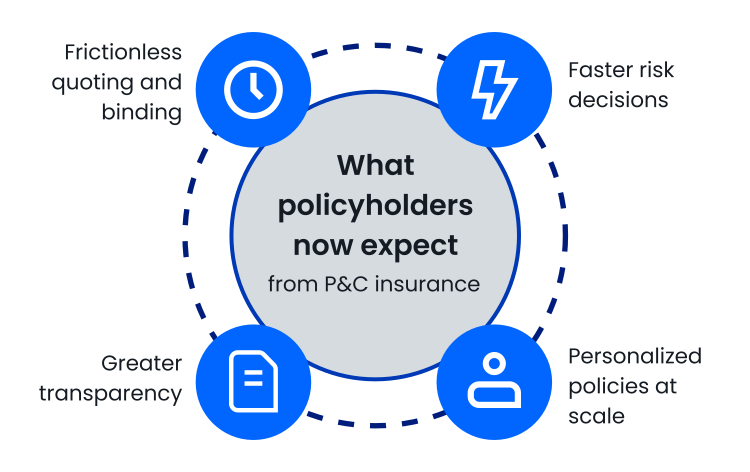
| Policyholder expectation | What we’re seeing in P&C insurance | Why it matters for underwriting |
| Frictionless quoting and binding | Carriers are prioritizing low-touch, digital-first submission flows with “first-pass” risk analysis | Faster underwriting decreases abandonment and operational costs |
| Faster risk management decisions | Standard risks are increasingly auto-approved or triaged | Speed becomes a competitive differentiator |
| Greater transparency | Policyholders expect clearer explanations of pricing and coverage | Policyholder trust and regulatory alignment soar |
| Personalized policies at scale | Pricing and coverage increasingly reflect property-level risk | Requires accurate, normalized property data |
Frictionless quoting and binding pressures carriers to streamline submission flows, because policyholders have grown used to low-touch, digital-first experiences. Slower underwriting can translate directly to lost business and higher operational costs—especially when standard risks could be triaged or approved quickly with the right data and automation.
For example, CIO Tim Hays at Mountain West Farm Bureau Mutual Insurance Company had this perspective:
“Most customers don’t know the shape or composite of their roof—but we do, or we should if our address tools are up to snuff. If we know the exact location of the home, that information already exists in data sources we can access. Stop asking people to guess what we’re going to verify anyway.”
Expectations for faster decisions, clearer explanations, and more personalized coverage are reshaping what “good” underwriting looks like. In the insurance digital transformation, transparency and explainability help build trust and support regulatory alignment, while personalization at scale depends on accurate, normalized, property-level inputs.
In other words, this table is more than a set of trends and is actually a checklist of what underwriting teams must enable to compete.
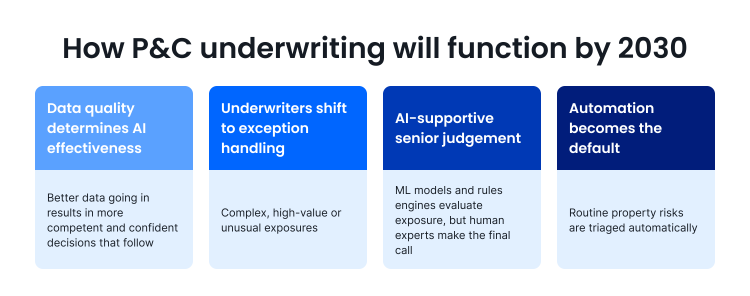
How P&C underwriting is expected to evolve by 2030
The next several years will not bring a sudden overhaul of underwriting but rather a steady, structural shift in how decisions are made, who makes them, and what inputs matter most.
The future of P&C underwriting will be defined by increasing automation of routine work, deeper reliance on high-quality and high-accuracy data, and a more strategic role for experienced underwriters as the thought leaders of their space.
The table below outlines where meaningful change is already underway and how industry experts expect responsibilities and capabilities to evolve by 2030.
| Area of change | What’s changing | Expert perspective |
| Automation | Routine underwriting decisions are increasingly automated | Automation handles volume, not judgment “Underwriting will always be partly judgment-driven… There are still gaps… that only a human underwriter can manage.” - Deloitte |
| Underwriter role | Shift from transaction processing to exception handling | Human expertise focuses on complex risk “Progressively automating decisions redirects underwriter attention toward intricate, profitable risks that demand their expertise.” - HCLTech |
| AI technology adoption | AI technology supports risk evaluation and prioritization | AI technology augments, not replaces, senior underwriters “81% of underwriting executives believe AI/gen AI will create new roles, delivering significant efficiency gains in operations, risk assessment, and decision-making.” - Underwriting rewritten |
| Data importance | Data quality directly impacts decision accuracy | Poor inputs undermine even advanced models “The accuracy of any risk assessment is reliant on high-quality input data.” - The CRO Forum |
Routine underwriting decisions will increasingly be automated. But automation does not eliminate the underwriter; it refocuses them. Human expertise will concentrate on high-value, complex, and unusual risk decisions, relying heavily on those who truly have chops in underwriting.
The underwriter role shifts from transaction processor to strategic risk evaluator. AI should be used to address the tedious nature of transaction processing, initial checks, and flagging. With this automation in place, underwriters can suddenly tap into their expertise. Exception handling becomes the primary domain of human judgment. AI supports risk evaluation and prioritization, but senior underwriters remain responsible for contextual interpretation.
Because of this shift from manual processing to AI-assisted risk evaluations, data accuracy grows exponentially. Poor inputs undermine even advanced models. Garbage in; garbage out, anybody?
The future of P&C underwriting in insurance will not be determined solely by AI sophistication—but by data quality governance and validation practices.
Hyper-accurate data as the cornerstone: Fueling intelligent underwriting
Data quality cleanliness and pinpoint accuracy are the hidden levers behind the future of P&C underwriting in insurance. Trust determines adoption. Accuracy determines model reliability. And both working together increases your ROI, customer satisfaction, claims resolution rates, regulatory compliance, and so… much… more.
Pinpoint-accurate address validation, rooftop-level geocoding, and hundreds of enriched property attributes establish the strongest foundation for intelligent underwriting. If location data is incorrect or incomplete at submission intake, policy renewal, borrower updates, etc., errors can and will cascade downstream.
Underwriting effectiveness and risk modeling all depend on the strength of the data pipeline before automation and human decision-making and strategy begin. Automation only amplifies data quality—good or bad. If you intend to keep up with the future of insurance, you need to base your decisions on geographically precise information and processes.
Leveraging diverse and dynamic data sources
While maintaining pristine data quality is highly important, diversifying the data points surrounding an address will also help you be ready for the future of insurance.
Property data analytics, such as property data and parcel boundary information, provide granular insight into construction type, roof condition, building age, square footage, and replacement cost indicators, as well as context for the shape of the insured parcel. Location intelligence then contextualizes those attributes within hazard zones, crime patterns, wildfire risk, and proximity factors.
Third-party APIs, like Smarty’s US Property Data, US Census Block and Tract Data, and US Parcel Boundary Data, enable real-time enrichment with decision-enabling specificity. Instead of relying solely on static, internal records, underwriters can access dynamic datasets that continuously update exposure profiles and track those changes through a persistent, unique identifier (PUID). (Smarty’s PUID, SmartyKey® is included free of charge in most Smarty product purchases, including verification, enrichment, geocoding, and
This shift from static to dynamic inputs defines the future of P&C underwriting in insurance. It enables more accurate pricing, tighter risk selection, and improved portfolio resilience.
Traditional vs. data-driven P&C underwriting
Traditional underwriting has long depended on a manual review of a relatively small set of data. That’s changing quickly.
More carriers are moving toward automated analysis of enriched datasets, compressing decision timelines from days or weeks to minutes—or even near real-time for straightforward risks.
As data sources expand beyond static internal records to include third-party, property-level inputs, underwriting also becomes more consistent. Standardized, model-assisted decisions reduce variability from one underwriter to the next and make it easier to scale without needing to add headcount to grow at the same rate as volume.
In the future, this doesn’t erase traditional expertise; it puts it to work where it matters most: governing models, reviewing exceptions, and applying judgment (especially in the complex cases that automation can’t confidently handle).
Traditional vs. data-driven P&C underwriting table
| Dimension | Traditional underwriting | Data-driven underwriting |
| Risk evaluation | Manual review of limited data | Automated analysis of enriched datasets |
| Decision speed | Days or weeks | Minutes or near-real time |
| Data sources | Static, internal records | Third-party, real-time, property-level data |
| Consistency | Varies by underwriter | Standardized, model-assisted decisions |
| Scalability | Resource-constrained | Built for high-volume processing |
What we are hearing from industry leaders
Industry leaders are describing a P&C risk environment that’s getting harder to price, harder to explain, and harder to control, likely because the underlying volatile loss drivers that are changing faster than traditional workflows can accurately absorb and represent.
On the catastrophe side, the story isn’t just “bigger hurricanes.” Munich Re points out that the “visible trend towards increasing losses is driven by supposedly smaller natural catastrophes: severe thunderstorms, hail, flooding or wildfires” (often called secondary perils).
Swiss Re adds that global insured losses from natural catastrophes reached $137 billion in 2024, and that “insured losses will approach USD 145 billion in 2025” if the trend holds.
Cyber also remains a P&C reality in its own right (as a stand-alone line and as a driver of business interruption and liability). The NAIC notes that “The number of claims rose almost 40% with nearly 50,000 reported.”
What this means is that:
- More volatility in loss experience.
- Claims are getting harder to handle.
- Aggregation risk is more real than most teams want to admit.
- The underwriting file has to be cleaner from the start.
- Risk drivers are converging across the portfolio.
- Better data becomes a strategic advantage.
What we’re hearing is simple: risk is getting more localized, more interconnected, and more sensitive to data quality at intake. That’s why smart carriers are investing so heavily in better property-level data, clearer governance, and workflows that can adapt as fast as the risk does.
Harnessing artificial intelligence and machine learning for enhanced risk assessment
Artificial intelligence and machine learning should no longer be considered as experimental add-ons in P&C underwriting.
Embed them in triage engines, fraud detection models, pricing algorithms, and portfolio monitoring systems. The practical shift is not that AI is "making decisions alone," but that it is reshaping how risk signals are surfaced and prioritized.
Machine learning models can identify non-obvious correlations across thousands of variables in near-real time. Property characteristics, geospatial hazard layers, historical claims, economic indicators, and behavioral signals all come together with lightning speed processing and analysis capabilities in the hands of AI.
Instead of manually scanning submissions for red flags, underwriters increasingly receive ranked recommendations, anomaly alerts, and suggested pricing bands.
In the future of P&C underwriting in insurance, the differentiator will not simply be who has AI, but who governs it well. Model transparency, monitoring for drift, and disciplined feedback loops from claims back into underwriting will determine whether AI improves combined ratios or quietly introduces new blind spots.
Generative AI introduces a different kind of leverage. While predictive models estimate loss probability and severity, generative tools help synthesize information and accelerate cognitive work in terms of decision support and summarization skills.
Used responsibly, generative AI becomes a productivity multiplier. Its greatest value will likely come from reducing administrative drag rather than automating final decisions.
Architecting for agility: The cloud-native imperative
Technology strategy increasingly determines underwriting capability. Legacy core systems were built for batch processing and static rating tables.
Modern underwriting demands real-time data exchange, flexible integrations, and rapid iteration:
- Real-time underwriting: Cloud-native platforms enable instant API calls for geocoding, enrichment, hazard scoring, and fraud screening at the moment of submission. That immediacy reduces manual rework and shortens quote-to-bind timelines. Autocomplete technology with built-in address verification and PUIDs, combined with rooftop geocoding, is a great place to start if you are unsure of which tools work best.
- Scalability: Catastrophe events, regulatory changes, or growth initiatives can dramatically increase submission volume. Cloud infrastructure allows carriers to scale compute and processing capacity without proportional infrastructure investment. The right provider should be able to verify and geocode addresses in bulk in a matter of hours or days, rather than weeks or months.
- API-first ecosystems: The future of underwriting in insurance depends on seamless connections between aggregate data providers, internal core systems, insurance rating engines, and all claims platforms. API-first architecture allows carriers to plug in better data sources and new analytical tools without rebuilding their entire stack.
Insurers can’t claim they are modernizing underwriting while clinging to an on-premise core. On-prem stacks turn every new data source, model, or workflow improvement into a slow, custom integration trapped behind legacy release and update cycles with perimeter-based security assumptions.
API-first, cloud-native ecosystems are the path forward because they let carriers integrate and iterate continuously, scale performance as volume spikes, and enforce security through identity, encryption, and policy without rebuilding the stack every time they want to get better.
In the next wave of underwriting, the carriers that abandon on-prem and commit to API-first ecosystems will move faster and price risk smarter; the ones that don’t will fall behind.
Why the future of P&C insurance depends on claims automation
Underwriting and claims cannot operate as isolated functions if carriers expect to improve profitability in a volatile and fast-paced risk environment. Claims data is the most direct feedback mechanism underwriting has.
When claims systems are automated and structured, loss information flows back into underwriting models faster, more accurately, and standardized in a way that makes detailed and comprehensive analysis possible. Patterns in severity, litigation trends, repair cost inflation, and fraud indicators can be incorporated into pricing and selection strategies in near real time.
Conversely, if claims data is delayed, inconsistent, or poorly coded, underwriting models rely on outdated assumptions. The strength of the underwriting function will increasingly depend on the maturity of the claims operation supporting it, and modern workflows make that dependency visible.
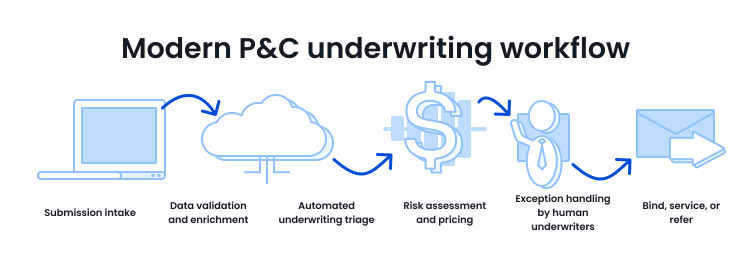
The modern P&C underwriting workflow
| Stage | What happens | Why it matters |
| Submission intake | Address and property information collected | Errors here (if any) cascade downstream |
| Data validation & enrichment | Property and location data verified and enhanced | Establishes a reliable risk foundation and sets the stage for the next step |
| Risk assessment | Rules engines and ML models evaluate exposure | Enables consistent decisioning and pattern analysis |
| Pricing & decisioning | Standard risks automated; exceptions escalated | Balances speed with oversight |
| Bind or refer | Policies bound or routed for review | Improves throughput and accuracy |
Challenges and ethics in the future of P&C underwriting
As machine learning insurance underwriting becomes more data-driven and popular, ethical and regulatory considerations move to the forefront.
Bias detection and mitigation must be embedded into AI systems. Models trained on historical loss data can unintentionally reinforce inequities if governance is weak. Regulators are paying closer attention to explainability, documentation, and accountability in algorithmic decision-making.
Data privacy is another pressure point. Underwriters now rely on enriched datasets that may include geospatial intelligence, behavioral signals, and third-party attributes. Carriers must balance analytical precision with compliance under evolving privacy laws (think Californian privacy laws, GDPR, and Daniel’s law for a few relevant examples).
Ultimately, the future of P&C insurance will reward organizations that treat governance as a competitive advantage rather than a compliance burden. Transparent models, auditable workflows, and disciplined data stewardship will build trust with regulators, brokers, and policyholders alike.
Conclusion
If there’s one takeaway to carry forward, it’s this: underwriting effectiveness depends on data quality before automation begins.
Automation is not the competitive advantage.
AI is not the competitive advantage.
Even speed, on its own, is not the competitive advantage.
The advantage belongs to the carriers who ensure that the data flowing into their underwriting engines is accurate, validated, normalized, and enriched at the moment of intake, and to those who hire truly talented underwriters who know what to do with those automations.
Clean address data is the financial lever that reduces quote-to-bind friction:
- It prevents rework and manual touchpoints that interrupt workflow.
- It improves straight-through processing rates.
- It strengthens fraud detection by validating property existence and characteristics before policies are bound.
- It supports regulatory compliance by ensuring decisions are based on documented, defensible inputs.
- And, it protects the combined ratio by preventing downstream claims surprises tied to inaccurate location intelligence.
In a world where catastrophe losses are rising, cyber claims are increasing, and social inflation is pressuring liability costs, underwriting margin depends on precision at the foundation. Rooftop-level geocoding, verified address validation, and persistent, unique identifiers are structural safeguard enhancements for modern underwriting systems.
Smarty’s address verification, rooftop geocoding, and property data solutions provide that foundation.
By delivering pinpoint-accurate location intelligence at submission intake, Smarty enables cleaner automation, stronger model performance, fewer workflow interruptions, and measurable ROI across underwriting, claims, compliance, and finance.
The future of P&C underwriting in insurance will be faster, more automated, and more data-driven. The carriers who win will not be those who automate the most, but those who automate on the cleanest, most reliable, and pinpoint-accurate data.
The future of P&C insurance underwriting FAQs
What is the future of underwriting?
The future of underwriting is undergoing a major shift. What once was a manually driven, paper-and-pencil process is now powered by predictive analytics driven by AI- and data-centric models. The cause for this shift is customer- and process-focused: AI and machine learning predictive models can handle the automated and routine processes of underwriting, like data entry, data analysis, product comparisons, initial KYC process, submitting applications, and more, to enable smarter human underwriting and judgment calls.
Is underwriting going to be replaced by AI?
No, but it will be bolstered by it. AI is good at data analysis, data synthesis, comparisons, and data entry. AI often falls short in addressing bias and in collaborating between insurers and reinsurers, and human judgment remains vital in underwriting.
What are the 3 C’s of underwriting?
The 3 C’s of underwriting for mortgages and lending in general are:
- Credit - The borrower’s credit reputation. This is based on a collection of several financial factors, such as their credit score, foreclosures, liens, bankruptcies, mortgage delinquencies, repos, credit accounts and types, and more.
- Capacity - The borrower’s debt ratios, like expense-to-income or payment-to-income ratios, compared to their salary and cash reserves. Basically, trying to see if the borrower has the capacity to repay any loan they attempt to acquire.
- Collateral - The borrower’s total equity or assets that could be repossessed by the credit provider or lender should the borrower default on repaying their loans. Examples of collateral could include cars, land, and homes, as well as stocks, bonds, and other assets that can be reliably recovered and resold.
Was this helpful?