
Provider data accuracy: Healthcare claims processing cost control



In the first two parts of this series, we looked at how provider location data shapes the healthcare experience from the outside in.
First, we sat down with Dave Medlock, CEO and founder of Maven One Health and a contributing thought leader. We covered how inaccurate provider locations create access issues—making it harder for members to find care, trust directories, and navigate networks—and expose healthcare organizations to compliance risks. Then, we looked at how those same data issues show up in member experience, driving frustration, delays, and unnecessary friction at critical moments.
This final piece moves further downstream because the impact of provider location data doesn’t stop at the point of care. It carries through into one of the most operationally complex and financially sensitive systems in healthcare: claims processing.
And data inaccuracy is at the heart of why healthcare organizations struggle to manage costs.
Claims processing only works if it can scale
Claims operations are built on volume.
At just 100,000 members, a health plan may process roughly 2.4 to 2.5 million claims per year.
Dave explained that there’s no viable model where humans review all of that. So many healthcare systems are designed around auto-adjudication—the ability to ingest a claim, evaluate it, and make a payment decision without human intervention.
“In practice, many organizations operate around a 75–80% auto-adjudication rate,” says Dave. “That still leaves hundreds of thousands of claims that require manual review each year.”
For a plan of that size, that can mean roughly 600,000 pended claims annually.
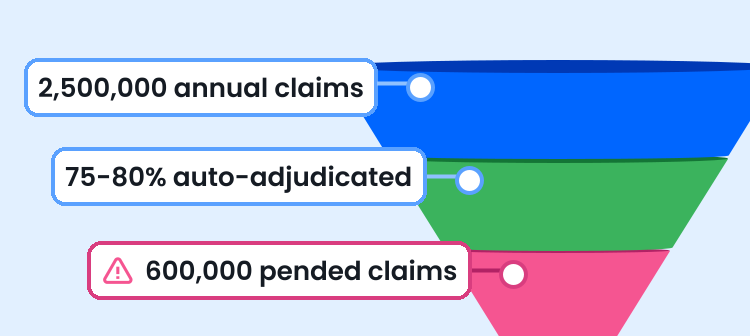
That’s not a small inefficiency; it’s also a structural cost problem that can be greatly reduced with a little more dedication to achieving higher address data accuracy.
Every claim depends on location, whether it’s obvious or not
Claims carry location data, and that location directly affects how the claim is processed.
Most claims include a few different address types, each with a different job. As Dave put it, “Every claim that we get is gonna have two, maybe three provider addresses on it.”
- A billing address
- A service location, and
- A separate pay-to address.
Each serves a different purpose.
The billing address is typically tied to the organization submitting the claim. For example, a medical group may have 10 clinic locations but submit claims through a central corporate office or billing department. This address helps identify who is billing for the service, but it may not tell you where the care actually happened.
The service location is the address of the clinic, office, facility, or other physical location where care was delivered. This is especially important because reimbursement is often tied to geography. The same procedure may be priced differently depending on where it was performed, based on regional cost structures and Medicare-derived fee schedules. Think of a small town in upstate New York versus New York City.
The pay-to address is where payment should be sent. In some cases, that may be the provider’s main office. In others, it may be a separate billing service or P.O. Box used to collect and reconcile payments. That distinction matters because a P.O. Box may be perfectly acceptable for payment, but it should not appear as the place where care was delivered. If so, that’s a red flag for fraud investigation.
Before a claim can be paid accurately, the system has to understand which address is which and confidently match the right location to the right purpose.
If it can’t, the claim doesn’t move forward.
The failure point is matching
Claims systems don’t fail because they lack identifiers. They fail because they can’t reliably connect the data they already have.
The process is straightforward in theory. A claim comes in, the system validates the member, matches the provider, and then matches the location.
That last step is where Dave says, “things break.”
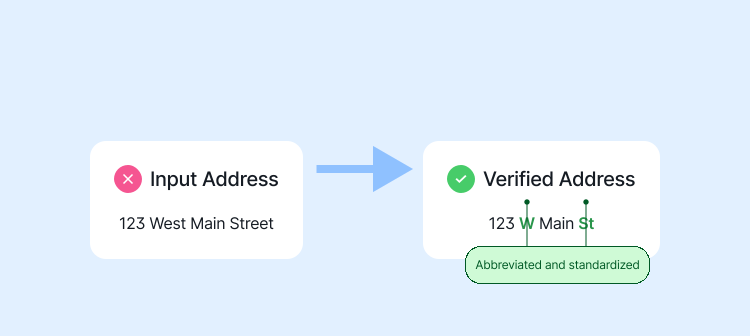
He goes on to explain that most systems rely on rigid matching logic. They expect address fields to align exactly; otherwise, they fall back to broader approximations, such as ZIP Code matching.
At the same time, the data itself is inconsistent. Provider records may store one version of an address. Incoming claims may contain another. Abbreviations vary. Formatting is inconsistent. Text is fat-fingered.
To a person, those differences are easy to reconcile.
To a system, they’re enough to cause a mismatch.
And when the system can’t confidently match the provider location, it doesn’t guess. It just stops.
The claim is pended.
Pended claims are where costs multiply
Once a claim is pended, it leaves the automated pipeline and enters a manual workflow.
Someone has to review it, interpret the data, and decide what happens next, and at scale, that’s expensive.
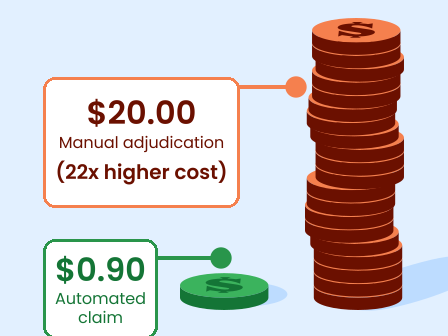
Industry benchmarks show that an automated claim costs about $0.90 to process, while a manually adjudicated claim costs closer to $20!
That’s roughly a 22× increase in cost for the same claim.
Applied at scale, the impact becomes significant. In the same 100,000-member plan example:
- 600,000 pended claims can drive $12 million in manual processing costs
- Compared to just $1.6 million for automated claims
In this scenario, Dave highlighted that even improving auto-adjudication from 75% to 85% can reduce costs by nearly $2 million annually.
And importantly, provider data plays a measurable role in that gap. Estimates suggest that “a meaningful share of pended claims—often around 25%—can be tied back to provider data issues,” including location mismatches.
Standardization is what makes exact matching possible
When provider data and incoming claims arrive in inconsistent formats, matching becomes harder than it needs to be. A ZIP Code may be wrong, a street name may be fat-fingered, or a street suffix may be abbreviated one way in one system and another way somewhere else.
That’s where normalization and standardization matter.
Built-in fuzzy-matching technology helps identify when two messy, inconsistent address records refer to the same real-world location. In effect, it helps take records that look different on the surface and make them comparable. Once those addresses are normalized and standardized, records that previously failed to match because of small variations can now match exactly.
That improves match rates and helps create a more reliable golden record.
Address matching is one way to connect records that belong together, but SmartyKey® makes that even easier. Instead of relying only on address strings, SmartyKey provides a persistent, unique identifier for an address. That means systems can recognize the same location with more confidence, even when the original input data varies across claims, provider files, or other sources.
Standardized address data also enables smarter validation. For example, a service location should be a physical place where care is delivered. As Dave pointed out, “you really shouldn't have a service location that's a P.O. Box… you're not actually seeing a member at a mailbox.”
At the same time, a pay-to address might legitimately be a P.O. Box.
Without structured, standardized data, those distinctions are hard to enforce. With it, they become clear rules that can be applied consistently.
Better automation leads to better operations
Improving auto-adjudication reduces cost and improves how claims operations function overall.
When teams spend less time resolving obvious mismatches, they can focus on higher-value work—auditing claims, identifying anomalies, and reviewing the cases that actually require human judgment.
People are a crucial part of the process, and better auto-adjudication isn’t meant to replace them. It’s meant to ensure these paid specialists are working on problems that machines alone can’t confidently and accurately resolve.
The impact doesn’t stop at claims
The effects of poor provider location data extend beyond claim adjudication.
They appear in downstream processes such as tax reporting. Health plans must send 1099s to providers, and those rely on accurate address data. When addresses are outdated or invalid, documents are returned, and teams are forced to perform manual corrections and reprocessing.
It’s another costly operational loop created by the same underlying issue.
One problem, three systems
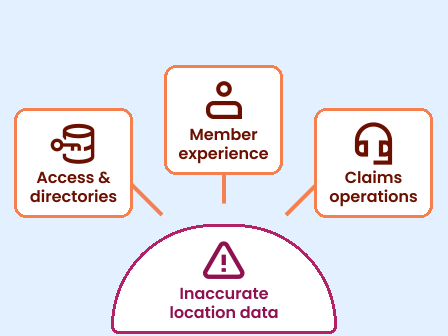
Across this series, the pattern is consistent.
In access and directories, poor location data makes it harder for members to find care.
In member experience, it creates friction and uncertainty.
In claims operations, it drives manual work and measurable costs.
Different systems. Same root cause.
Final thoughts
Provider location data is often treated as a background detail.
In reality, it’s a core input that determines whether systems can make confident decisions, whether workflows can scale, and whether costs stay predictable.
Across this series, we’ve followed that impact from the front end of the healthcare experience to the back end of claims operations.
If there’s a consistent takeaway, it’s this: when location data is precise, standardized, and reliable, everything downstream works better and costs less.
Before you modernize anything else, fix the data that fuels everything.
Thanks for reading along with us. We hope this series helped clarify how something as simple as an address can quietly shape performance across the entire healthcare ecosystem—and where the biggest opportunities for improvement actually are.
If you’d like to try out an address verification API for yourself, we have many ways to do that:
- Free live US Address Verification tool
- Free live International Address Verification tool
- Free global address verification tool
- 42-day free trial of the US Address Verification API
- 42-day free trial of the International Address Verification API
- Free bulk address validation tool
- Or get even more lookups with our plugins and add-ons
Was this helpful?