
International Geocoding upgrades: How to use precision levels without guesswork



Geocoding can seem as simple as putting money in a vending machine and making a selection. You submit an address, and get coordinates back. In many instances, geocoding could be that straightforward.
In business processes, coordinates influence fraud checks, delivery routing, compliance processes, customer experience, and risk decisions across industries like insurance, healthcare, logistics, fintech, and ecommerce.
However, location signals are often too broad or "plausible." The impact on your workflow is costly: mispriced risk, avoidable manual work, and harder-to-defend decisions.
Smarty’s January 2026 upgrades to International Geocoding address that problem directly. The focus isn’t just on returning coordinates, but on making those coordinates usable in real workflows—with clear signals about what they represent and how they can be applied.
Let's walk through the updates, how to interpret the new signals, and how to apply them in production without guesswork. You can take a quick detour to check out our amazing geocoding solutions for free, without providing unnecessary information, or continue reading to learn how to make precision geocoding do more of the heavy lifting for you.
| Find latitude and longitude for addresses worldwide | Convert geographic coordinates into addresses | Pinpoint the exact location of a US structure |
| Try it now | Try it now | Try it now |
Whether you're verifying a patient's address, routing a delivery, scoring fraud risk, assigning a sales territory, or pricing a policy, the same problem arises: how precise is this location, and can we trust it enough to act?
Here’s what you can expect to learn about in this blog:
- What’s new in Smarty’s International Geocoding
- Precision, in practical terms
- Why understanding precision level matters in production systems
- Turning precision into workflow logic
- Why Smarty
- Why Smarty belongs at the top of your data cascade
- How to evaluate providers with this in mind
- Conclusion: Precision is a control knob
- International Geocoding precision FAQs
What’s new in Smarty’s International Geocoding
The update centers on one idea: transparency that can be operationalized.
Smarty now returns a geocode classification alongside each result.
This classification tells you how the coordinate was derived. Some results come from a single known point from a single geocode associated with the address. Interpolated geocodes are calculated between nearby addresses and their respective geocodes. In other cases, the output address matched several geocodes. To provide a single result, Smarty calculates and returns the average coordinate of those points.
These distinctions don’t indicate that one result is inherently "bad" or unusable. Instead, they provide additional context about how the coordinate was produced so you can build your system logic around it appropriately:
- A single-point geocode returns a single matching geocode
- An interpolated result returns a geocode that was interpolated from a range of addresses near the returned address.
- An averaged (multiple-point) result indicates the output address matched several geocodes. To provide a single result, we calculated and returned the average coordinate of those points.
The second update introduces a new precision level: PostalCode.
International data rarely behaves cleanly or consistently at every precision level. In some countries, locality-level precision, sometimes called city-level, is the most reliable level available due to how address systems are structured. In others, postal codes can be highly granular.
Smarty’s “PostalCode” geocode fills an important middle ground. In countries like the United Kingdom, Japan, and Canada, postal codes can be extremely precise—sometimes approaching street- or building-level usefulness. In other regions, they provide a reliable regional signal for operational workflows.
PostalCode-level results support a variety of business operations, including sales territory assignment, tax region mapping, and regional risk scoring, while still allowing for strategic property-level decisions.
These additions make it possible to stop guessing what a geocode means and start using it intentionally.
Precision, in practical terms
Precision isn't binary; it's a hierarchy shaped by both the input address and the structure of each country’s addressing system.
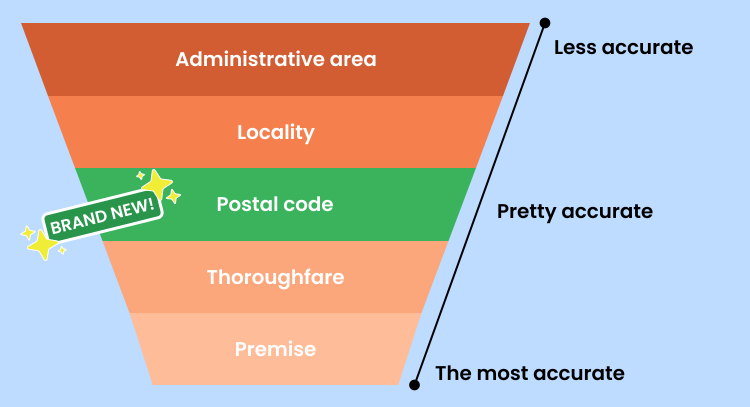
Segmenting data is crucial for business success. Administrative area and locality support regional reporting and segmentation. PostalCode narrows that scope operationally useful precision for many workflows. Thoroughfare and premise narrow the precision to the street or building level, where it becomes suitable for routing, dispatch, last-mile delivery, and property-specific decisions.
When analyzing the “verification_status” output field, you’ll be able to see this precision level at work.
| Precision level | What it represents | Where it fits |
| Administrative area | Country, state, province | Reporting, high-level segmentation |
| Locality | City or town | Regional analysis, early routing |
| *Postal code | Postal zone/neighborhood | Territory assignment, tax logic, and regional scoring |
| Thoroughfare | Street-level | Routing, service logic |
| Premise/delivery point | Building-level | Underwriting, dispatch, property decisions |
There’s an important constraint here: precision is influenced by both available reference data and how addresses are defined within each country. Not every location will resolve to a premise or street-level result—and in many regions, locality or postal-level precision represents the highest-quality data available.
What matters is whether your system can recognize the level it received and apply it appropriately.
Classification adds that second dimension. It tells you whether the coordinate came from a direct source or was estimated. Two points can look identical on a map and still require different handling. That difference lives in the metadata.
Why understanding precision level matters in business workflows
The most expensive geocoding errors are the ones that pass silently.
A coordinate looks valid, flows through the system, and gets used for pricing, routing, or compliance—without clear alignment between the decision being made and the precision of the data.
Precision brings that alignment into focus. It allows systems (and the professionals behind them) to match the level of detail in the data to the level of confidence required for the decision.
- In fraud and identity workflows, location precision helps confirm whether a user, transaction, or account behaves consistently with expected geography.
- In logistics and last-mile delivery, it determines whether a package reaches a front door or a general area—impacting cost, speed, and customer satisfaction.
- In ecommerce, it affects checkout success, delivery accuracy, and the number of failed shipments or returns.
- In healthcare, it supports patient matching, service eligibility, and compliance with location-based regulations.
- In insurance, it determines whether a location is suitable for property-level risk or only for regional segmentation.
The goal isn’t to obtain perfect precision everywhere (although wouldn’t that be nice?).
The goal is to match the precision of the address and any decision surrounding that precision to a defensible reason for making it.
Turning precision into workflow logic
The practical shift is simple: stop applying one universal rule to every geocode.
Different workflows carry different levels of risk, and they should be treated as such. Here are our recommended workflow enhancements that we believe you can make now, thanks to Smarty’s International Geocoding precision indicator.
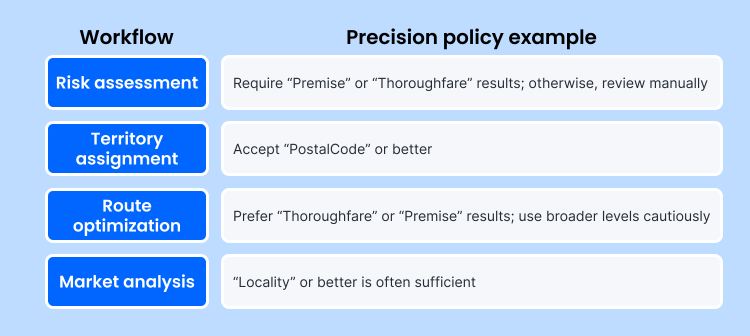
Using a policy-driven approach reduces unnecessary manual review while preventing overconfidence in weak signals.
It also improves transparency.
When you track the distribution of precision levels and classifications over time, unexpected shifts can reveal upstream data issues or integration changes early, before they create larger problems or rack up unnecessary costs.
Why Smarty
Any provider can return coordinates. The challenge is giving their customers the speed, accuracy, and transparency with those coordinates at scale.
Smarty’s approach focuses on making geocoding usable in real systems, not just on achieving a technically correct geocode.
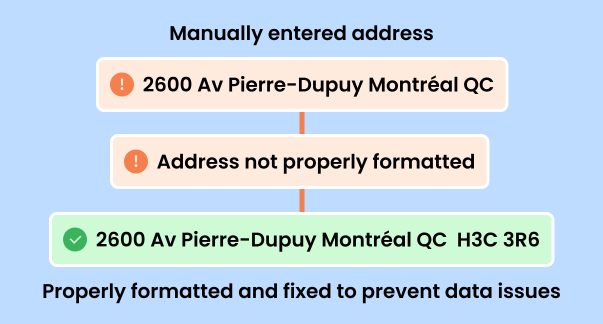
The first advantage Smarty offers is clear, consistent signals. Precision and classification are explicit and designed for use in decision logic. Teams don’t have to infer meaning or build fragile assumptions into their workflows.
The second advantage is Smarty’s simplicity of integration and predictable behavior. The APIs are straightforward to implement and accurate within those regions, in line with local formatting guidelines. That reduces the need for teams to memorize or look up country-specific handling, making global rollout more manageable for IT teams.
The third is that Smarty provides you with accessible, real support. When something behaves unexpectedly—and in production systems, it eventually might—teams can reach Smarty through phone, chat, or email. That shortens troubleshooting cycles and reduces the operational risk of being stuck diagnosing location issues alone.
For organizations that want to go further, Smarty now also offers Professional Services. A dedicated address data expert can help evaluate how geocoding is currently used, identify gaps, and design improvements tailored to your workflows and business goals.
This combination often leads to measurable gains for you:
- Stronger inputs for CAT risk modeling and exposure analysis
- More defensible pricing decisions supported by clearer location data
- Reduced operational waste from unnecessary manual handling
- Fewer returned mail pieces due to cleaner, standardized address data
- Increased international fraud prevention and signaling
This is where geocoding moves from a utility to a performance lever.
Why Smarty belongs at the top of your data cascade
Smarty recognizes the value of consistency because of how many accept and evaluate data: in a cascade of trusted providers.
Smarty also recognizes that painstaking time and energy decide who is trusted at the very top, because the earlier high-quality geocoding is introduced, the more value will compound downstream, and the sooner a return on investment can be realized.
When location data is standardized, enriched, and properly classified at the point of entry, every downstream system benefits:
- Risk models receive more accurate inputs.
- Fraud systems get cleaner signals.
- Routing and delivery operations become more precise.
- Compliance and audit teams have clearer justification for decisions.
- Analytics teams gain more trustworthy regional segmentation, market analysis, and reporting.
- Marketing approaches become more targeted.
Smarty’s accuracy also creates a stronger foundation for scale, allowing teams to expand automation, support higher volumes, and grow into new regions without introducing the same level of operational friction downstream.
When geocoding is treated as a downstream fix, those benefits are harder to recover. Errors have already propagated, and systems are forced to work around them.
Positioning Smarty’s International Geocoding at the top of the cascade turns it into a sturdy foundation rather than a patch for weaker geocoding solutions that have missed providing a detailed analysis previously.
How to evaluate providers with this in mind
We get it; we’re definitely biased and think we’re the best at what we do.
We don’t want or expect you to just take our word for it. Come test Smarty out.
And.
Feel free to test out the other guys, too. Here are some things to keep in mind and ask those other providers during the evaluation and testing phase for an international geocoding product.
But first, remember that coverage is important, but it isn’t enough on its own.
What matters in practice is whether the output can be understood, trusted, and used in decision-making. That comes down to a few key questions you should be asking:
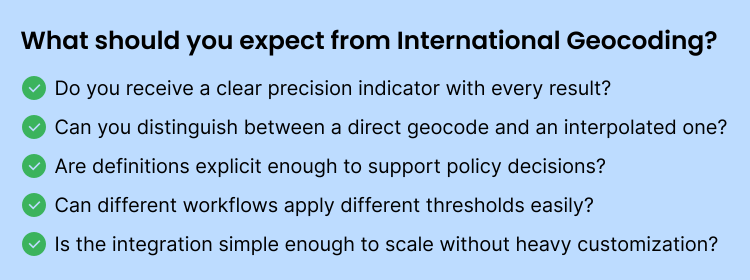
The difference between vendors often shows up here, not in whether they can return a coordinate, but in whether that coordinate can be used confidently across systems.
Conclusion: Precision is a control knob
Precision determines how confidently your systems can act.
When it is treated as an afterthought, teams end up compensating with manual review, rework, and downstream fixes.
However, when geocoding precision is treated as a core signal, systems become more reliable, decisions become more defensible, and workflows scale more cleanly.
Smarty’s International Geocoding upgrades make that shift practical. With clear precision levels and classification signals, teams can move from approximation to intention—and from guesswork to control.
Explore International Geocoding, review the documentation, or connect with our team to see how these signals can be applied in your workflows.
International Geocoding precision FAQs
What’s the difference between geocode accuracy and precision?
Precision describes how specific a result is, such as city-level, postal code-level, or building-level. Accuracy describes how close the result is to the true location. These two concepts work together to provide a more complete understanding of a geocode.
Is postal code precision good enough?
For many regional workflows, yes. “PostalCode” works well for territory assignment, tax mapping, and regional scoring. It's generally not sufficient for property-level decisions or exact routing.
What does it mean if a geocode is interpolated?
It means the coordinate was estimated from nearby known latitude and longitude data rather than being tied to a single authoritative point. It can still be useful, but it should be handled more carefully in higher-risk workflows.
How should geocodes be stored for audit and compliance?
Store the original address, standardized result, coordinates, precision level, and classification together. That preserves the context behind each decision and supports traceability.
Do I need both address verification and geocoding?
In most enterprise workflows, yes. Address verification standardizes and validates the input. Geocoding adds spatial context and location metadata for that verified point. Together, they create a more reliable foundation for downstream decisions.
Was this helpful?