
Risk mitigation and location intelligence: The power duo behind smarter decisions


When businesses across industries base decisions on partial datasets, key decision-making signals become disconnected, fragmented, and inconsistent. That’s why risk mitigation is most effective when it’s based on comprehensive location intelligence. Using authoritative location and property data, businesses can make data-driven decisions that reduce operational, financial, and compliance risk.
To ensure their location intelligence stays accurate and contextualized, businesses can:
- Validate, standardize, and geocode addresses
- Enrich addresses with property attributes
- Keep address and property data up-to-date
How? That’s where Smarty steps in.
Smarty’s US Master Address List is a comprehensive database of every address in the US. With it, businesses can develop risk mitigation efforts that don’t leave gaps for homes and businesses in high-risk areas.
On top of that, when a master address list is paired with property and parcel boundary data, businesses gain even deeper insights, so that when addresses come rolling in, they can be fully evaluated and used to assess and mitigate risk.
Smarty provides the tools businesses need to connect US address, property, and parcel data for smarter decision-making, BI integrations, and market expansion. Give them a try!
| US Master Address List | US Property Data | US Parcel Boundary Data |
| Get a sample list | Test the demo | Request a sample file |
In this blog, we’ll dive deeper into the dynamic duo of risk mitigation and location intelligence:
- Why risk mitigation & location intelligence start with location truth
- The power duo: US Master Address List & US Property Data
- What you unlock with risk mitigation and location intelligence
- Best practices
- Measuring impact
- TL;DR
Why risk mitigation & location intelligence start with location truth
Risk mitigation falls apart when it’s built on inaccurate location intelligence. Bad data creates hidden risk across industries. Bad address data is often where the trouble starts. Bad addresses instead of location truth make business challenges add up fast.
Here’s what to watch for.
Inaccurate property risk scores
Incomplete, incorrect, and imprecise addresses lead to inaccurate property risk assessments, and that can create some costly problems for real estate investors and P&C underwriters.
When underwriters misjudge a property’s risk because of bad address data or inaccurate geocoding, they can misprice policies and make poor eligibility decisions.
For real estate investors, bad address data can pull property attributes for the wrong property entirely. That means missing the red flags needed to evaluate maintenance needs and environmental hazards, as well as surprise insurance premiums, repairs, and long-term costs. Yikes!
Miscompliance
Finance companies and healthcare providers can both face compliance penalties when bad address data slips through the cracks.
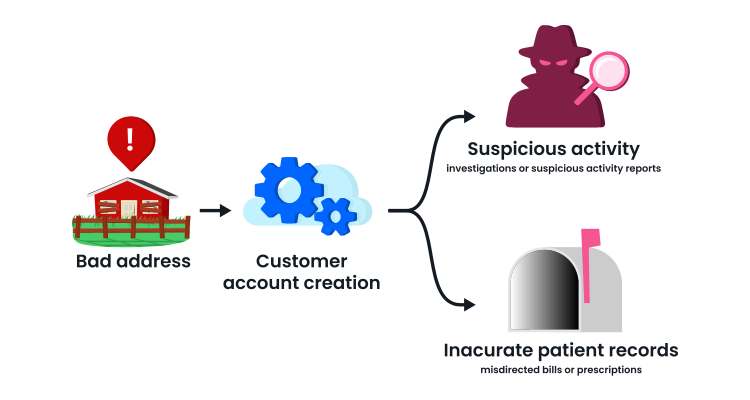
Financial fraudsters can hide behind inaccurate addresses to bypass Know Your Customer and Anti-Money Laundering checks during onboarding. When fraud, money laundering, or data leaks come to light down the road, finance companies are left to clean up the fallout through investigations, audits, and Suspicious Activity Reports.
Bad addresses in patient records make it difficult for healthcare providers to merge data and run reports. That can lead to duplicate patient records, mismatched records, and bills or prescriptions sent to the wrong patient. In provider data, bad addresses turn into delayed treatment, higher costs, and increased compliance exposure.
Failed deliveries & truckrolls
When address data is inaccurate, telecom, last-mile delivery, and ecommerce companies can send technicians and parcels to the wrong delivery point.
For telecoms, a misdirected technician could mean wasted labor hours and longer customer wait times. For retailers, misdelivered printed promotions, catalogs, and personalized offers waste both time and money.
Last-mile delivery carriers feel the pain, too. Without precise address data to flag risky stops ahead of time, last-mile delivery carriers face more exceptions, rescues, rollovers, call-ins, rework, and manual fixes.
So how do businesses avoid all that chaos?
By building risk mitigation, BI integrations, and market expansion on location truth—a master address list full of validated, geocoded addresses, each with its own persistent, unique identifier (PUID).
And that’s exactly what Smarty’s US Master Address List provides.
The power duo: US Master Address List & US Property Data
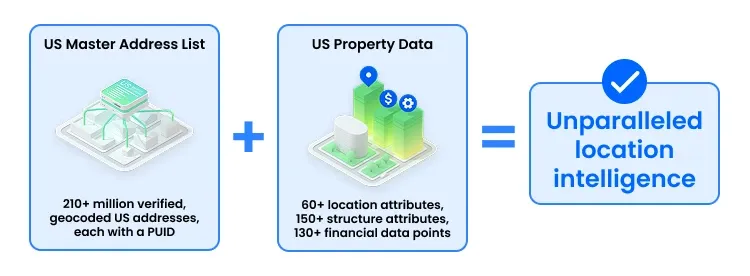
Risk mitigation and location intelligence get a whole lot better with a list of every US address, each enriched with over 350 property data points.
The foundation: US Master Address List
The US Master Address List is a national database of over 210 million verified US addresses. Each one comes with SmartyKey, a PUID that an address retains even if its street name or ZIP Code changes.
PUIDs help businesses deduplicate and blend data without jeopardizing security. Instead of combining data using a point of personally identifiable information (PII), like email addresses, phone numbers, and street addresses, you can use SmartyKey to merge records from one data source or multiple data sources, all while keeping everything anonymous and eliminating duplicates.
Beyond that, the US Master Address List utilizes address geocoding to provide latitude and longitude coordinates, along with a geocode precision rating. For each address, you’ll get geocode coordinates and their precision level—rooftop, parcel, or ZIP9.
With honest precision levels for each geocode, businesses can rely on their results to power risk mitigation and critical workflows with confidence.
For businesses looking to base risk mitigation on top-notch location intelligence, the US Master Address List can be used as a single source of location truth. With everyone on the same page and working from the same foundation, address data becomes the framework for risk mitigation efforts across analytics, operations, and compliance.
The context: US Property Data
Powered by our US address enrichment API, US Property Data turns addresses into property attributes and financial data points. When it comes to risk mitigation, US Property Data helps businesses assess and segment risk by providing additional context, including:
- Property location attributes—structure elevation, county, city, mailing address, topography, etc.
- Property structure attributes—square footage, roof material, roof type, construction type, etc.
- Financial data points—property's total market value, assessed value, tax data, prior sale amount, etc.
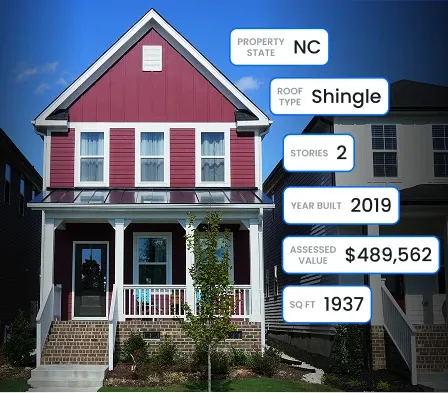
With property data built on an authoritative address list, businesses can understand where risk may exist, so making data-driven decisions about risk mitigation and market expansion becomes a whole lot easier.
What you unlock with risk mitigation and location intelligence
When risk mitigation is built on location intelligence, businesses have a lot to gain. Let’s break it down by industry.
Property risk insights
P&C insurers and real estate investors can use the US Master Address List, Property Data, and Parcel Boundary Data to create high-accuracy risk models for every US address.
For P&C insurers, that means you can automate underwriting and streamline claims.
During the application process, the US Master Address List and US Property Data prefill accurate data into application fields that applicants often have to guess at, like structure elevation, roof material, and construction type. This mitigates address-related mistakes from the start, so things run smoothly later.
At binding, underwriters can rely on prefilled, error-free addresses and property data to confirm a property falls within coverage zones and to review relevant property attributes. That helps underwriters bind straightforward policies faster, easier, and in compliance.
That same location intelligence keeps paying off downstream. Claims teams save time by avoiding manual re-entry of property details and gain a more complete view of the property upfront. The result? Less work and more accurate claim cost estimates.
Similarly, finance companies offering home equity loans can use precise geocoding, address validation, and property data to build robust investment risk profiles for every US property.
For real estate investors, this same data makes it easier to track changes in property risk over time, make predictions based on trends, and better assess risks to future property value.
Data-driven expansion
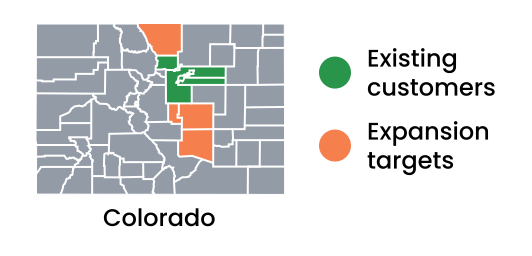
With property data for any US address, telecoms can compare their current customers to those in other markets. That makes it easier to find similar markets in new regions and expand networks with more confidence.
Operational savings & customer engagement
With accurate location intelligence to flag risky stops, ecommerce companies and last-mile delivery carriers can reduce returned deliveries, avoid failed truck rolls, and build more efficient routes.
Verified mailing addresses paired with financial property data also help ecommerce companies personalize marketing materials for specific demographics, making customers more likely to engage, feel satisfied, and become repeat buyers.
Compliance risk mitigation
The US Master Address provides a list of validated addresses. By drawing PUIDs from each address, healthcare providers can merge fragmented patient records, identify and eliminate duplicates, create more complete patient histories, and meet compliance requirements.
Address validation also helps reduce compliance risk by helping documents containing PII reach the right patient.
Best practices
After implementing the power duo of the US Master Address List and Property Data, three best practices can help you get even more value from your address data.
- Refresh your enrichment data regularly so your data-driven decisions are always based on the latest information.
- Treat locational intelligence as a cross-functional asset since address data shouldn’t belong to one team. It supports risk mitigation across teams—operations, analytics, compliance, marketing, you name it.
- Track the address data behind risk decisions because when teams document every risk signal, it’s easier to explain where decisions were made.
Following these practices, you’ll keep your address enrichment data accurate and your teams aligned on data-driven decisions.
Measuring impact
Already using Smarty’s US Master Address List and Property Data? It’s time to measure the ROI. With these KPIs, you’ll be able to see what’s improving:
- On-time delivery rate: Are deliveries arriving on time?
- First-attempt delivery success rate: How often are mail pieces or packages being redelivered?
- Billing accuracy: Are bills reaching the correct address?
- Truck roll success rate: Are technicians arriving at the right address, on time?
- Support volume: How many address-related support tickets are sent?
- Support call length: How long does customer support spend on a call manually fixing address errors?
- Underwriting speed: How quickly are eligibility decisions being made?
- Risk segmentation: Are potential customers accurately grouped by risk characteristics?
- Marketing expansion: Are newly targeted areas converting at higher rates?
TL;DR
Risk mitigation and location intelligence work best when location truth pairs with context. Location truth comes from an authoritative master address list, while context is added when those addresses are enriched with property and risk-relevant attributes.
While a master address list provides the PUIDs teams need to track their address data, property data provides the signals they need to assess potential risk. Together, location truth and context drive confident decisions.
Ready to take your decision-making to the next level? Start a 42-day free trial to put Smarty’s US Property Data and US Master Address List to the test.
Was this helpful?