
2026 UPDATE: Revisiting USPS API rate limits after rollout



At the time USPS rolled out its new APIs on January 25, 2026, its documentation stated that address verification was limited to 60 requests per hour. That stood in sharp contrast to the newly retired Web Tools API, which had previously supported approximately 5 address lookups per transaction. This included the legacy USPS Address Information APIs, which many organizations had relied on for years.
For teams that depend on low-latency, reliable validation, this appeared to signal a major operational disruption.
Since then, however, USPS support conversations and follow-up testing at Smarty suggested that the platform may be more flexible in practice than the documentation alone initially indicated. In practical terms, the bigger question for many teams became whether the documented USPS address validation API rate limit would hold up the same way across different access levels and production use cases.
According to sources familiar with how the rollout has functioned in practice, USPS Public Access includes OAuth, Addresses, Service Standards, International Pricing, Domestic Pricing, Shipping Options, Locations, User Info, and Tracking.
Those sources said Public Access limits work more like this:
- Addresses = 20,000 lookups per day
- Pricing, Locations, Service Standards, and Tracking = 500,000 lookups per day
- OAuth and User Info = 1,000 lookups per day
Additionally, the Labels APIs require additional approval and configuration. To use those APIs for outbound and return labels, organizations must be enrolled in USPS Ship and have an Enterprise Payment Account.
Those same sources indicated that organizations that are not already using the Label API to print labels but are seeking USPS address validation API access above 20,000 calls per day may need to obtain an upgrade.
So while USPS documentation stated a default cap of 60 requests per hour for their new APIs released in January 2026, follow-up testing and conversations with USPS support staff suggested that actual usage thresholds may vary depending on access level, use case, account setup, and approval status.
That doesn’t make the original concern irrelevant. It simply reframes it.
For many organizations, the problem shifted from interpreting a single headline number to understanding the actual USPS API quota limit attached to their account, workflow, and approval path.
The core issue around the USPS API rate limits
The core issue is no longer just whether every user is strictly limited to 60 requests per hour. It's that the rollout introduced uncertainty around throughput, access tiers, approval requirements, and production suitability at a time when many organizations were trying to determine whether USPS could still support their validation workflows at scale.
The implications of USPS API rate limits
Even though we’ve discovered that the throughput throttling is less dramatic than initially specified, an address-validation workflow that previously handled 6000 queries per minute can now only support ~13.9 per minute, creating immediate bottlenecks in any real-time or high/medium-volume system.
The previous Web Tools APIs were historically treated as “functionally unlimited,” especially by businesses using them quietly behind the scenes for bulk data processing, address-cleanup pipelines, or continuous operational verification.
These organizations have not been conditioned to monitor throughput or prepare for throttling. Many didn’t even realize they were about to be rate-limited at all, or that critical systems that depend upon Web Tools would begin to fail altogether.
Even where the practical ceiling proved higher than the documentation first suggested, the USPS address validation API rate limit still introduced enough friction to slow modern business workflows and send them scrambling for a fix.
For anything other than casual use—but more especially for mission-critical, enterprise workloads—USPS’s rate limits effectively eliminate USPS as a viable single-source address verification solution in most industries.
CRM, SaaS, and enterprise systems
Modern business systems depend on accurate addresses for onboarding, identity verification, risk assessment, vendor management, account creation, support workflows, and third-party lead ingestion. When throughput drops, these systems slow down or break entirely.
For companies that ingest outside data (think purchased leads, partner datasets, or regulatory records), USPS’s updated limits still block timely imports. Systems that once validated thousands of rows per night will now take weeks or months to complete. This undercuts sales operations, cross-selling, customer analytics, and onboarding.
Shipping and logistics workflows

Your shipping operations need to be fast, consistent, and predictable. When you hit your address verification rate limit, even a slight slowdown creates big problems throughout the entire fulfillment process. Suddenly you start seeing:
- Slowed or stopped label generation
- Halted routing, because orders can’t move forward until the address is validated
- Failed or significantly delayed nightly batch-cleaning jobs
- Frustrated customers due to delayed packages and extra follow-up steps for verification
- Wasted team time and higher operational costs as staff wait out rate limits or try to work around delays
- Leadership questioning why your fulfillment performance is slipping
If your team feels pressure to keep orders moving while the address-verification step is blocked, they might start:
- Pushing orders through without validating the address
- Guessing or filling in missing address details
- Manually entering whatever information they have just to print a label
- Skipping quality checks to avoid holding up the line
- Using cached or outdated address data to keep orders flowing
If shortcuts are taken, you’ll start to have even bigger problems from:
- Returned mail
- Mislabeled or incorrect packages
- Delivery delays that frustrate customers
- Carrier correction fees and avoidable shipping costs
- Extra manual cleanup and rework for your team
- A drop in fulfillment accuracy and reliability
These problems don’t come from the outage itself. They come from the shortcuts your team feels forced to take when things slow down. With that in mind, there’s one important exception worth calling out.
If your business prints fewer than ~13.9 labels per hour, the new USPS Address Validation structure may still work just fine. It’s free, simple, and can work, depending on your needs.
But once you scale beyond that, you’ll experience operational bottlenecks due to the updated USPS API rate limits.
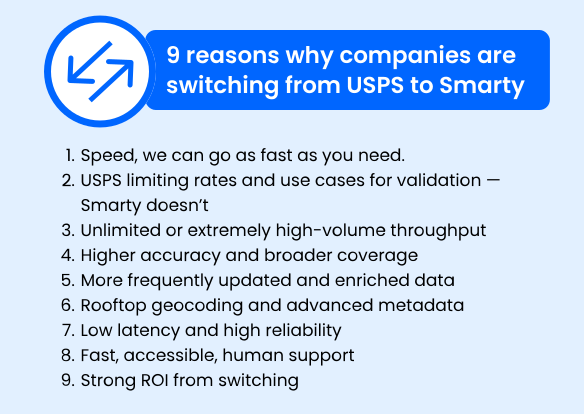
9 reasons why companies are switching from USPS to Smarty
1. Speed
At 25,000 per second, Smarty is ~107,913.67 times faster than the USPS under the new USPS API limits.

2. USPS limits rates and use cases for validation—Smarty essentially doesn’t
USPS’s Service Level Agreement (SLA) for the new rate-limited API prohibits the use of address validation for any purpose other than sending mail or shipping. Smarty offers a much more generous use case allowance—you can use it for any purpose.
3. Unlimited or extremely high-volume throughput
Smarty allows high-scale, high-speed address validation without restrictive hourly caps. Our address validation tools are designed for real-time verification in both single-address and high-volume batch operations, capable of processing millions or even billions of records quickly and reliably.
4. Higher accuracy and broader coverage
USPS only validates addresses to which it delivers mail. It doesn’t maintain a complete national database of all valid U.S. addresses. Millions of legitimate addresses—new construction, rural properties, non-postal residences, private roads—don’t appear in USPS datasets.
Smarty includes them.
With more than 20 million non-USPS addresses and an architecture designed for completeness, Smarty’s match rates ALWAYS exceed those of the USPS. This leads directly to fewer shipping errors, lower support costs, and more reliable business analytics.
5. More frequently updated and enriched data
Smarty aggregates and updates property data from multiple authoritative sources so that you can take full confidence in knowing your nationwide addresses are up to date and fully enriched. With over 350 potential metadata points returned on every address from US Property Data, addresses are fresher and more complete than USPS’s inconsistently scheduled updates and underwhelmingly data-limited addresses.
6. Rooftop geocoding and advanced metadata
USPS provides no rooftop coordinates and limited metadata.
Smarty, on the other hand, recognizes the power that your business has when supplied with latitude/longitude, DPV, RDI, ZIP+4, carrier route, georeferencing, property insights, and more. An enriched address with up to 55 points of additional metadata means that you can more easily prevent fraud, take more calculated risks, geospatially analyze your datasets, and more, all while validating your address lists.
This additional data powers analytics, routing, risk modeling, and compliance workflows in any industry, serving businesses and organizations of all sizes.
7. Low latency and high reliability
Smarty offers consistently fast global response times and national response times, with standard US plans starting at 25,000 addresses per second (and we can go much, much faster if needed).
Built on a highly redundant, cloud-agnostic infrastructure, small to medium-sized businesses can enjoy enterprise-grade reliability and uptime, while enterprise-level businesses can exceed this standard if needed.
Our US response time SLA guarantees a response time of ≤ 500 milliseconds.
Our global response time SLA guarantees a response time of ≤ 1000 milliseconds.
A historical uptime of over 99.999%, and demonstrated ability to side-step outages like AT&T, CrowdStrike, AWS, Microsoft Azure, Conduent, Asana, Atlassian’s Jira, and more make Smarty the no-brainer solution for organizations looking for consistency and reliability in their workflow partnerships and address validation automations.
8. Fast, accessible, human support
Even those relying on USPS as a data source regularly report difficulty getting USPS support responses.
From our own experience trying to contact them before rolling out their new APIs in January 2026, we can confirm it was a frustrating and fruitless endeavor. Even after we questioned whether the rate limits could be increased, they sent an email containing several links that didn’t address the question at all, offering no information or agreement to raise the rate limits.
Smarty offers responsive human support with fast turnaround times across chat, email, phone, and professional services. Teams can get help with onboarding, integration, and architectural design from an unscripted human being who’s knowledgeable, fluent in code, and available to any team that might need to ask a question.
9. Strong ROI from switching
Many companies working with Smarty will tell you they’ve experienced immediate perks from switching to Smarty:
- Higher address match rates
- Reduced failures and fewer undeliverable shipments
- Faster ecommerce checkouts
- More efficient internal data workflows
- Improved customer service and reduced returns
- Cleaner databases with less manual cleanup
- Clear documentation for integration
- Simple integration, with SDKs supporting most modern programming languages, often up and running in hours or days instead of weeks or months. Sign up for a free trial to see for yourself.
- Responsive support teams and customer service
- Fair pricing with clear pricing models, avoiding hidden fees and charges
Kicks and giggles from a team that takes their job seriously but still knows how to have fun
How to switch providers to avoid dealing with the USPS API rate limit
Rather than writing additional code to integrate with the new USPS API tools, now is the perfect time to switch to Smarty in 3 easy steps.
1. Audit your existing integration
- Identify USPS dependencies
- Review your API call volumes
- Assess whether peak traffic already exceeds ~13.9/hour (it likely does)
- Ensure that your use case is allowed by the USPS license (Smarty allows for almost any use case, whereas USPS only allows address verification if printing mailing or shipping labels).
2. Identify which workflows are already failing or stalling success under USPS API limits, paying special attention to
- Checkout flows
- Nightly data pipelines
- Bulk validation routines (something USPS doesn’t permit)
- Internal (your teams) and external (your customers/clients) calls to the USPS API
3. Build a transition plan with Smarty
- Map current processes
- Start a free trial for US Address Verification or International Address Verification
- Use straightforward REST, SDKs, or CLI tools, or feel free to write your own code
- Get hands-on guidance from our responsive, human support
Feel free to check the ROI you’ll almost instantly achieve from investing in super-sonic levels of speed and near microscopic levels of pinpoint accuracy. You don’t have to take our word for it, either.
Here’s a list of satisfied customers who will tell you it’s time to make the leap, too:
- AIRA
- Fabletics
- Maven One Health
- New Mexico Department of Health
- PurpleLab
- Shippo
- Snohomish County PUD
- Unison
- And so many more!
Conclusion
USPS’s 2026 API changes still mark a major departure from the way many organizations historically used their Web Tools APIs.
Even if post-rollout testing and USPS support conversations suggest the USPS API limits are not always as restrictive in practice as the documentation initially stated, the new platform still introduces a meaningful slowdown and enough uncertainty to create serious operational friction.
For businesses that depend on address validation to support checkout, fulfillment, onboarding, CRM workflows, or large-scale data processing, that change isn’t minor. It affects speed, scalability, and confidence in production.
Smarty continues to offer the throughput, accuracy, coverage, enrichment, reliability, and support that those teams need to keep critical workflows running smoothly. For organizations that can’t afford bottlenecks, Smarty remains the stronger long-term choice.
Test us out today with a free 42-day trial and a set of your hardest address lists.
Was this helpful?